



Key points:
- The protests remain suspended pending the 1 September meeting with the European Commission.
- The dispute concerns the rule allowing stays of up to 90 days in any 180-day period, which also applies to professional drivers from non-EU countries.
- Figures cited by MIA suggest that around 17,000 drivers in North Macedonia may be affected. Across the Western Balkans, the total could reach approximately 100,000.
- Carriers are calling for consistent rules on calculating stays and dedicated arrangements for drivers working in international transport.
- Without an agreement, further border blockades could lead to queues, congestion and delays on freight routes between the Balkans and the EU.
The borders remain open for now, but the dispute is far from settled. Following a meeting of transport-sector representatives in Skopje on 11 August, hauliers’ associations decided not to launch new blockades immediately. Their next step is to wait for talks with the European Commission.
A meeting is due to take place in Brussels on 1 September. Carriers will then assess whether the discussions have produced enough progress to keep the protests on hold.
Why the 90-day rule is becoming a barrier to work
The disagreement stems from the Schengen rule that limits nationals of non-EU countries to a maximum stay of 90 days in any 180-day period.
For tourists, the limit is generally easier to follow. International trucking is a different matter. Drivers from Serbia, Bosnia and Herzegovina, Montenegro and North Macedonia regularly deliver freight to EU countries and spend a significant part of their working lives inside the Schengen area.
Every entry into and day spent on an international route therefore counts towards the permitted stay limit. Once that allowance has been used up, a driver may have difficulty re-entering the Schengen area, even if they hold the necessary professional qualifications, employment contract and transport documents.
Carriers say this creates a paradox: the truck and its cargo can legally continue moving, while the driver may reach the immigration-based stay limit.
EES makes stay-day calculations more difficult
The issue is becoming more significant as the EU rolls out its Entry/Exit System (EES), an electronic system for recording the entries and exits of nationals from non-EU countries.
Until now, authorities have partly relied on passport stamps when checking how long someone has stayed in the area. Electronic records will make it possible to calculate much more precisely how many days a person has actually spent in the Schengen area.
Transport organisations argue that this more accurate tracking is turning a long-standing rule into an increasingly serious operational challenge. Companies must monitor not only vehicle and cargo availability but also how many days each driver has left. That makes route planning, scheduling and delivery coordination more difficult.
About 100,000 drivers could be affected
The dispute extends well beyond individual companies. Figures cited by MIA suggest that around 17,000 drivers in North Macedonia may be affected. Across the Western Balkans, the total could reach approximately 100,000 drivers.
Neđo Mandić, a representative of Serbia’s transport sector, said some drivers had already begun avoiding particular international routes because they feared problems during border checks.
Carriers are not simply calling for the limit to be abolished. One of their main demands is a clear and uniform interpretation of the rules across all countries. Industry representatives say that procedures can currently vary from one border crossing to another.
Should professional drivers be treated as cross-border workers?
Transport organisations want international drivers to be treated differently from ordinary visitors. Their argument is based on the nature of the job. A driver does not enter the EU for a holiday or to settle there. They cross the border to complete a delivery, unload cargo, collect another shipment and return.
Possible solutions include dedicated stay rules, separate permits or other exemptions for professional drivers. The issue has also reached the European Parliament, where the Commission was asked about long-term visas or a special system for drivers from the Western Balkans. So far, however, no measure has been introduced to address the problem in carriers’ day-to-day operations.
Previous truck protests disrupted border crossings
The current threat of blockades is not the first escalation in the dispute. In January, hauliers from Serbia, Bosnia and Herzegovina, Montenegro and North Macedonia staged coordinated protests at several freight crossings leading into the Schengen area. The action was later suspended after talks with Brussels began and the possibility of special rules for professional drivers emerged. By mid-August, no such arrangement had been implemented.
The suspension therefore does not resolve the dispute. Carriers have agreed to wait until the 1 September meeting, but mobilisation could resume if the talks fail to produce concrete commitments.
Blockades would hit key freight corridors
Any renewed protests would affect more than companies based in the Western Balkans. The region is a vital part of the overland network linking Central Europe with the south of the continent and the Adriatic. Freight flows through its border crossings support industry, trade and ports. Blockades at major crossings could create long queues of trucks, delay deliveries and disrupt trade corridors between the Balkans and the EU.
Driver availability could become an additional constraint. If some drivers had to avoid certain routes because they had exhausted their stay allowance, carriers’ capacity could fall even without an official border closure.
1 September could determine what happens next
No new blockades have been formally announced so far. Carriers say they are prepared to continue the dialogue, but they want clear rules and a solution that can be applied in everyday transport operations. The European Commission remains open to discussing the sector’s concerns, while maintaining that the current Schengen rules remain in force.
The 1 September meeting could therefore determine the next phase of the dispute. If no solution acceptable to carriers emerges, the protests seen at the start of 2026 could return to the borders.
What began as a disagreement over immigration rules is increasingly affecting the organisation of international freight transport. The central question is how to reconcile Schengen requirements with the work of drivers who routinely cross borders as part of their jobs.

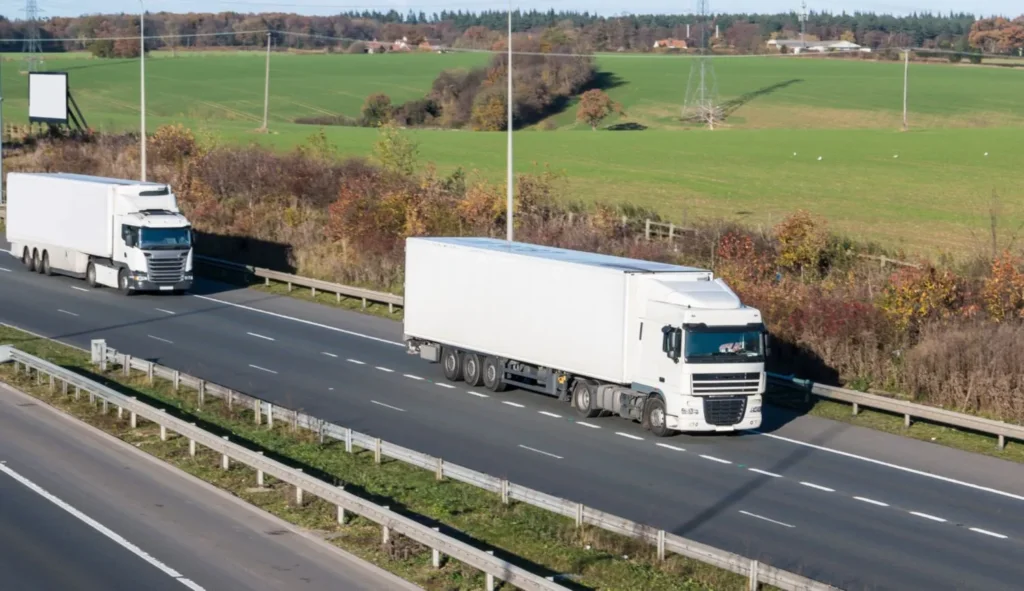


![[UPDATE] Balkan hauliers call off blockade as protest suspended after breakthrough in talks](https://cdn-trans.info/uploads/2026/02/d31ece774c09c3d2748667e9536-1024x1024.webp)


