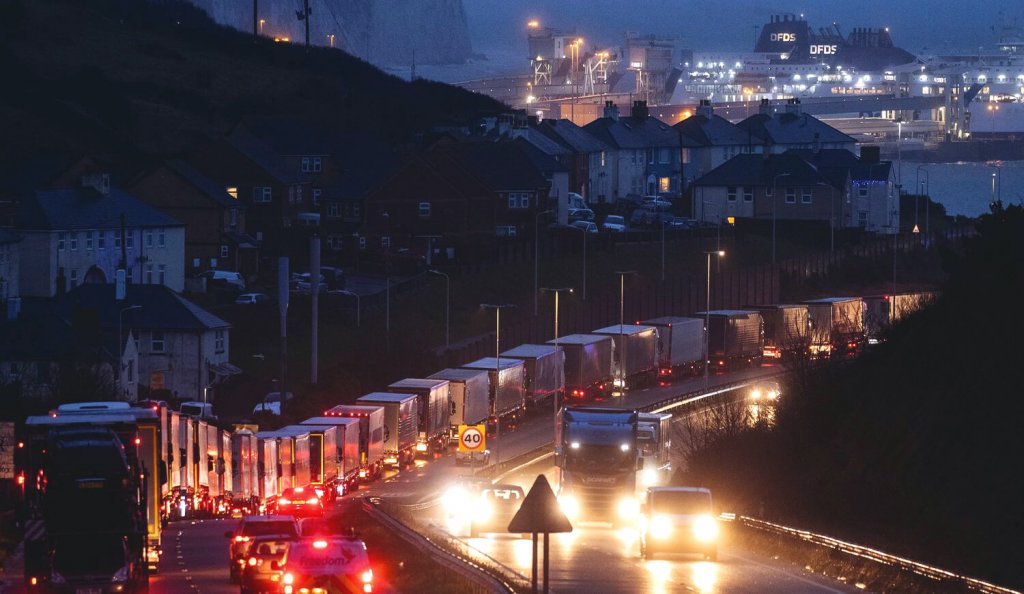
UK transport and logistics organisations have urged the European Commission to suspend penalties linked to the EU’s 90-days-in-180 rule for at least two years, warning that stricter enforcement alongside the EU’s new biometric border system could leave operators short of drivers and disrupt supply chains.
In a letter sent on 12 February to Maroš Šefčovič, Commissioner for Trade and Economic Security, a coalition of UK trade bodies asked the Commission to seek short-term measures as the EES becomes fully operational on 10 April. They argue that when member states begin strictly enforcing the 90/180 rule for UK nationals, many operators moving people and goods across borders may find they do not have enough eligible drivers to cover work in the EU.
Among their requests:
- Suspend fines or punishments for exceeding the 90/180 limit for at least two years
- Apply light-touch enforcement during disruption and planned peak periods to keep traffic moving
- Support the development of off-site biometric pre-registration (via an app) to reduce border processing time
The organisations also reiterated their longer-term aim of securing a professional drivers’ exemption.
Western Balkans: blockades, then talks and a warning Brussels cannot ignore
The UK letter follows protests much closer to the EU’s borders. In early February, drivers from Bosnia and Herzegovina, Montenegro, North Macedonia and Serbia blocked border crossings for several days, citing fears that stricter EES-linked enforcement of the 90/180 rule would make regular EU work impossible.
An online meeting on 3 February brought together European Commission representatives, Western Balkans transport ministers and regional transport organisations. Participants agreed that there was an urgent need to develop transitional arrangements to allow drivers to continue operating without incurring penalties once EES is fully operational.
The message from the region was blunt: without tangible progress soon, further border blockades could not be ruled out.
Maida Gorčević, speaking for Montenegro, said the drivers concerned do not pose a migration risk and urged practical solutions, stressing that the group involved is “clearly defined and limited” and works mainly with EU countries, including Germany, the Netherlands, Italy, France, Belgium and Croatia.
No political consensus for an exemption but a working group is coming
The Western Balkans meeting also exposed the limits of what Brussels can promise quickly. Trans.info reported that representatives of most EU member states acknowledged that there is currently no political consensus to amend Schengen rules or to create a formal exemption for professional drivers under the EES.
However, the European Commission signalled that it is willing to seek solutions within the existing legal framework to prevent supply chain disruption and protect regional trade.
A technical working group involving the EU and Western Balkans countries is expected to meet soon to analyse data on:
- how many professional drivers are affected,
- patterns of stay in the Schengen area,
- and operational problems likely to arise once EES records all border crossings and enforcement tightens.
Commission representatives reportedly stressed there are no quick fixes, but confirmed willingness to engage in an accelerated, structured dialogue.
The same pressure point, across different borders
Put together, the UK letter and the Western Balkans protests highlight the same fault line: a ruleset designed for travellers colliding with the working reality of international road transport.
For operators, the concern is not theoretical. If EES enables more consistent tracking of time spent in the Schengen area, companies relying on repeated cross-border work fear:
- driver availability constraints,
- route planning disruptions,
- and greater risk of delays at borders if processes are not streamlined.
The UK coalition argues that without a bedding-in period and discretion at peak times, the industry could face a sharp operational shock from April.
Meanwhile, Western Balkan hauliers have already shown they are prepared to take the issue to the roads and border gates if solutions remain out of reach.


![[UPDATE] Balkan hauliers call off blockade as protest suspended after breakthrough in talks](https://cdn-trans.info/uploads/2026/02/d31ece774c09c3d2748667e9536-1024x1024.webp)