



The International Road Transport Union says the driver shortage has now moved beyond the normal freight cycle, with vacancies remaining high even as freight demand softened after the post-pandemic peak.
Across the 18 markets covered in the report, IRU estimates that there are 2.9 million unfilled professional driver positions globally, equivalent to an 11% global shortage rate. In Europe, the shortage rate stands at 13%, up from 12% in the previous reading.
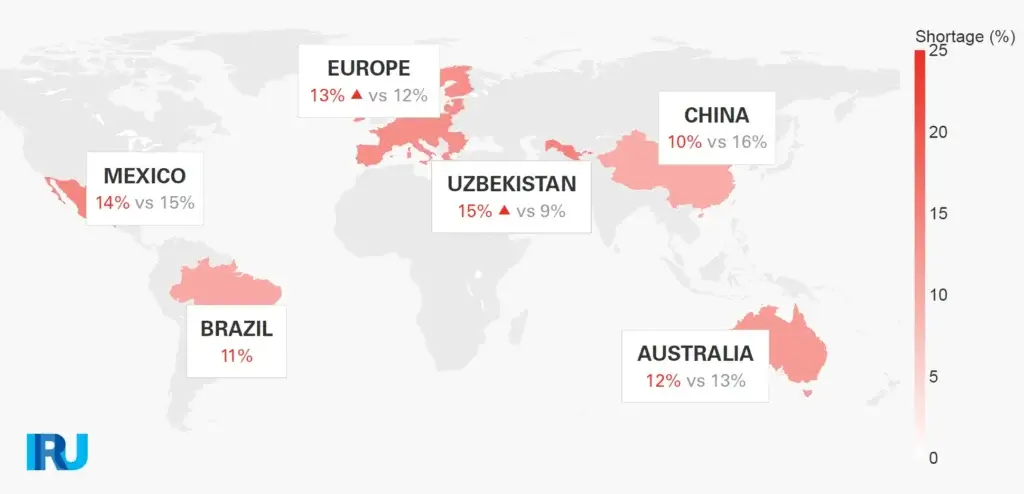
Driver shortage rates in selected markets, 2025 vs previous reading. Source: IRU Global Driver Shortage Report 2025.
According to IRU, the 2025 figures exceeded every previous reading and show a “clear break from the economic cycle”. The organisation says that, while the reasons differ by region, the common feature is that the shortage is no longer correcting itself over time. In Europe and Australia, the main pressure comes from ageing workforces retiring faster than new entrants can replace them. In China and Uzbekistan, demand growth is outpacing transport capacity, while Mexico and Brazil continue to face structural labour constraints.
Driver shortage dominates European operators’ concerns
The scale of the issue is also reflected in operators’ business priorities. In Europe, 65% of trucking companies ranked driver shortage as their top concern in 2025, far ahead of operational costs, the economic landscape, decarbonisation and digitalisation.
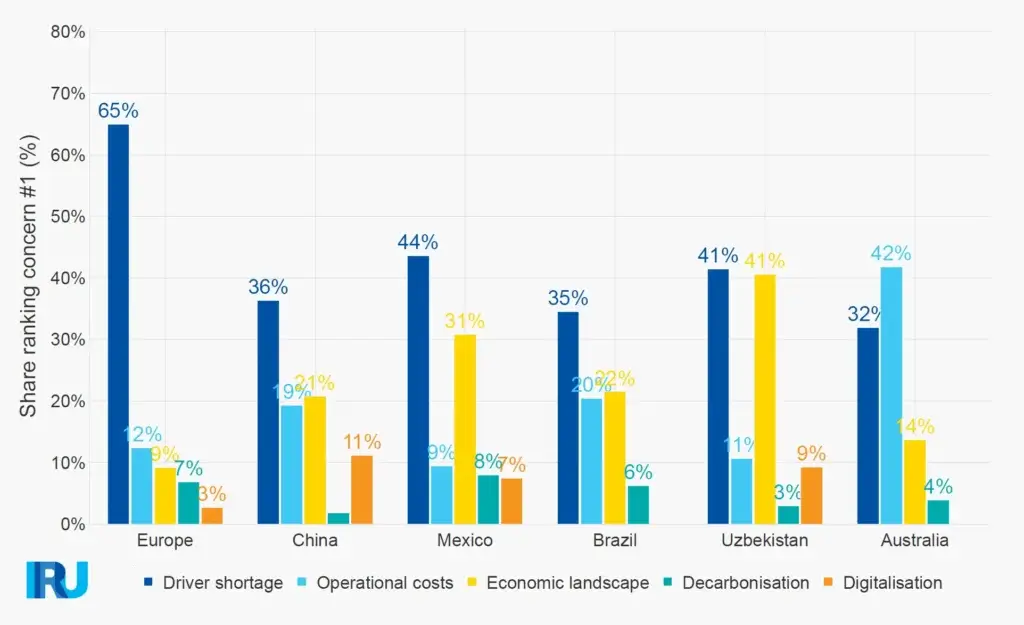
Top concerns for trucking companies by market, 2025. Source: IRU Global Driver Shortage Report 2025.
The picture is different in other markets. In Australia, operational costs were ranked as the top concern by 42% of operators, compared with 32% for driver shortage. In Uzbekistan, driver shortage and the economic landscape were level at 41%. In China, driver shortage was still the biggest concern, but by a much narrower margin, at 36%, followed by the economic landscape and operational costs.
This suggests that Europe’s labour problem is particularly acute: while other regions are balancing driver availability against cost pressure and demand conditions, European operators appear to be facing a more direct workforce replacement problem.
Read more: Driver retention is no longer just about pay: predictability and work-life balance now lead
Small operators most exposed
IRU’s report also points to a divide between large and small transport operators. According to the organisation, small operators account for 98% of EU road freight enterprises, but their shortage rate is six percentage points higher than that of large operators.
The organisation says smaller firms also have older workforces and more limited access to foreign recruitment. This leaves them more exposed to retirement-driven labour shortages and makes workforce renewal harder to manage.
IRU’s analysis disaggregates workforce risk by company size across 14 European markets, highlighting where replacement pressure is greatest.
Retirement wave already under way
The most serious long-term challenge for Europe is the approaching retirement wave. IRU says the continent already has more than 502,000 unfilled driver positions, and that further retirements before 2030 will create a growing replacement challenge across multiple markets.
The report frames this as a structural issue rather than a temporary mismatch between labour supply and freight demand. In almost every surveyed market, the 2025 shortage exceeded the 2021 baseline and remained elevated despite weaker freight activity in recent years.
For operators, this means the problem cannot be solved by waiting for a softer market to ease recruitment pressure. Instead, the sector faces a longer-term need to replace retiring drivers, improve retention and attract new groups into the profession.
Women and young people remain largely untapped
IRU identifies women and younger workers as the largest untapped labour pools for the sector. Women account for just 4% of EU truck drivers, although the report says data shows they enter the profession at a younger age than men.
Where female participation has increased, IRU says progress has come through targeted public-private initiatives rather than organic recruitment. The report examines demographic opportunities by market and looks at recruitment models with measurable outcomes.
The report also looks beyond pay, analysing operational, infrastructure and lifestyle factors that influence recruitment and retention. These include working conditions, licensing, barriers to entry and route type.
Supply chain risk
IRU says the report is designed to help transport operators, public authorities, associations, procurement teams and supply chain managers assess workforce exposure and plan for future labour shortages.
The organisation says the study is based on operator-sourced data collected through its global association network, rather than modelled estimates or proxy indicators. It covers 18 markets across Europe, Australia, Brazil, China, Mexico and Uzbekistan, and includes analysis by country, company size, age, gender and route type.
For shippers and procurement teams, the findings underline a growing risk in transport capacity. If the current trend continues, driver availability could become an increasingly important factor in supplier resilience, freight rates and service reliability.
IRU also points to case studies from Finland, the Netherlands and Türkiye as examples of recruitment and retention measures that could be replicated in other markets. The central message, however, is that driver shortages are increasingly becoming a structural workforce problem — one that will not be solved simply by waiting for freight demand to soften.


