Key takeaways:
- The experiment took place on a closed track under controlled conditions.
- Participants did not know when their windscreens would suddenly be covered by water.
- Responses varied: some lifted off the accelerator, while others braked heavily or steered away.
- The test was not designed to identify one correct reaction or assess the participants’ driving skills.
- Girteka’s experts stress the importance of adjusting speed, following distance and driving style before conditions deteriorate.
- Risk increases in autumn and winter, when rain, poor visibility and wet roads become more common.
The test used a simple but realistic scenario. A car travelled over a wet surface before a large volume of water suddenly hit the windscreen. The participants had no warning of when it would happen.
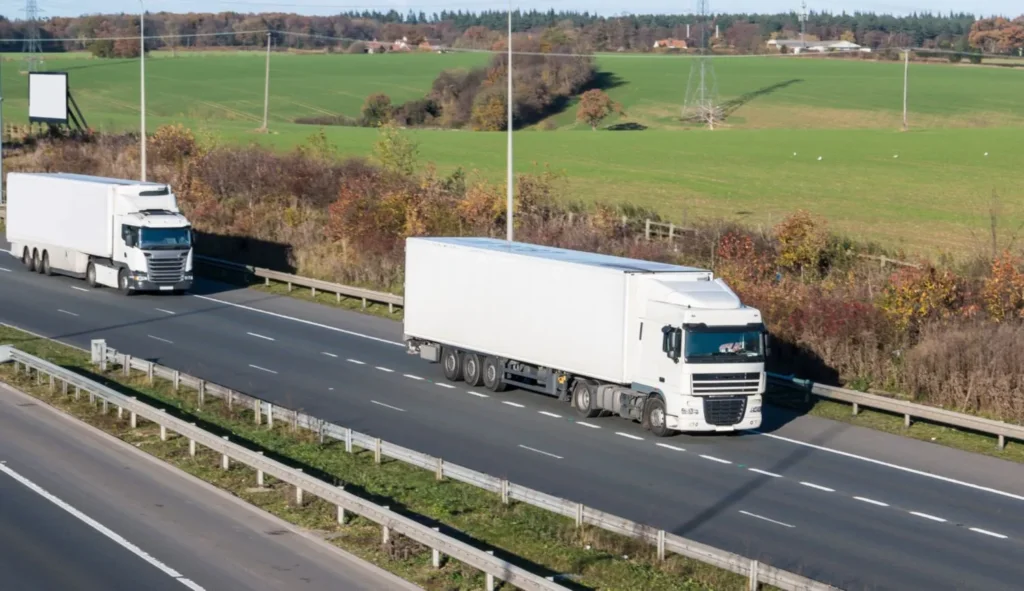
On public roads, the same thing can occur when a car is travelling alongside or overtaking a truck in heavy rain. A truck’s large wheels can throw up a substantial amount of water, briefly reducing or completely blocking the view of the driver passing alongside.
Although the loss of visibility may last only a few seconds, those moments leave drivers with very little information about what lies ahead.
Drivers braked, lifted off or steered away
The participants reacted in markedly different ways. Some lifted off the accelerator, others immediately applied the brakes, and some turned the steering wheel as soon as the water hit.
The time taken to react and regain a clear view also varied between participants.
Even highly experienced motorists can be caught off guard. When visibility suddenly disappears, the instinct is to do something immediately: brake, change direction or take another evasive action. But an abrupt response without proper control can make the situation more dangerous, explains Singaras Čepaitis, head of driver training at Girteka.
Girteka says the purpose of the exercise was not to assess individual drivers or determine which reaction was best. Instead, it demonstrated how strongly the human factor influences an emergency and how little time is available for conscious analysis once visibility is gone.
The most important decisions are made earlier
According to Girteka’s experts, the risk often develops before the windscreen is covered.
Wet roads increase braking distances and reduce grip. Rain, dirt and poorer lighting make it harder to assess what is happening ahead. If a driver is also travelling too fast or leaving too little space behind the vehicle in front, there are far fewer options when something unexpected occurs.
Road safety is not only about how well a driver responds once danger appears. It also depends on the decisions made beforehand. Speed, following distance and awareness of the surroundings determine how much time and room are available in an unexpected situation, says Mindaugas Paulauskas, CEO of Girteka Transport.
Čepaitis says that when visibility suddenly disappears, drivers should avoid sharp steering inputs and instinctive heavy braking while keeping the vehicle stable.
More important still is creating a safety buffer in advance. That means reducing speed, increasing the gap to other vehicles, assessing the weather and ensuring that the tyres and windscreen wipers are in good condition.
Trucks can add another layer of risk
The danger from road spray is especially pronounced around heavy vehicles. Their larger wheels and the greater volume of water they displace can send a much bigger wave across a car’s windscreen than a passing passenger vehicle would.
Drivers should therefore anticipate a temporary loss of visibility when overtaking a truck in heavy rain. Modern safety systems do not remove this risk. Speed, following distance and the driver’s decisions remain critical.
Autumn and winter make conditions tougher
The issue becomes even more important as the weather worsens. Shorter days, more frequent rain, wet roads and rapidly changing conditions all require drivers to adjust their approach before the situation becomes hazardous.
That applies to passenger-car drivers as well as professional truck drivers.
When you manage a large transport fleet, safety cannot depend solely on a driver’s experience or ability to react quickly. It has to be built into the system through training, clear procedures, proper vehicle maintenance and continuous risk prevention, stresses Paulauskas.
Experience cannot replace a safety margin
The experiment does not prescribe one response for every situation in which visibility is lost. What it does show is that surprise can trigger very different—and often instinctive—reactions. That is why the priority should not be trying to save a dangerous situation at the last moment, but reducing the risk before it develops.
Drivers cannot control when a passing truck will send a wave of water across their windscreen. They can control their speed, their following distance and how much room they leave themselves to respond.