Key points:
- German police identified a speeding offence during an inspection in Kirchheim by analysing digital tachograph data.
- A Moldovan driver was operating a French lorry-and-trailer combination at 122 km/h where the limit was 80 km/h.
- He had to pay several hundred euros on the spot as a security payment against the expected fine.
- Officers checked 26 vehicles and people, uncovered numerous violations and barred six vehicles from continuing until the problems were resolved.
- German case law allows tachograph records to be used as evidence, although a speed reading does not automatically establish a driver’s liability.
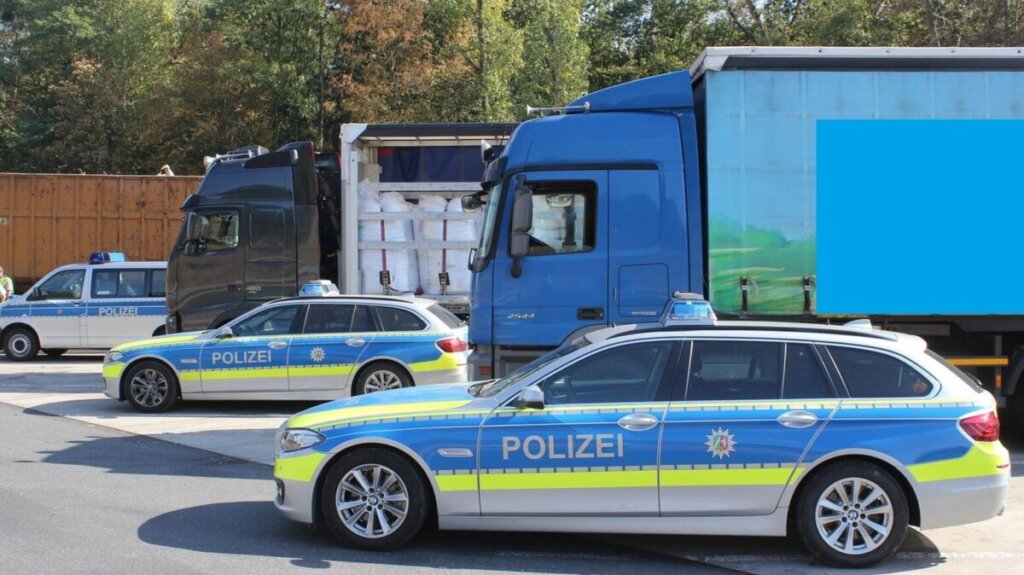
The offence came to light on 16 September during a heavy-vehicle inspection at the SVG-Autohof in Kirchheim, Hesse. The operation formed part of a safety day organised by Fernfahrerstammtisch Hessen and involved specialist police officers from northern, central and eastern Hesse.
In addition to checking driving and rest times, vehicle condition, load securing and compliance with dangerous-goods rules, officers also examined speeds recorded by digital tachographs.
Tachograph analysis reveals 122 km/h
One case drew particular attention: a Moldovan driver at the wheel of a French lorry-and-trailer combination. Analysis of the digital tachograph showed that the vehicle had reached 122 km/h in an 80 km/h zone. That is 42 km/h above the limit.
Because a fine was expected, the driver had to pay a security payment on the spot worth several hundred euros. The exact figure was not disclosed; police described it only as a sum in the mid-three-figure range. The payment is not the final fine. It secures funds against any penalty that may ultimately be imposed.
The German police statement does not clarify whether officers had additional evidence of the speeding, such as dashcam footage or a speed-camera reading.
Six vehicles were barred from continuing
The Kirchheim inspection uncovered considerably more than one speeding offence. The operation involved checks on 26 vehicles and people in total. The violations included problems with load securing, driving and rest times, vehicle condition, speed and regulations governing the transport of animals.
In six cases, the problems were serious enough for police to prohibit the vehicles from continuing until the defects had been corrected.
One of the vehicles stopped was a Croatian vehicle combination with dangerous technical defects and major shortcomings in the way its load had been secured. The journey could resume only after the vehicle was repaired and the cargo properly fastened. During the operation, officers filed 23 reports concerning regulatory breaches and collected security payments totalling several thousand euros.
Police also opened proceedings over a consignment of tyres being transported with an incorrect vehicle configuration. The case concerns the recovery of an economic benefit through an adjustment to the fine; the amount is expected to fall in the mid-four-figure range.
A tachograph had previously recorded as much as 156 km/h
The September case in Hesse is the latest example of German authorities using tachograph records to establish a lorry’s speed.
In early July, police stopped a lorry on the A6 near Sinsheim after witnesses reportedly said it had been travelling at around 140 km/h through a roadworks zone.
After stopping the vehicle, officers analysed the digital tachograph data. The device had reportedly recorded speeds of up to 156 km/h.
The inspection also uncovered signs of possible tachograph manipulation. Police confiscated the driver’s licence, driver card and vehicle keys.
The Kirchheim case differs from the earlier A6 incident. In its September statement, police referred to speeding identified during a routine analysis of tachograph data, without mentioning an earlier witness report or suspected manipulation of the device.
Can tachograph data alone justify a speeding fine?
Whether authorities can impose speeding penalties solely on the basis of tachograph data remains disputed in European transport law. National practice and court decisions are not consistent across Europe.
In mid-June 2026, a court in Brindisi, Italy, overturned a fine imposed on a lorry driver solely on the basis of a printout from a digital tachograph.
The court found that the device reading alone was insufficient to attribute the offence to the driver. The enforcement authority had not provided other evidence of speeding, such as a speed-camera measurement.
The ruling concerned the interpretation of Regulation (EU) No 165/2014, which governs the use of tachographs in road transport. These devices record driving time, rest periods and vehicle speed, among other information, but they are not primarily intended to replace equipment used to enforce speed limits.
The Italian judgment does not rule out tachograph data from speeding proceedings altogether. In another ruling, Italy’s Supreme Court accepted that such records may be used as evidence in certain circumstances.
As previously reported by Trans.info, in 2020 the European Commission challenged Italian rules that allowed fines to be routinely issued solely on the basis of tachograph data.
German courts accept tachograph records as evidence
Germany takes a more nuanced approach to tachograph records. Case law from German Higher Regional Courts, including the Higher Regional Courts of Hamm and Cologne, allows tachograph data to be used as evidence in speeding cases.
That does not mean every reading showing a speed above the limit is automatically enough to penalise a driver.
Authorities must also consider the circumstances of the individual incident, whether the location and time of the offence can be established, the speed limit in force at that location and the accuracy of the measurement. German case law has also stressed the need to apply an appropriate margin of error in the driver’s favour.
In Poland, the Road Transport Inspection does not routinely issue speeding fines solely on the basis of historical tachograph records.
One reason is that a speed record alone does not clearly identify where the offence occurred or which limit applied there. Tachograph data can nevertheless provide supporting evidence, for example when reconstructing road accidents or analysing suspected cases of excessive vehicle speed.
The Kirchheim case shows that tachograph data can be used to uncover speeding during a later roadside inspection, even when no measurement was taken at the time of the alleged offence. Here, the reading resulted in the driver having to pay several hundred euros as a security payment against an expected fine.