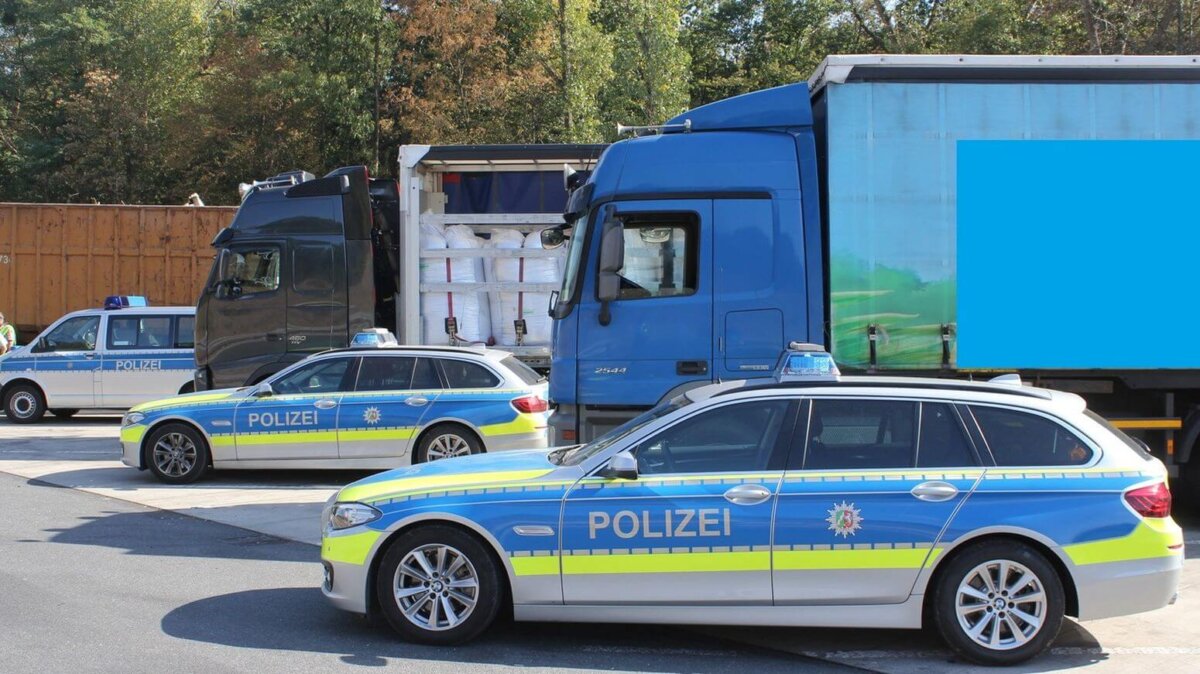

The stop took place on the A6 near Sinsheim. Police intervened after witnesses reported a lorry travelling at roughly 140 kilometres per hour through a roadworks zone.
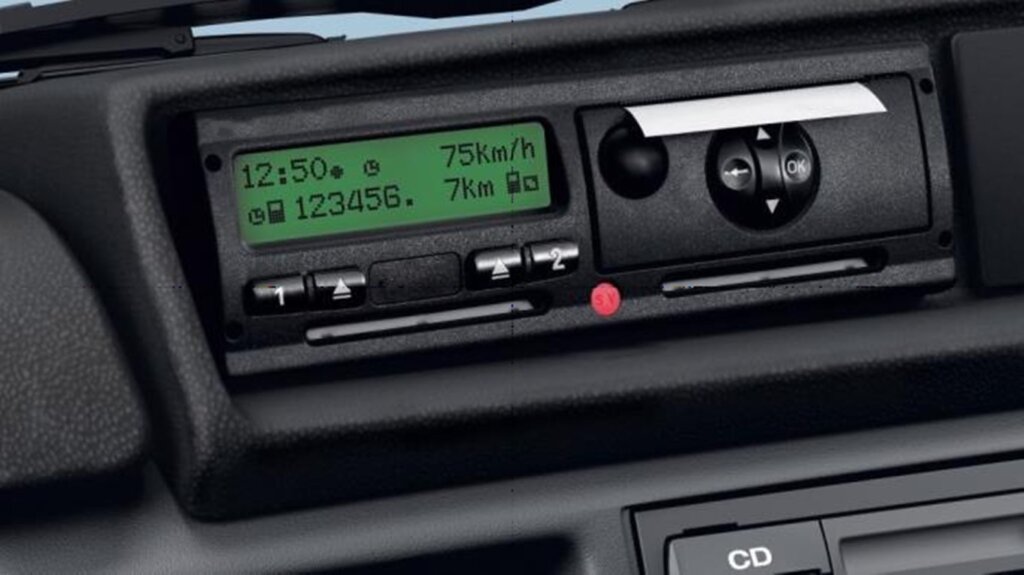
After pulling the vehicle over, officers reviewed the digital tachograph data. According to the readout, the truck had reached speeds of up to 156 kilometres per hour.
Police said the case goes beyond an alleged speeding offence. Investigators also reported suspected manipulation of the tachograph, which could extend the inquiry to potential falsification of technical records. The driver’s licence, driver card and the vehicle keys were seized.
Beyond this specific incident, the case raises a recurring legal and operational issue: can tachograph data alone justify a speeding fine?
Italian court: a tachograph printout isn’t enough
In mid-June, a court in Brindisi annulled a fine issued to a truck driver where the only evidence was a printout from a digital tachograph.
The judge noted that tachographs are primarily designed to monitor driving time, breaks and rest periods under Regulation (EU) No 165/2014 — not to enforce speed limits.
Because the authority did not provide additional proof, such as a measurement from a speed camera or other enforcement equipment, the penalty was overturned. In the court’s view, relying solely on a tachograph record did not meet the standard required to attribute a speeding offence to the driver.
This does not mean tachograph data is automatically excluded from proceedings. In Italy, interpretation remains contested: an Italian Supreme Court ruling has allowed tachograph records to be used as evidence in certain circumstances.
The European Commission has already weighed in
The Brindisi ruling is not Italy’s first decision of this kind. A shift in part of the Italian case law followed action by the European Commission, which in 2020 challenged national rules that enabled routine fines based exclusively on tachograph data.
In the Commission’s assessment, that approach conflicts with Regulation (EU) No 165/2014, because the tachograph’s core purpose is monitoring professional drivers’ working time — not general speed-limit enforcement.
At the time, Brussels urged Italy to amend its rules, warning that failure to do so could ultimately lead to proceedings before the Court of Justice of the European Union.
What’s the approach in Poland?
In Poland, the Road Transport Inspectorate does not issue speeding fines based only on historical tachograph records.
The main reason is practical: a speed trace alone does not clearly identify where the offence occurred, what speed limit applied at that location, or the context needed to assess the situation. Poland’s Ministry of Infrastructure has repeatedly assured the transport and logistics sector that routine fines based solely on tachograph data will not be used.
That said, tachograph information can still be relevant. It may support accident reconstruction and can be used in so-called overspeed cases — when the tachograph records driving above the limiter setting for more than one minute.
As enforcement evolves and fraud risks grow, carriers are also paying closer attention to compliance and penalties linked to tachograph misuse, as seen in Sweden’s approach to tachograph fines.
Germany allows tachograph data as evidence — with limits
Germany takes a more nuanced view. Decisions by Higher Regional Courts, including OLG Hamm and OLG Köln, have for years allowed tachograph records to be used as evidence in speeding cases.
The courts have also indicated that missing up-to-date verification does not automatically eliminate the evidential value of the record — although an appropriate margin of error should be applied in the driver’s favour.
Even so, this does not mean every historic tachograph entry results in a fine. The case law focuses on whether the evidence may be admitted in proceedings, not on whether authorities should run routine enforcement based on later data analysis. In practice, German services generally do not issue tickets solely from tachograph data reviewed after the fact, because a readout does not establish what speed limit applied at the time and place of the recorded event.
The debate also connects with broader concerns about device integrity and compliance, particularly in light of discussions around tachograph security and how vulnerabilities can affect enforcement and evidence.
In the A6 case, the tachograph isn’t the only piece of evidence
The A6 stop illustrates why context matters when tachograph data is used in enforcement. In this case, the device record was only one element of the evidential picture. Police also had a witness report describing extremely fast driving, and during the inspection they found indications of possible tachograph manipulation.
Suspected interference with technical records can carry significantly more serious consequences than a speed reading itself. At the same time, the case underlines the broader point: a tachograph entry does not automatically establish a driver’s liability. Whether it can be used as proof depends on national rules, the circumstances of the incident, and how enforcement bodies and courts apply the law.