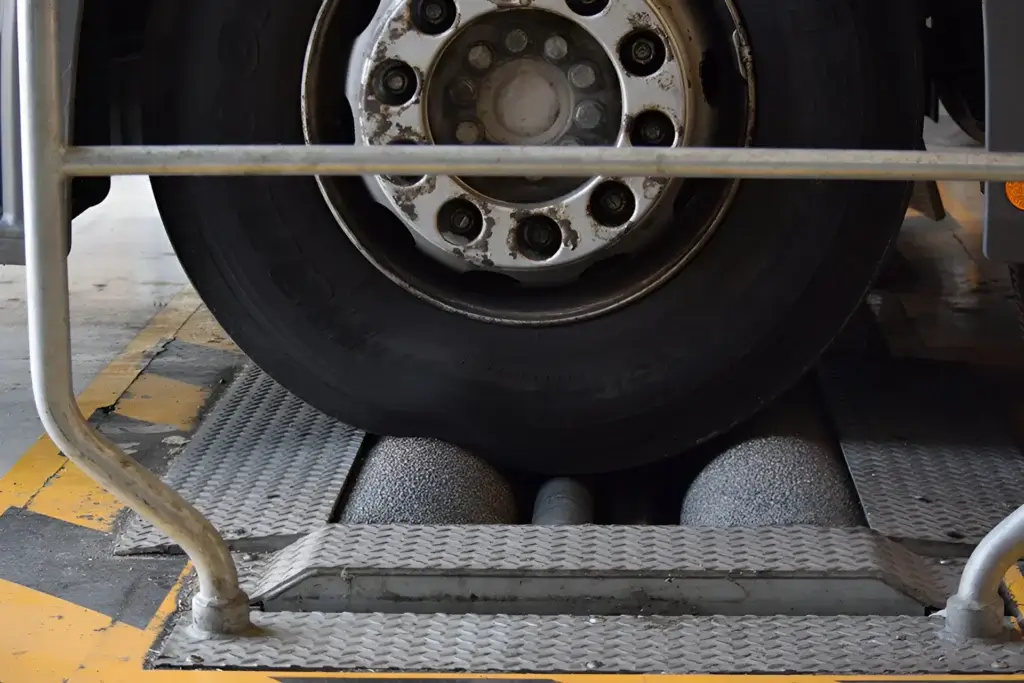
In total, 50 trucks were checked. Twenty-four drivers were found taking their regular weekly rest inside the vehicle, despite EU rules banning the 45-hour break from being spent in the cab. Belgian police issued on-the-spot penalties, while the Labour Inspectorate also opened cases linked to potential social dumping.
Checks move beyond the port — and over fifty-six thousand euros in on-the-spot fines
The third PUKHUS operation took place on the Sunday evening of 13 May 2026. Unlike earlier rounds, inspectors didn’t focus solely on the Port of Antwerp. Teams also carried out checks in industrial areas and on roads across the Antwerp police zone.
The operation involved, among others, the traffic police, local police HEKLA, the maritime police of the Federal Police, and labour inspection services SIOD, TSW, RSZ and VSI. Observers from Cyprus, Greece, Romania, Austria and the Netherlands were also present.
Inspectors flagged additional offences as well. Two drivers did not have a valid driving licence, and one was driving without using a driver card.
The total value of fines issued on the spot came to €56,220. Belgium’s Labour Inspectorate also launched three investigations into suspected social dumping.
Regular weekly rest must be taken outside the cab
Under current EU rules, a regular weekly rest — a break lasting at least 45 hours — cannot be taken in the vehicle. Employers are required to provide suitable accommodation with sanitary facilities.
These provisions followed years of disputes over interpretation. Even before the EU regulation was updated, countries including Belgium, France and Germany had already introduced their own bans and penalties.
A key turning point came with a Court of Justice of the European Union ruling in December 2017 in a case involving Belgian carrier Vaditrans. The court confirmed that regular weekly rest cannot be taken in the vehicle cab. Several years later, the ban was explicitly written into Regulation (EC) 561/2006.
Enforcement of these rules remains contentious in the transport sector. Carriers have long pointed to the shortage of secure parking and the limited availability of hotels that can realistically serve truck drivers.
Fines across Europe: up to €30,000 in France
Penalties for taking regular weekly rest in the cab vary widely by country. In some states, sanctions are particularly severe — for both drivers and operators.
In Belgium, where the latest PUKHUS action was carried out, the fine for this offence is €1,800. Authorities may also immobilise the vehicle until the amount is paid.
Germany applies an hourly penalty model. Drivers can be fined up to sixty euro for each hour of illegal rest taken in the vehicle, while the carrier can face up to one hundred eighty euro per hour. For a full 45-hour break, that can mean as much as €2,700 for the driver and €8,100 for the transport company.
France is among the strictest in Europe. Its transport code allows for a fine of up to €30,000, as well as the possibility of a prison sentence of up to one year. In addition, an administrative penalty applies of up to €1,500, or up to €3,000 in cases of repeat offences.
In Spain, since February this year, spending the regular weekly rest in the cab is treated similarly to failing to take the required 45-hour break. Fines range from €1,001 to €2,000.
Scandinavian countries also impose tough penalties. In Sweden, the fine for this type of rest is twenty thousand Swedish kronor, which is around eight thousand złotych.
In Denmark, a driver can be fined ten thousand Danish kroner (around five thousand seven hundred złotych), while a business can face up to twenty thousand Danish kroner (around eleven thousand four hundred złotych).
More enforcement focused on real-world rest conditions
The Belgian operation underlines a wider shift: checks on driving and rest times increasingly go beyond tachograph data and look at the actual conditions in which drivers spend their weekend breaks.
In many countries, authorities now carry out night-time operations and inspections in industrial parking areas — locations where it’s easiest to find vehicles being used for regular weekly rest. In practice, this raises the risk of high penalties, particularly on international routes running through Belgium, France or Germany.
More checks, but the parking gap is still there
Belgium’s latest action feeds into the broader European debate about truck drivers’ rest conditions. In April last year, the European Commission published a wide-ranging report on safe and secure truck parking in the EU and on the practical realities of rest for professional drivers.
The report pointed to a major shortfall in parking infrastructure. Estimates put the deficit at around 390 thousand secure truck parking spaces, with the gap potentially growing to as many as 483 thousand spaces by 2040. The document also examined the availability of hotels and sanitary facilities near parking areas, and whether taking regular weekly rest outside the vehicle is feasible in real conditions.
The Commission noted that in many countries — particularly Belgium, France, Germany, Italy and Spain — drivers struggle to find secure parking and suitable accommodation. At the same time, these are also among the places where weekend rest checks are most common.
The report also floated a possible adjustment to controversial Mobility Package rules. Brussels suggested opening a debate on allowing regular weekly rest in the cab — but only at the highest-security parking sites, certified at gold or platinum level.
From the outset, the idea has been highly divisive. The European Transport Workers’ Federation (ETF) criticised the proposal, arguing that a truck cab should not replace proper rest conditions — and that the core issue remains the lack of adequate infrastructure for professional drivers.