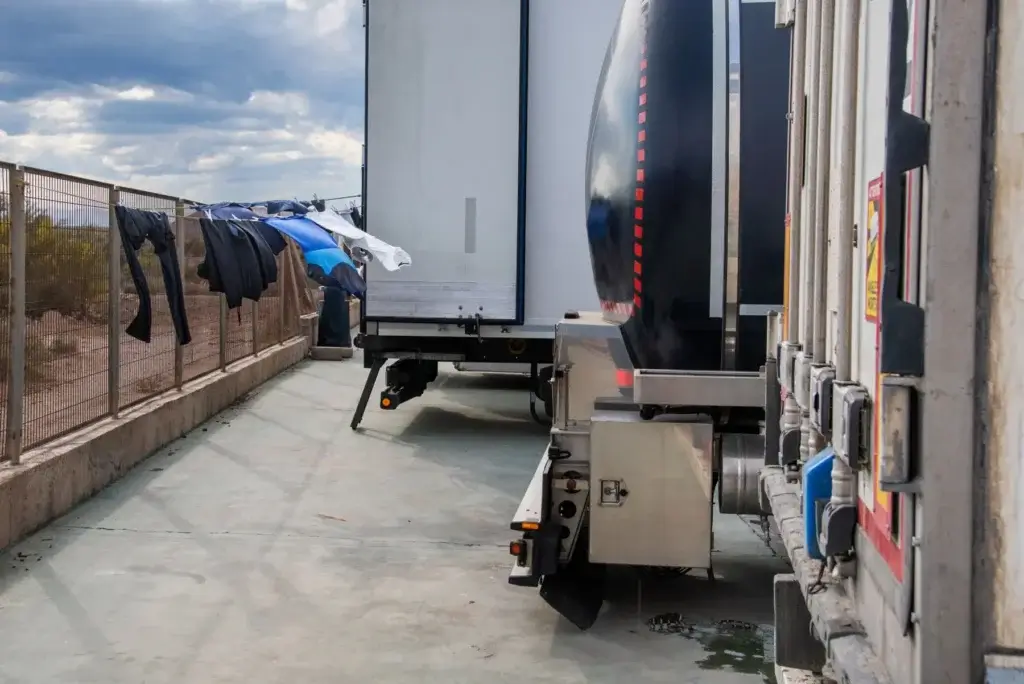
This is the latest development in the story, which we reported on earlier – at the time, the driver from Tajikistan had stopped the tractor unit in the Netherlands and lived in the cab for several weeks, demanding payment of outstanding wages.
Court upholds the driver’s right to strike
The Overijssel court in the Netherlands ruled that the driver, Muhammadas Muridzoda, was entitled to stop the tractor unit and keep it until the employer settled the payment. Under the ruling, the Klaipėda-based transport company Marvel Solar Energy must pay the driver nearly €18,000 in unpaid wages.
The court also stressed that the driver acted lawfully by relying on the so-called right of retention (retentierecht) – meaning a creditor may temporarily retain another party’s property until that party settles the debt.
The employer tried to argue that retaining the tractor unit was a disproportionate measure because the vehicle’s value far exceeds the amount claimed. However, the court found that the driver had no other realistic means of exerting pressure on the employer.
Months on the road without full pay
According to the case file, the driver from Tajikistan spent almost nine months living in the tractor unit cab and working in Western Europe, mainly in the Netherlands, Belgium and Germany.
In the first weeks, wages were paid, but later he began receiving only part of the agreed pay. The employer promised to settle the full amount later, once the driver returned to Lithuania.
However, as the court found, the driver had no real opportunity to return – the company kept planning new trips, so he was driving around Western Europe practically without a break.
A major logistics client also became involved
An important aspect of this story is that one of Europe’s largest logistics clients was involved in the transport chain. The trip carried out by the striking driver had been commissioned by the Austrian logistics giant LKW Walter, whose annual turnover is around €2.8 billion.
The company does not employ its own drivers and organises transport by working with transport companies across Europe.
After the story became public, LKW Walter said it takes reports of potential labour-law violations very seriously. The company stated that all partners it works with must comply with fair working conditions and minimum-wage requirements.
Due to the situation, cooperation with the Lithuanian company Marvel Solar Energy was temporarily suspended until the circumstances are fully clarified. If it turns out that the information provided by the driver is correct, the Austrian company does not rule out terminating cooperation with this company entirely.
Such decisions show that labour disputes in the transport sector can have consequences not only for the companies themselves, but also for their relationships with major international clients.
The ruling could set a precedent
According to the Dutch trade union FNV, the court ruling could have broader implications for the entire European transport sector.
The court gave a clear answer to the question of whether a driver may stop a tractor unit and hold it as leverage over unpaid wages. The answer is yes.
According to union representatives, this situation is not an isolated case. There may be tens of thousands of drivers in Europe facing similar working conditions – receiving only advances, with the full wage paid only after returning to their country of origin.
What’s next
For now, it is unclear whether the Lithuanian company will comply with the court ruling immediately. If the money is not paid, enforcement proceedings may be initiated. In that case, the tractor unit could be seized and sold to cover the debt owed to the driver.
Muhammadas himself hopes to receive the wages owed to him as soon as possible and return to his family. According to his representatives, he does not intend to work for this company again.
Reaction from Lithuanian institutions and politicians
This story has also attracted attention in Lithuania. The State Labour Inspectorate said that the driver himself has not officially approached the institution, but an investigation is already under way into possible other violations of the Labour Code by the company. Once information about the striking driver from Tajikistan was received, the investigation will continue and all circumstances will be assessed.
Lithuanian politicians also acknowledge that the working conditions of foreign drivers in the transport sector are raising more and more questions. According to MP Remigijus Motuzas, there are cases where foreign workers are employed only for a short period.
“A foreign citizen, if employed and then dismissed after 3–6 months, loses their residence permit in Lithuania,” MP Remigijus Motuzas told the LNK portal.
Meanwhile, representatives of the transport sector urge people not to dramatise the situation and say that labour disputes between employees and employers are a natural part of business, and that driver shortage in the sector is around 30% per year.
“Compared with other professions, that figure is low or does not stand out as being higher,” said Povilas Drižas, Secretary General of the Transport and Logistics Alliance (TTLA).
Additional context is provided by statistics: around 150,000 people work in Lithuanian transport companies, of whom about 90,000 are foreigners, so the issue of working conditions is becoming not only a matter of individual disputes, but also a broader topic of labour-market policy in the transport sector.