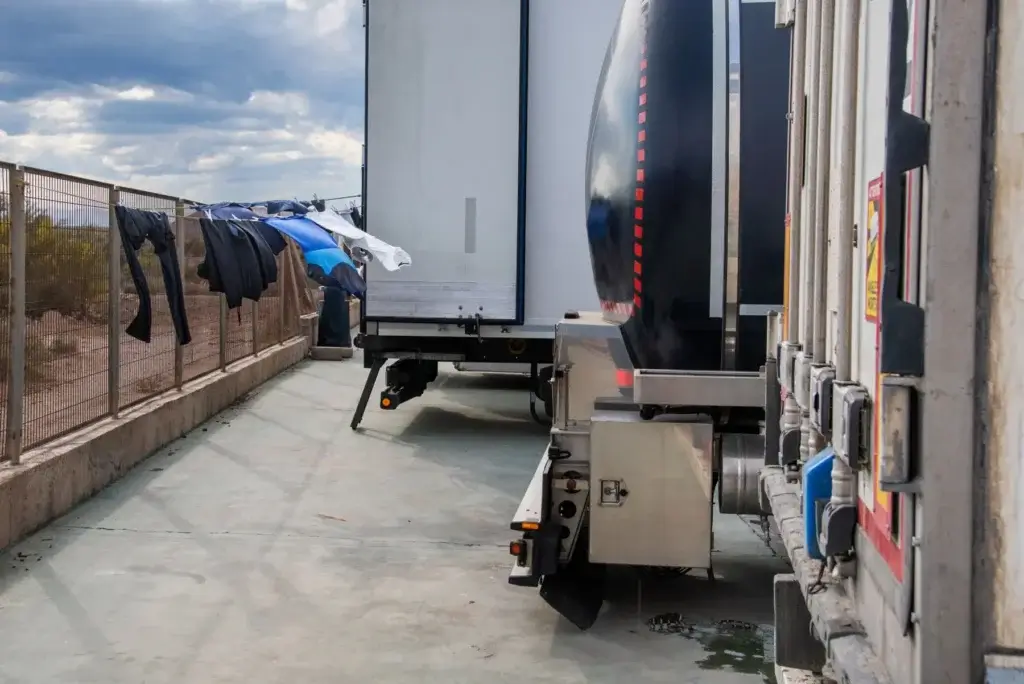
A wage dispute involving a Lithuanian-registered haulage company has led to a second high-profile driver protest in the Netherlands in recent weeks. After a recently reported case in which a driver lived in his truck for two weeks near the A1, one of the Netherlands’ main motorways, a similar situation is now unfolding at the Port of Rotterdam – Europe’s largest seaport – in the Maasvlakte industrial zone.
A tractor unit carrying a load that has not been delivered to Germany has been standing there for more than a week. Its driver, Parviz, from Tajikistan, says he has not received his full wages for several months and has decided to stop the delivery until he is paid.
According to the driver, his employer – Gretvėja, a company registered in Šiauliai, northern Lithuania – owes him at least €30,000.
Two years in the cab
The driver says he works for a Lithuanian transport company with around 750 tractor units, carrying out haulage operations for Dutch companies. For the past two years, he says, the cab has been his permanent place of residence – and during that time, he has not seen his family.
Over the last seven months, he says, he has received only part of his already low salary.
“I received some payments, but not my full salary,” Parviz told Dutch regional outlet Rijnmond.
The calculations were based on what he had been paid over the past two years. After recalculating the hours worked together with Dutch trade union FNV, it became clear that the total was far too low. These calculations did not yet include compensation for holiday entitlement and for permanently living in the cab, the nt.nl news portal reports.
The employer denies that too little was paid and, when asked for comment, provided a breakdown of the hours worked and the salary it says was due. However, according to FNV, the document only confirmed the union’s calculations – and the driver had not received the amount stated in that breakdown.
With no other way out, he stopped at Maasvlakte Plaza, a truck parking area in Rotterdam’s Maasvlakte port zone, and refuses to continue the delivery.
The load as leverage
The driver is relying on the right of retention (Dutch: retentierecht) – a legal mechanism that allows someone to keep property in their possession until a debt is paid. In practice, he is keeping both the tractor unit and the load until the employer settles the alleged wage debt. A note attached to the container states that the goods will not be delivered until his wages are paid.
According to representatives of the trade union supporting him, there were attempts to remove the vehicle. A tow truck arrived, but the police did not allow the tractor unit to be taken away, as the driver had the right to remain in the vehicle under the retention claim, according to the union.
The driver says his employer dismissed him.
“Instead of paying me, they tried to force me out of the truck without paying,” he said.
A systemic problem
The situation is being monitored by Dennis van Looijen, a representative of FNV. The organisation organised a small fundraising effort: food was bought for the driver, and funds were provided for showers and parking fees. The most essential expenses are expected to be covered at least for the coming weeks.
FNV representative Edwin Atema says this is not an isolated case. According to him, foreign drivers – especially those from non-EU countries – often receive only advances, while final wage payments are delayed until they return to their home country. Such a practice, he says, makes employees dependent on their employer.
The union stresses that drivers working in the Netherlands are entitled to pay and allowances set out in the Dutch sector collective agreement, which establishes minimum conditions for work performed in the country.
More broadly, the case reflects ongoing concerns in European road transport about wage enforcement in cross-border operations and the vulnerability of non-EU drivers working through international subcontracting chains.
Parviz’s work with the Lithuanian company
Back in Central Asia, Parviz worked as a tractor unit driver and says he enjoyed the job, driving mountain roads from one border to another. However, the prospect of higher earnings brought him to Europe. He found a Lithuanian company online that promised several thousand euros per month, nt.nl reports.
After arriving in Lithuania, he took part in training. Even then, he says, he suspected something was wrong. Before travelling, he had looked into European driving and rest-time rules, but during training they were allegedly told that, on management’s instructions, they would not need to follow them.
Over two years, he says he barely saw Lithuania. He mostly worked in the Netherlands, Belgium and Luxembourg, as well as France and Germany. He says he was paid according to Lithuanian standards. He also alleges that the employer required him to switch off the tachograph at weekends so it would appear he was resting in a hostel, even though in reality he spent the time in the cab.
He says he was not stopped during checks and insists he drives properly and carefully. But after seven months of uninterrupted work, barely leaving the cab and never sleeping anywhere else, he decided he no longer wanted to be involved in potential violations. Colleagues told him about the option of stopping the vehicle and beginning a protest.
That is how he ended up at Maasvlakte. Shortly after the protest began, he says a company representative tried to take over the tractor unit, but he refused to hand it over until he received the money. Later, the company also sent a tow truck, but the driver called the police. Officers recognised his right to remain on site until the wage dispute is settled, according to the union’s account.
Eventually, the company also sent a colleague from Belarus, who parked his tractor unit next to Parviz. The driver jokingly called him an “informant”.
What next?
How the situation will develop remains unclear. With his employment contract terminated, he also loses his residence permit, meaning he officially has four weeks to leave the European Union, as his right to stay is linked to his employment status. Parviz plans to contest the dismissal, but at the same time says he is looking for a new employer in Europe. Most likely, he will first have to leave the EU and will only be able to return after obtaining a new permit. If the dismissal remains on his record, it may make obtaining a new permit more difficult.
Parviz alleges that employers exploit legal loopholes. According to him, promises about working conditions and pay are often made only by phone, without written proof. In his view, this leaves employees in a hopeless situation, so many simply keep working even when they face violations. He says he intends to stay at Maasvlakte Plaza for as long as necessary until he receives the money he says he is owed.
Parviz also claims he has noticed a new trend: some companies are allegedly starting to hire drivers from the Philippines, who may be less familiar with European rules. In his view, this can create opportunities for exploitation. He says that when he came to Europe, he expected a strict and effective control system, but his experience has changed that view.
Gretvėja’s comment
In its comment, Gretvėja says it firmly rejects all allegations. According to the company, the driver was paid in full in accordance with his employment contract. It also says employees are respected and that operations are conducted in line with the highest professional and legal standards.
The haulage to Mannheim was ordered by Dutch forwarding company Falco Lines, registered in Ridderkerk, near Rotterdam, and employing around 16 people. According to nt.nl, when asked to comment, the company declined to do so. However, it told RTL Nieuws that it does not consider itself a party to the employment relationship and has no role in agreements between the employer and the employee.