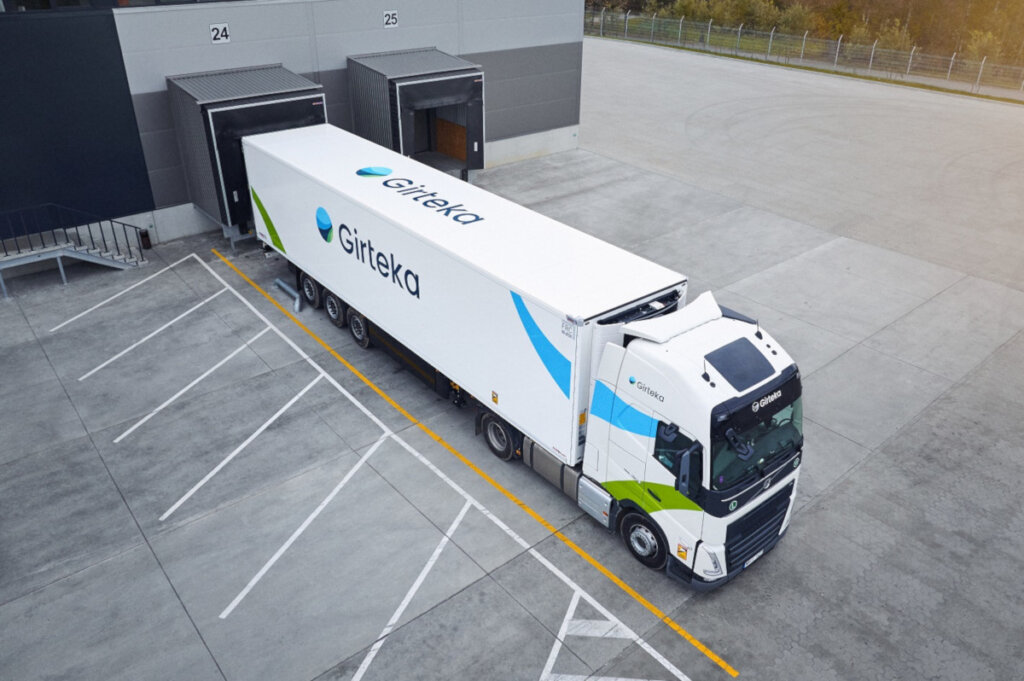
The new recruits are going through the Girteka Drivers Academy. Girteka says the candidates already have long-haul experience, but they still need to top up qualifications required in Europe – including rules on working time and mandatory professional certification.
“During their time at the Girteka Drivers Academy, our new drivers from Brazil delivered strong results, showed a real willingness to learn, and were highly committed to adapting to European road regulations, including obtaining Code 95. We’re pleased that despite their extensive experience, they remain curious, motivated, and eager to focus on what they do best – driving,” said Mindaugas Paulauskas, CEO of Girteka Transport.
The Lithuanian group adds that the Brazilian drivers responded positively to both the training programme and the support provided by instructors as they prepare to work in Europe.
All you need to know about how companies recruit drivers from Brazil: ‘Driver Auction’: how Brazil truckers are recruited and brought into European haulage
Brazil emerges as a new recruitment market for European hauliers
Hiring in Brazil fits a wider pattern across Europe’s transport sector. Carriers – particularly in Central and Eastern Europe – are increasingly running recruitment campaigns outside the European Union.
Companies point to local drivers’ long-distance background and their willingness to take on international work. More and more often, the process starts remotely: document checks and interviews take place before candidates travel to Europe. Once on the ground, drivers complete the additional requirements needed under EU rules.
‘Driver auctions’: a more market-driven way to source non-EU labour
Recruiting drivers from outside the EU is becoming not only more global, but also more structured and increasingly shaped by market mechanisms. In the sector, recruiters have begun using the term ‘driver auction’ to describe a model based on carriers’ demand forecasts and matching those needs with candidates from Brazil.
Under this approach, transport companies share their expected staffing needs – sometimes up to 12 months ahead – and recruiters use that information to launch selection. Candidates go through multiple screening stages, training, and preparation for European conditions before they leave. In many cases, they also need their own funds to get started – around €800 to cover initial expenses after arrival.
The model is aimed mainly at smaller hauliers that don’t use large, expensive recruitment systems. In practice, it can also tie a driver to a specific employer from the recruitment stage, increasing the worker’s dependence on the company during the first months of employment in Europe.
This is the route being used by carriers in Lithuania, as well as in Poland, Austria, Latvia, Italy and Spain.
Gretvėja plans to hire 200 Brazilians
Earlier this spring, Lithuanian company Gretvėja announced plans to employ up to 200 drivers from Brazil.
The recruitment was handled by M/Brazil, an agency focused on sourcing drivers for roles in Europe and the United States. Company representatives have said that the pay gap between Brazil and Europe is one of the key factors driving interest – both from hauliers and from drivers themselves.
Preparing candidates includes more than transport-regulation training. It also covers language learning and support with organising day-to-day life and work in Europe.
Concerns grow over hiring drivers from outside the EU
As recruitment outside the EU scales up, debate is intensifying around working conditions and how dependent employees can become on their employers.
In many countries, residence and work permits are linked to a specific company. In practice, that means losing a job can quickly create problems with legal stay.
In recent months, the industry has also been watching wage disputes involving carriers that rely on drivers from outside Europe. One example was a protest by a driver from Tajikistan employed by Gretvėja at the port of Rotterdam, related to unpaid wages and the settlement of working time.
Carriers argue, however, that without opening up to workers from third countries, keeping parts of Europe’s transport operations running will become increasingly difficult. The sector has faced a driver shortage for years, and the number of new candidates entering the European market remains too low.
Is global recruitment becoming the new normal?
Girteka says hiring drivers from Brazil is intended as the first step in a broader direction.
“We’re pleased to be able to build a diverse and highly qualified driver community,” Girteka said.
The competition for drivers is clearly moving beyond Europe, and the race to attract talent from South America may accelerate further in the years ahead.