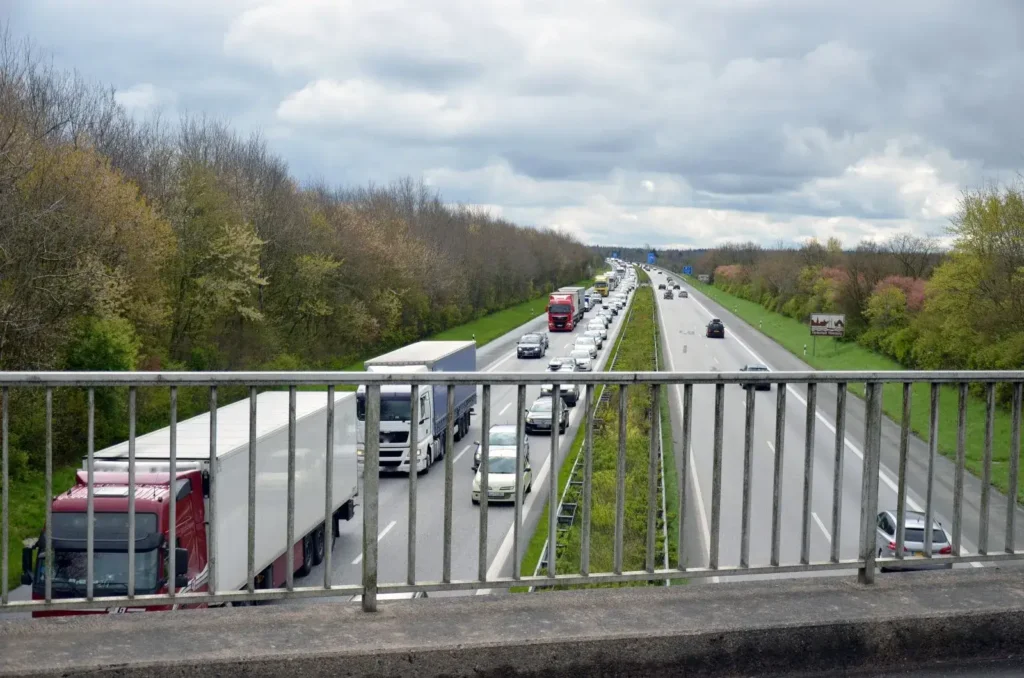
Denmark is preparing legislative changes to grant Færdselsstyrelsen new enforcement powers for foreign heavy goods vehicles.
Under the draft bill, during roadside checks, officials would be able to direct a vehicle for inspection and escort it to a designated control point. The vehicle will not be released until outstanding fines for unpaid road charges are settled. The measure would apply only to final, due fines; cases that are still under appeal or not yet legally binding would not be covered.
According to the explanatory memorandum, the current system does not ensure effective enforcement against foreign carriers, as vehicles can leave Denmark without settling unpaid fines.
The fine is linked to the vehicle, not the driver
One of the most controversial elements of the proposal is that the fine would be linked to the foreign-registered vehicle itself, rather than to a specific driver. As a result, it would not matter whether the person currently driving the vehicle is the same driver on whom the fine was originally imposed.
Such situations may arise if the vehicle has changed ownership since the fine was issued, if it is operated by a transport company with multiple drivers, or if it is rented or leased and the offence was committed by another driver using the same vehicle. In practice, this shifts enforcement risk to whoever is in possession of the vehicle at the time of the roadside check.
If the current driver pays the fine to continue the journey, any subsequent settlement between that driver and the actual debtor would be a civil matter and remain outside the scope of Danish authorities.
Exception for Nordic countries
The draft includes a significant exemption. Vehicle immobilisation would not apply to debtors from Finland, Iceland, Norway or Sweden.
The reason is practical rather than political. As stated in the explanatory memorandum, Denmark already has highly effective mechanisms for recovering monetary fines from these countries under long-standing Nordic enforcement cooperation. For other countries, equivalent tools either do not exist or are considered far less effective, which – in the view of the lawmakers – justifies the introduction of stricter measures.
End of a single, automatic fine
At the same time, the Danish government has announced plans to reform the penalty system for road-charging infringements. Currently, violations are punished with a single fixed fine of DKK 9,000 (around €1,200), regardless of the circumstances.
The Danish Ministry of Finance has informed industry representatives that work is underway to differentiate fine levels so that:
- the highest penalties would apply only in cases of blatant, systematic and deliberate toll evasion;
- unintentional errors, technical faults, system failures, device downtime or data-entry mistakes would no longer automatically trigger the maximum fine.
Danish carriers have long criticised the current system as overly rigid and disconnected from operational realities. Last year, the issue was referred to the European Commission by the transport organisation ITD, which argued that the Danish penalty regime conflicts with the EU principle of proportionality, requiring sanctions to be tailored to the nature and seriousness of the offence.
Industry reaction: cautious approval
The haulage association Danske Vognmænd (DTL) has welcomed both the proposed vehicle immobilisation rules and the planned differentiation of fines. At the same time, the organisation stresses that the draft legislation must still pass through the full parliamentary process in the Folketinget, and that any parliamentary elections could delay or suspend the reform.
When could the changes take effect?
The bill was published on 3 February 2026, with the public consultation running until 23 February 2026. According to the current timetable, the new rules are scheduled to enter into force on 1 July 2026.
If adopted in the proposed form, Denmark would join the group of countries applying the most restrictive enforcement instruments against foreign carriers evading road charges. For operators transiting the country, the message would be clear: unpaid tolls could result not only in financial penalties, but also in the forced standstill of the vehicle.