Key takeaways:
- Vessel delays are currently absorbing around 5% of global deep-sea container capacity, equivalent to 1.7 million TEU.
- Before the pandemic, delays typically tied up around 2.2% of capacity.
- Global schedule reliability remains at roughly 60–65%, compared with 70–80% before the pandemic.
- On the North Europe–US East Coast trade, just 28% of services arrived on time in July.
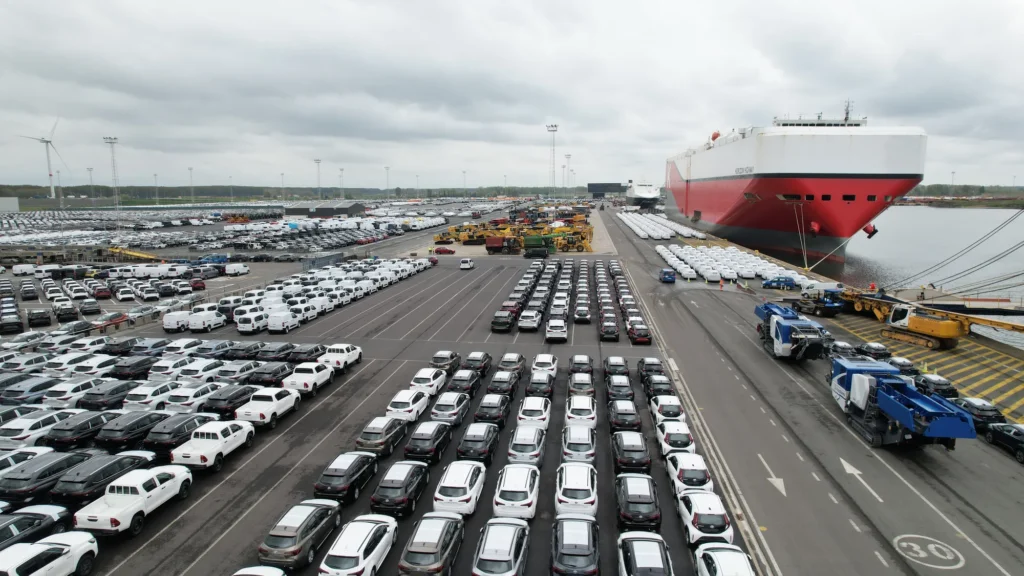
- Rotterdam and Antwerp have faced high yard utilisation, while carriers are urging customers to collect containers promptly to prevent further congestion.
The global container fleet has continued to grow, but a significant part of that additional capacity is effectively being cancelled out by longer and more frequent delays.
Analysis published by Sea-Intelligence on 19 August estimates that 5% of global deep-sea container shipping capacity is currently absorbed by delays. Applied to today’s fleet, that represents around 1.7 million TEU of vessel capacity that is temporarily unavailable to move cargo.
For comparison, between 2011 and 2019 delays typically absorbed only 2.2% of global capacity. The additional 2.8 percentage points above that historical level alone represent around 1 million TEU.
Sea-Intelligence puts the scale into perspective by noting that a container fleet of 1.7 million TEU would rank among the world’s largest shipping companies.
Ships are late – and staying late for longer
The problem is not simply the number of ships missing their scheduled arrival.
Sea-Intelligence says global container vessel schedule reliability remains at around 60–65%, compared with a normal range of roughly 70–80% between 2011 and 2019.
When vessels do arrive late, their delays have also become longer. Late vessels are now typically 5–5.5 days behind schedule, compared with around three to four days before the pandemic.
The analyst’s latest detailed monthly figures show global schedule reliability falling by 1.9 percentage points to 62.6% in June 2026. The average delay for vessels that arrived late stood at 5.31 days.
The combination has an important effect on available shipping capacity: a ship that spends additional days delayed is capacity that cannot be used elsewhere in the network.
North European congestion hits transatlantic reliability
Conditions are particularly challenging on services involving North European ports.
According to the European freight forwarding association CLECAT, citing the latest Sea-Intelligence figures, persistent congestion at North European ports has kept schedule reliability on transatlantic services below 50% for much of 2026.
Performance deteriorated further in July, when only 28% of services from North Europe to the US East Coast arrived on time.
CLECAT says the disruption has already prompted carriers to skip some port calls or introduce blank sailings.
Strong import volumes from Asia are adding to the pressure. Yard utilisation at Rotterdam and Antwerp has regularly exceeded 90%, according to the association, complicating terminal operations and delaying the loading of containers bound for the United States.
The result is an unusual situation in which the nominal capacity of the global container fleet is increasing while the amount of capacity actually available to shippers remains constrained.
Rotterdam faces pressure on both sea and land
Recent developments at Rotterdam illustrate how several different problems can compound the wider congestion.
Maersk said in its August European market update that operations at Rotterdam Maasvlakte II had been disrupted by temperatures above 30°C, which forced temporary terminal gate closures.
The port has simultaneously experienced a sharp increase in refrigerated imports ahead of new EU restrictions affecting certain meat imports from Brazil from 3 September.
According to Maersk, the surge has put additional pressure on reefer handling and inspection procedures, resulting in longer waiting times. Additional refrigerated container plug capacity has been secured at Maasvlakte II for August.
The carrier has advised customers using Rotterdam to allow additional time for collections and deliveries and arrange inland transport as early as possible.
Similar warnings apply more widely across North European terminals. Maersk has asked customers to collect import containers promptly, warning that delayed collection contributes to congestion and can increase the risk of cargo having to be discharged at alternative terminals.
Congestion increasingly becomes an inland transport problem
Rotterdam itself has acknowledged that growing container traffic is putting greater pressure not only on terminals but also on roads and other parts of the inland logistics network.
In June, the Port of Rotterdam said peaks in container traffic were resulting in congestion and longer waiting times and called for more cargo movements to take place during evenings and nights.
That makes the consequences of maritime congestion increasingly relevant to road freight operators.
A vessel arriving several days outside its planned window can suddenly release large volumes of containers into a terminal at once. Hauliers and freight forwarders must then reorganise collections, while terminals, customs processes, rail connections, barges and surrounding roads all have to absorb the same surge.
For cargo owners, the practical effects can include changing ETAs, unpredictable container availability, missed collection slots and additional pressure on storage and inland transport capacity.
Sea-Intelligence’s figures suggest that these disruptions are no longer a temporary anomaly. While the extreme congestion seen during the pandemic has passed, the container shipping network has settled into a pattern of lower reliability and longer delays than before 2020.
And with the equivalent of 1.7 million TEU currently tied up by those delays, the cost is increasingly being measured not only in waiting time, but in shipping capacity that exists on paper yet cannot be used.