
Key points
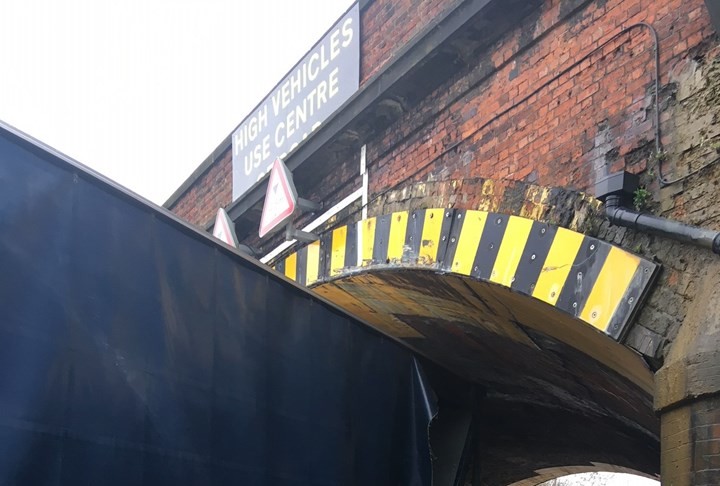
- 1,666 bridge strikes were recorded in 2024/25, an 8.75% increase on the year before.
- They caused more than 186,000 minutes of train delays, costing around £12 million.
- Strikes peak in October, at almost 10 a day.
- The senior traffic commissioner warns that regulatory action, including loss of the operator’s licence, is “a real possibility”.
The latest national figures from Network Rail cover the financial year 2024/25. Bridge strikes rose from 1,532 in 2023/24 to 1,666, or “one every five hours”. They caused more than 120 days of train delays (186,384 minutes), costing around £12 million in delays and cancellations.
Britain’s most-hit bridges
The bridge hit most often was on Watling Street (A5) in Hinckley, with 22 strikes in one year. It was followed by:
- Harlaxton Road, Grantham – 18,
- Stuntney Road, Ely – 15,
- Stonea Road, Stonea – 15,
- Lower Downs Road, Wimbledon – 15.
A single strike can be very costly. Harlaxton Road was hit three times in one week in November 2024, and one of those strikes caused £423,000 of damage and 59 hours of passenger delays.
“Every bridge strike endangers lives, disrupts rail services, and delays tens of thousands of passengers,” said Martin Frobisher, Network Rail’s group safety and engineering director.
October is the worst month
According to Network Rail’s Wise Up, Size Up campaign, bridge strikes peak in October, at almost 10 a day. They happen most often between 10am and 11am and stay frequent until about 6pm. Each strike costs around £13,000 on average.
Network Rail’s research suggests the problem often starts in the cab: 43% of lorry drivers admitted they do not measure their vehicle, and 52% admitted they do not take low bridges into account when planning a route.
Licences at risk
Traffic commissioners treat bridge strikes as a serious compliance failure. In guidance to operators, the senior traffic commissioner wrote: “Regulatory action is a real possibility for those operators who fail to take appropriate control measures.” That action can include “the loss of the operator’s licence”.
Drivers face their own risks. The traffic commissioners’ statutory guidance on driver conduct, revised in November 2025, says that most collisions with infrastructure “might be avoidable and caused as a result of negligence and poor training”. Bridge strikes are listed as a reason to call a driver to a hearing.
Recent cases show what commissioners look at:
- Carey London Ltd: a trailer carrying an 8-tonne excavator, measured at 15ft 4in, hit a bridge. The operator licence was cut in half and the driver’s vocational entitlement was suspended for two months. “The outcome of this incident could have been truly catastrophic,” the traffic commissioner said.
- TCG Logistic Ltd: a 14ft 6in vehicle hit a 14ft 3in bridge in Romsey. All in-cab height indicators had been set to 14ft 6in “regardless of the height of the trailer”, which the commissioner found contributed to the strike. The driver was also under time pressure, and the director said the shipping schedule had put more pressure on the operation that week. The decision included warnings for the operator, transport manager and driver.
Other recent decisions show that commissioners look closely at day-to-day management, as when an operator lost its licence for faking maintenance records.
How to avoid a strike
The lessons for operators are simple and cheap compared with the cost of a strike:
- measure every vehicle and load, and record the height in the cab,
- update the height indicator for every trailer change,
- plan routes with truck-specific navigation and check low bridges,
- do not push drivers to cut corners to make delivery slots.
With October the peak month for strikes, now is a good time to check that these steps are in place.