


Key points:
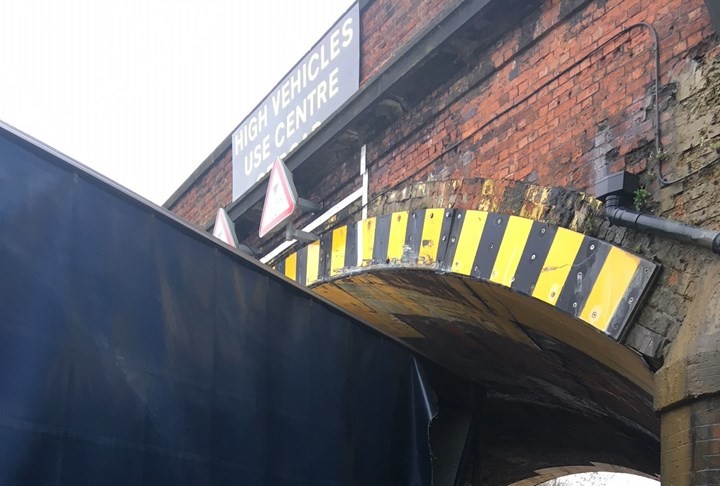
- Network Rail recorded 1,706 bridge strikes in 2025/26, up from 1,666 a year earlier.
- The strikes caused 185,319 minutes of train delays and cost around £13.25m in delays, cancellations and repairs.
- The A5 Watling Street bridge in Hinckley, Leicestershire, was struck 26 times and tops the list.
- Network Rail urges drivers to check vehicle height and plan suitable routes before every journey.
Bridge strikes are rising again
Network Rail published its list of the most-bashed bridges to mark Road Safety Week (15 to 21 November). The ranking covers strikes reported between 1 April 2025 and 31 March 2026.
The total of 1,706 bridge strikes is 40 more than in 2024/25 and 174 more than in 2023/24, although it is still below the 1,864 strikes recorded in 2021/22.
| Financial year | Bridge strikes |
|---|---|
| 2021/22 | 1,864 |
| 2022/23 | 1,588 |
| 2023/24 | 1,532 |
| 2024/25 | 1,666 |
| 2025/26 | 1,706 |
Source: Network Rail
Britain’s most-bashed railway bridges
| Bridge | Strikes | |
|---|---|---|
| 1 | Watling Street A5, Hinckley, Leicestershire | 26 |
| 2 | Stuntney Road, Ely, Cambridgeshire | 24 |
| 3 | Stonea Road, Stonea, Cambridgeshire | 23 |
| 4 | Station B4105, Berkswell, West Midlands | 18 |
| 5 | Hayfield Road A624, New Smithy, Derbyshire | 14 |
| 6 | Coddenham Road, Needham Market, Suffolk | 14 |
| 7 | Abbey Farm, Thetford, Norfolk | 13 |
| 8 | Warminster Road, Westbury, Wiltshire | 13 |
| 9 | Mantle Road, Brockley, South East London | 13 |
| 10 | Barrowby Road, Grantham, Lincolnshire | 12 |
Source: Network Rail. Prescott Street (Wigan), Middleton Road (Surrey) and Poole Road (Poole) also recorded 12 strikes each.
The A5 Watling Street bridge in Hinckley tops the list again, while two bridges in Cambridgeshire take second and third place.
“Never a minor incident”
“A bridge strike is never a minor incident,” said Martin Frobisher, Network Rail’s Group Safety and Engineering Director. He urged drivers to know the height of their vehicle, check the route and pay close attention to bridge restrictions.
Mohammad Raza, Senior Structures Advisor at National Highways, added that bridge strikes can cause substantial damage, lengthy delays on the roads and even injuries.
For drivers and operators, the consequences can go well beyond the repair bill. As trans.info reported earlier, a single bridge strike can cost a driver their licence and an operator its operator’s licence.
Cameras, sensors and goalposts
From December 2025, Network Rail ran a three-month trial with BES Group at Harlaxton Road bridge in Grantham. Cameras and impact sensors sent real-time alerts and recorded data and video after a collision. In most cases, the system helped engineers assess possible damage more quickly, and Network Rail is now refining it.
Other measures include protective beams, height warning signs, road markings and height-restriction goalposts, such as those installed at Bishton Road bridge in Newport. Network Rail’s bridge strike champions also visit haulage businesses to raise awareness.
Advice for drivers and operators
As part of its “Wise Up, Size Up” campaign, Network Rail recommends that drivers and operators:
- check the vehicle height before every journey,
- plan routes suitable for the vehicle and note any height restrictions,
- secure loads before setting off.
Traffic commissioners regularly take action after bridge strikes, even when no damage is caused, as shown in a recent case in which a driver was suspended and the operator warned.


