Driver safety and cargo theft in the transport and logistics sector: key takeaways
- Organised crime groups in the transport and logistics sector have moved beyond straightforward theft tactics. Deception, distraction, impersonation and psychological pressure aimed directly at drivers are increasingly part of their methods.
- Europe currently has a shortfall of more than 390,000 secure parking spaces for trucks, while 79% of professional drivers have experienced danger or an unsafe situation during a stop.
- A driver’s personal safety must come first. During an attack or attempted theft, following procedures and calling the authorities — rather than confronting the attackers — should be standard practice.
- A modern transport company must invest not only in cargo monitoring, but also in regular driver training on how to recognise threats and respond to incidents.
The driver is the person closest to the danger every day. They collect the load, stop at truck parks, remain in contact with the transport office and make time-sensitive decisions. They may be the first to encounter a situation in which an ordinary delivery suddenly becomes a serious security incident.
From slashed tarpaulins to psychological manipulation
Organised crime groups in the transport and logistics sector have significantly expanded their methods. They no longer rely solely on cutting open a trailer curtain or stealing an entire trailer.
Criminals increasingly monitor drivers in parking areas, exploit fatigue and use distraction tactics. Some impersonate officials, while others try to create pressure or manipulate drivers. These are threats that many drivers simply did not face a few years ago.
Europe’s severe shortage of secure truck parking
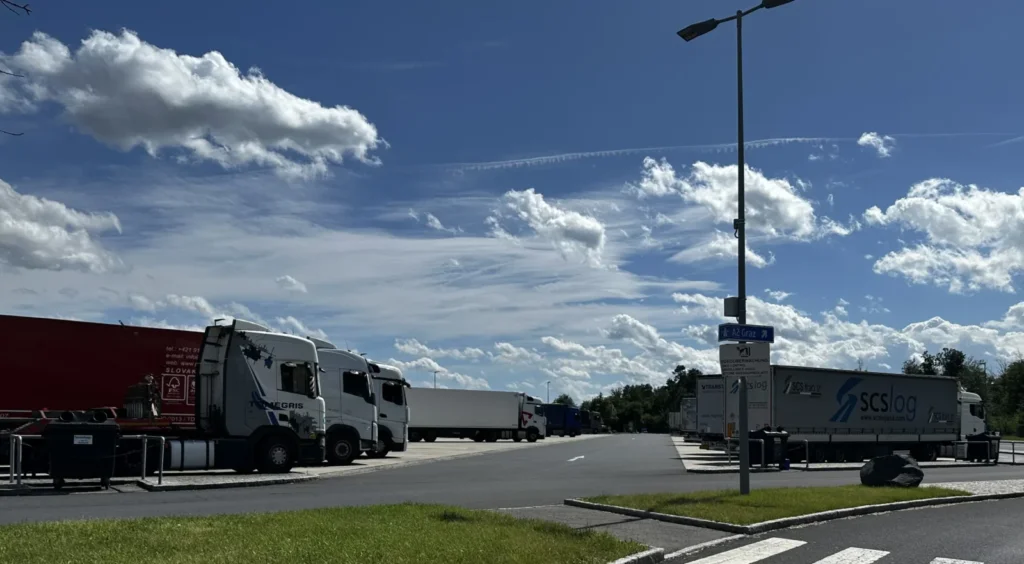
At the same time, the shortage of safe places to stop is becoming more serious. According to the latest European Commission study, the European Union currently has a shortfall of more than 390,000 secure parking spaces for heavy goods vehicles. If investment does not accelerate, the shortfall could reach approximately 483,000 spaces by 2040.
As a result, thousands of drivers every day have no choice but to stop in locations that offer inadequate protection for themselves or the cargo they carry.
This is not merely an infrastructure issue. It is also a matter of personal safety. The European Commission report found that 79% of professional drivers had experienced danger or an unsafe situation while stopped, while just 9% believed European truck parks offered an adequate level of security.
It is difficult to get proper rest when a driver spends the night worrying that someone may be trying to break into the trailer instead of recovering for the next leg of the journey.
Drivers are not security guards
Many companies provide mandatory training on occupational safety, working hours, transport regulations and vehicle operation. That is the necessary foundation.
But when was the last time drivers received an update on how organised crime groups operate today? Can they recognise the signs of a cargo theft scam? Can they spot suspicious behaviour in a parking area? Do they know what to do if someone claims to be a police officer or another official? Are they prepared to respond to an attempted robbery? Most importantly, do they understand that their own safety matters more than the load in these situations?
That last point may be the most important. Many drivers feel deeply responsible for the cargo they transport. They want to do their job properly and may believe they must do everything possible to protect the load. As a result, some may attempt to intervene or take actions that put their health, and potentially their lives, at risk.
Companies must not allow that expectation to develop. A driver is not a security guard. Drivers are not equipped or trained to confront organised criminal groups, nor do they have the tools or authority to take on that role.
Their responsibility is to recognise the threat, remain calm, activate the appropriate procedures and call for help as quickly as possible — not to apprehend the perpetrators.
Technology cannot replace human judgement
Driver safety should therefore be one of the pillars of every transport and logistics company’s security strategy.
Training on cargo theft, criminal tactics, safe parking, incident response and crisis communication should not be a one-off exercise during onboarding. It should be an ongoing process that evolves as the threats change.
Companies regularly invest in new monitoring systems, telematics and vehicle security measures. They should invest in their people just as consistently. Even the best technology cannot make a decision for a driver standing alone in a parking area in the middle of the night.
If companies expect drivers to share responsibility for protecting cargo worth hundreds of thousands of euros, they must provide more than the right tools. Drivers also need knowledge, clear procedures and reliable support.
Companies cannot demand responsibility without providing proper preparation. Cargo can be insured. A vehicle can be repaired. Goods can be replaced. A driver’s life and health cannot. That is the principle every discussion about transport security should begin with.
This article is part of an ongoing series examining the growing problem of cargo theft and security in the transport industry. The series explores how criminal groups operate and how companies can protect both their loads and their drivers. Find all the articles under the #TransportSecurityInsights tag.