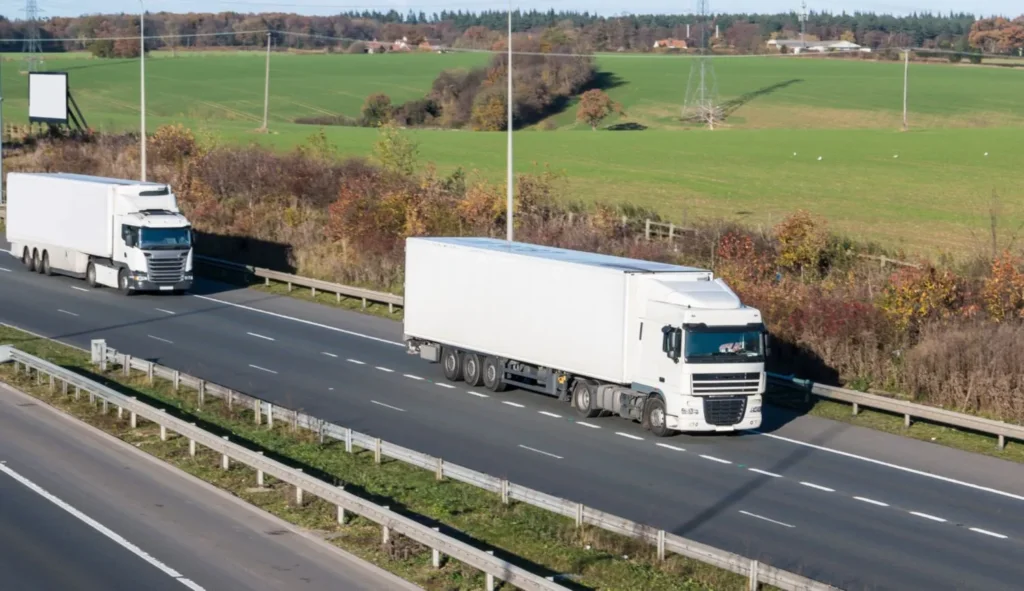
What started as a money-saving detour has turned into a traffic problem. According to the Lanaken–Maasmechelen police, trucks from across Europe have been heading to the Oude Bunders industrial area to fill up, causing serious congestion on roads leading to the pumps. The local force says this is no longer just about Dutch motorists crossing the border for cheaper fuel; it is mainly lorries that are now creating the biggest bottlenecks.
View Larger Map
The situation became serious enough for the federal police to report “monster queues” on the right-hand lane of the E314. Local police say a more drastic measure, a permanent closure of the exit from the Netherlands, is even being considered as an emergency option, although they want to avoid that if possible. Their answer for now is to set up a managed truck buffer zone on the industrial estate so lorries do not keep piling up on surrounding roads.
Police say they will also discourage more trucks from entering during busy periods, monitor traffic actively to reduce the risk of dangerous situations, and use diversions where needed to spread the flow more safely.
The Dutch side: hauliers are already changing how they drive
The Belgian queues are only one sign of the pressure. In the Netherlands, hauliers are already changing day-to-day operations as diesel prices bite. According to TLN, some Dutch truckers have started lowering cruising speeds to reduce fuel burn, while others are paying closer attention to tyre pressure and switching to more efficient tyres to cut consumption.
UnitedConsumers listed the Dutch national recommended average diesel price at €2.682 per litre on 23 March 2026, calling it the highest level in its data series.
The fuel-saving logic is simple. According to Volvo Trucks, driving at 85 km/h instead of 90 km/h can cut fuel consumption by about 3.5%, while reducing speed further from 85 km/h to 80 km/h can lower it by another 2–3%. In a sector with tight margins, that is enough to change behaviour.
Fuel-price gaps are redrawing truck routes
What is happening in Maasmechelen is not an isolated case. Fuel tourism had already started taking hold in other parts of Europe last week, as widening diesel price gaps began pulling vehicles away from higher-cost countries and towards cheaper neighbouring markets.
One of the clearest examples was Slovenia. As Trans.INFO reported earlier, the country capped diesel at €1.528 per litre from 10 March after cutting excise duty, while self-service diesel on ordinary roads in Italy had climbed to €2.072 per litre by 16 March. That left a gap of around 50 cents per litre, with peaks above 60 cents between stations only a few kilometres apart.
For hauliers, that is not a marginal difference. A truck taking 600 to 800 litres could save roughly €240 to €400 per stop, with even bigger savings for vehicles with dual tanks. On routes passing through Slovenia, access to cheaper fuel quickly became a real competitive advantage.
A similar pattern emerged on the German–Czech border. Earlier reporting showed that some filling stations in Czechia were experiencing queues long enough to block access roads, with waits of 30 minutes or more. At one border station, diesel was reported at around CZK 38 per litre, compared with roughly CZK 54 at a nearby German station. In some areas, traffic near filling stations was said to have tripled within a week.