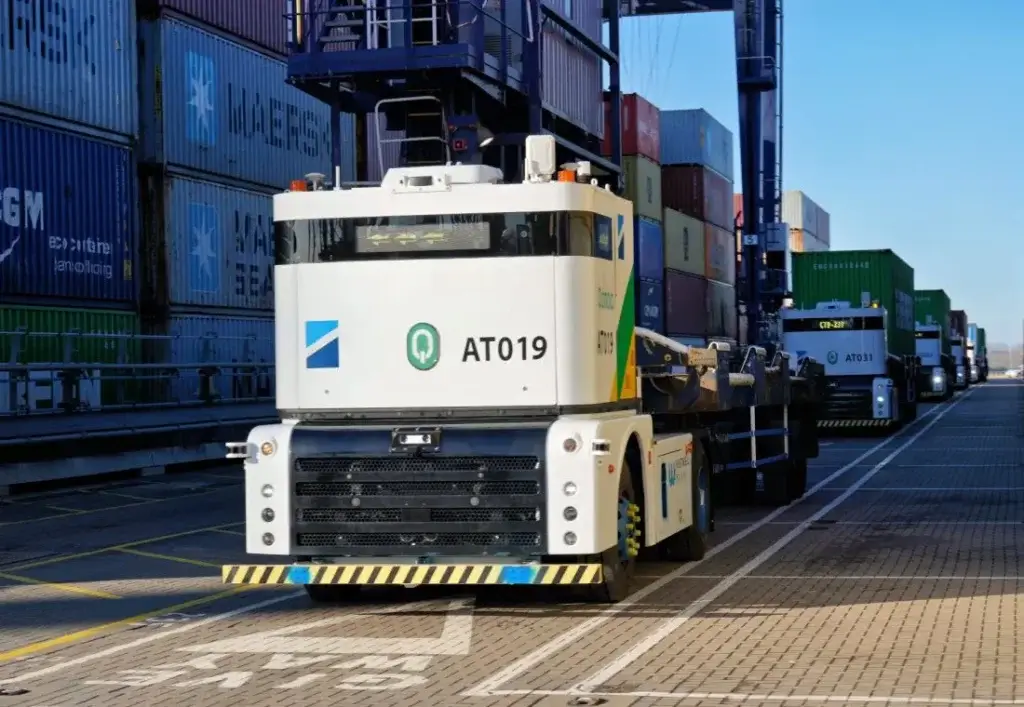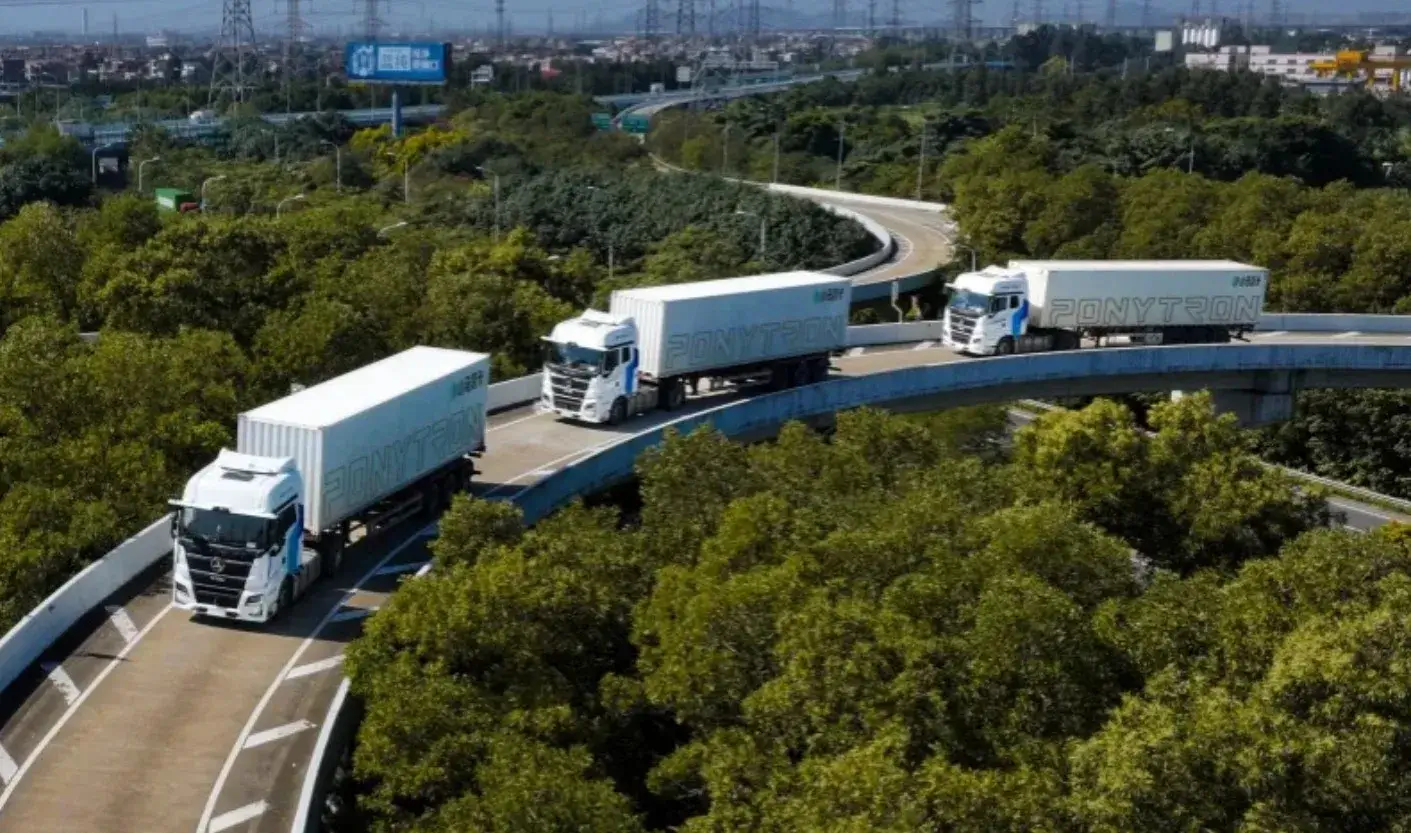

This isn’t full autonomy yet. Instead, it’s designed to fit today’s legal realities while still taking advantage of driverless technology. The practical shift is from hands-on driving of one truck to supervising an entire convoy and stepping in where rules require a human in control.
A 1+4 convoy as a workaround for driver shortages
In the system developed by SANY and Pony.ai, the first truck is driven by a human, while four additional vehicles run in autonomous mode and trail the lead unit.
The concept is mainly about operations. In many countries, regulations still don’t allow fully driverless heavy trucks on public roads. A 1+4 convoy makes it possible to introduce automation within the existing rulebook — without waiting for immediate legal changes.
According to figures shared by the developers:
- the cost per kilometre could drop by as much as 29 percent,
- and operating profit could increase by 195 percent.
The solution is aimed primarily at predictable, repeatable routes — such as port drayage and fixed regional lanes.
From driver to convoy operator
What changes most in this model is the human role. Instead of focusing on one vehicle, the person in the lead truck supervises the performance of the whole set.
In practice, that means moving from five separate driving jobs to a single convoy operator — while still keeping human oversight where regulations demand it. The autonomous trucks handle the driving task, and the human takes on a supervisory and decision-making function.
Built around redundancy and safety systems
SANY’s fourth-generation trucks are based on a drive-by-wire architecture with full redundancy in key systems. Steering, braking, power supply, communications and sensors all have backup modules.
If one component fails, a secondary system is designed to take over its function.
The vehicles are equipped with:
- batteries with capacity above 400 kilowatt-hours,
- a camera and radar suite that monitors the surroundings in real time,
- systems that enable regenerative braking.
Testing has included, among other things, extreme temperatures and electromagnetic compatibility.
Decarbonisation is part of the plan
Each fully electric vehicle could cut carbon dioxide emissions by around 60 tonnes per year. Across a fleet, that translates into a meaningful reduction in the carbon footprint of road transport.
The project is being developed with Sinotrans, China’s largest logistics operator, to help ensure the technology matches real operational use cases.
China accelerates the push toward autonomy
SANY and Pony.ai have been working on the joint programme since 2022 and are now moving toward production readiness. The first truck batches are expected to reach the market in 2026.
Globally, the pace of adoption varies widely. In the United States, debates continue around autonomy levels and the safety of driver-assistance systems, while in China the technology is moving into industrial deployment.
Europe’s earlier lessons: platooning as a transitional step
Road convoys aren’t a new idea. In Europe, MAN and DB Schenker tested platooning back in 2017 on Germany’s A9 motorway, examining how trucks could be linked into an electronically coordinated convoy. At the time, the big questions centred on the future of the driving profession, the technical changes needed in vehicles, and how law would have to evolve.
A few years later, trials highlighted the limits of that approach. Manufacturer analyses suggested real-world fuel savings were lower than expected, and keeping a stable convoy in live traffic proved difficult. As a result, some players — including Daimler Truck — began shifting attention away from platooning and toward full level 4 autonomy.
Road freight is in a transition phase
The 1+4 system fits a moment when road transport isn’t ready for full autonomy, but is increasingly using automation to cut costs and raise productivity.
From a European perspective, projects like the SANY–Pony.ai convoy underline that the debate is no longer whether automation will arrive — but what form it will take, and how drivers will remain part of the transport system.
In that context, AI is also becoming a lever for network optimisation and cost efficiency alongside vehicle autonomy.


![Costs up 11%, rates up 5%: FarEye’s Suryansh Jalan on the hidden “inefficiency tax” in Europe’s last mile [INTERVIEW]](https://cdn-trans.info/uploads/2026/10/264940df8e8870b74281e69aeac-1024x769.webp)