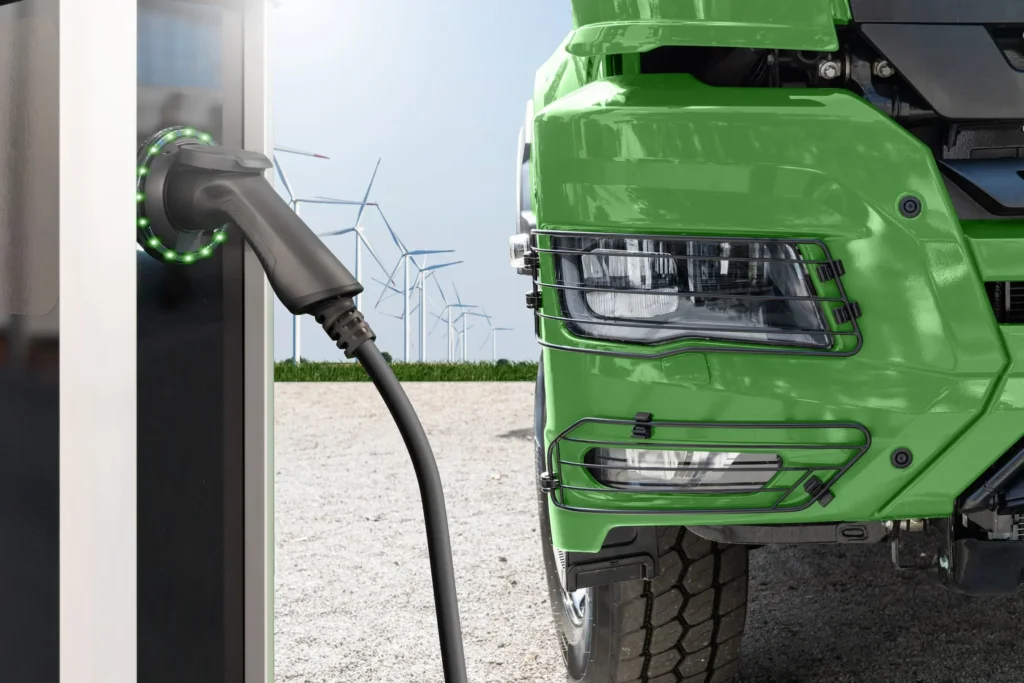
The transition to electromobility raises major questions for the transport sector. Transport companies, hauliers and fleet managers in particular want to know: is switching to electric drives worthwhile? According to a recent analysis by Greenflash, a provider of intelligent energy systems, electric trucks offer clear economic advantages over diesel vehicles in the medium term.
Higher acquisition costs, but lower running costs
According to Greenflash, producing a diesel truck generates around 27.5 tonnes of CO₂, compared with around 53.6 tonnes for an electric truck. However, the initially poorer climate balance becomes positive after 33,000–68,000 kilometres, depending on the electricity mix. More decisive, though, are the ongoing costs.
A diesel truck incurs operating costs of around €60 per 100 kilometres, while an electric truck costs approximately €36.60. If the operator uses its own electricity supply, the amount decreases even further. With a consumption of 200 kWh per 100 kilometres, Greenflash calculates electricity costs of just €16 — a difference of €44 per 100 kilometres compared with diesel.
Practical comparison: eActros vs Actros
A practical calculation has been provided by the logistics company Dachser, which compared the daily costs of a Mercedes eActros 600 (electric) with a Mercedes Actros V 2545 (diesel).
| Cost category | Mercedes eActros 600 (€) | Mercedes Actros V 2545 (€) |
| Acquisition | 267.6 | 177.3 |
| Fuel/energy | 220.6 | 251.1 |
| Toll | 0 | 221.1 |
| Total per day | 488.2 | 649.5 |
The electric truck cost €521.40 per day, compared with €649.50 for the diesel. The largest differences were in toll charges (€00.00 vs €221.10) and energy consumption (€220.60 vs €251.10).
Overall, the electric truck delivered a monthly saving of more than €3,225. Extrapolated over a year, Dachser reports annual savings of more than €38,700.
A calculation with many variables
When the switch pays off depends largely on the operational profile. According to Greenflash, electrification becomes economically viable after three to four years in regional transport and after five to seven years in long-distance operations.
Government subsidy programmes and the CO₂ levy — which will rise to €55 per tonne in 2025 — accelerate amortisation. The increasing use of CO₂-based tolls also acts as a strong cost lever.
Intelligent systems as the key
However, replacing vehicles alone is not enough. According to Greenflash, full economic benefits are only achieved when electric trucks are integrated into an intelligent energy system. Such systems link together solar installations, charging stations and battery storage to supply electricity cheaply and efficiently.
This can reduce electricity costs to between 4 and 12 cents per kilowatt-hour — a clear advantage over grid electricity prices.
Charging infrastructure remains a challenge
Despite the advantages, significant obstacles remain. Charging infrastructure still needs expansion in many regions. For smaller companies with limited space or insufficient grid capacity, electrification becomes a logistical challenge.
Vehicle availability is another factor: delivery times for electric trucks can exceed a year, delaying fleet transitions.
Caution rather than euphoria
Electric trucks can become an economic advantage if planning, energy supply and vehicle selection are carefully aligned. According to Greenflash, an intelligent, integrated system provides the best conditions for reducing operating costs in the medium term while meeting regulatory requirements. Hauliers should therefore treat electrification as a long-term strategic investment — not a short-term trend.