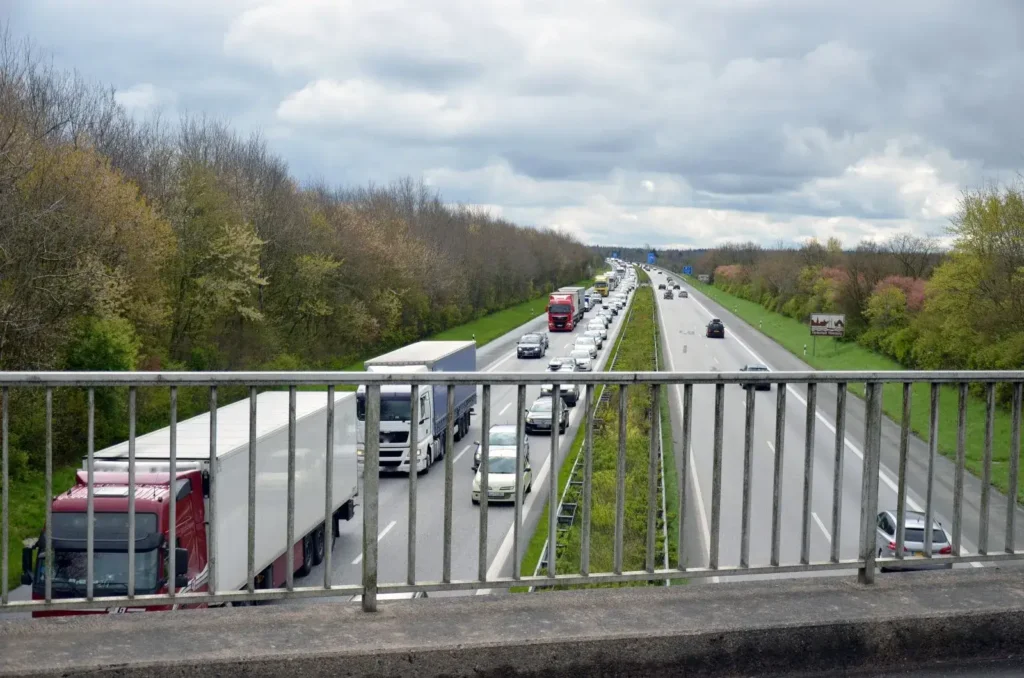
The refund applies to motorway tolls for journeys made between 1 January and 31 December 2025 with vehicles used for goods transport. However, only vehicles in environmental class Euro V, Euro VI or higher, as well as alternatively fuelled or electric vehicles, are eligible.
The vehicles must also fall within the relevant motorway toll classes. For axle- and profile-based classification, eligible vehicles are those in classes B, 3, 4 or 5. Where volumetric classification is used, the eligible classes are 2, 3 or 4.
Euro IV and older vehicles are therefore excluded from the scheme.
Foreign operators are explicitly included
The Italian resolution makes clear that the refund can be requested not only by hauliers registered in Italy, but also by foreign operators.
Eligible applicants include road haulage companies or groupings based in another EU member state that hold a Community licence under Regulation 1072/2009. Swiss operators with a Swiss licence issued under the EU–Switzerland road transport agreement are also included, as are UK-based operators holding a licence issued under Regulation 1072/2009.
The scheme also covers own-account transport operators based in another EU country, Switzerland or the United Kingdom.
Applicants must enter the registration number and Euro class for both Italian and foreign-registered vehicles. For foreign plates, the issuing country must be specified. If the vehicle is registered outside the EU, the applicant must upload a PDF copy of the registration document and the document authorising travel in Italy.
For EU-registered foreign vehicles, the declared Euro class will be checked against the EUCARIS vehicle register. If the declared class differs from the register data, the register data will be used for the procedure.
Minimum toll spend: €200,000
The measure is aimed at operators with substantial motorway use. To qualify, applicants must have at least €200,000 in eligible 2025 motorway toll costs, excluding VAT.
The refund is calculated on tolls paid through recognised deferred-payment providers. The resolution currently names AS 24 Italia, Axxes, DKV Euro Service, Telepass and Unipoltech as the recognised providers.
Refund rates depend on Euro class and toll spend
The percentage reduction depends on the operator’s annual toll spend and the environmental class of the vehicles used.
According to TrasportoEuropa, for Euro VI, higher-class, electric or alternatively fuelled vehicles, the theoretical reduction starts at 5% for companies with €200,000–€400,000 in eligible toll turnover. It then rises to 7% for €400,001–€1.2m, 9% for €1.2m–€2.5m, 11% for €2.5m–€5m and 13% above €5m.
For Euro V vehicles, the rates are two percentage points lower: 3%, 5%, 7%, 9% and 11% across the same turnover bands.
The reduction cannot exceed 13% of eligible toll costs. The resolution also provides an additional night-time element for operators that made at least 10% of their eligible toll turnover during the night, defined as motorway entry after 22:00 and by 02:00, or exit before 06:00. However, the 13% overall cap still applies.
The final percentages may still be adjusted. If the total amount of eligible reductions exceeds the available resources, the Central Committee will apply a coefficient to bring the payments within the available budget. If applications do not exhaust the fund, the percentages may also be recalculated.
Application dates
The application procedure is split into two phases through the PEDAGGI online system on the national road hauliers’ register portal.
The first phase, for reserving the application, opens at 09:00 on 3 June 2026 and closes at 14:00 on 9 June 2026.
The second phase, for entering the application data and signing and submitting the application, opens at 09:00 on 23 June 2026 and closes at 14:00 on 22 July 2026. However, because the PEDAGGI system processes data asynchronously, the final deadline for entering phase-two data is 21 July 2026; the 22 July deadline applies only to digital signature and submission.
Applications must be digitally signed by the applicant’s legal representative or authorised person, and stamp duty must be paid through PagoPA. Failure to comply with even one of the required procedural steps makes the application inadmissible.