
The financial reality of transport is harsh: fuel, tolls, wages and leasing need to be covered right away, while payment for a completed job can take weeks. As many as 85 percent of Polish transport companies say that payment terms longer than 30 days put their business at real risk.
The situation is made worse by uneven contract penalties — 76 percent of carriers say they regularly receive penalties for events outside their control — and by practices that start the payment period only after paper documents are delivered, something experienced by up to 96 percent of companies. The result is that even a well-run business can be pushed to the edge without having done anything wrong. This is the gap SafePay was designed to address on Trans.eu.
How does SafePay work in practice — from accepting the load to getting paid?
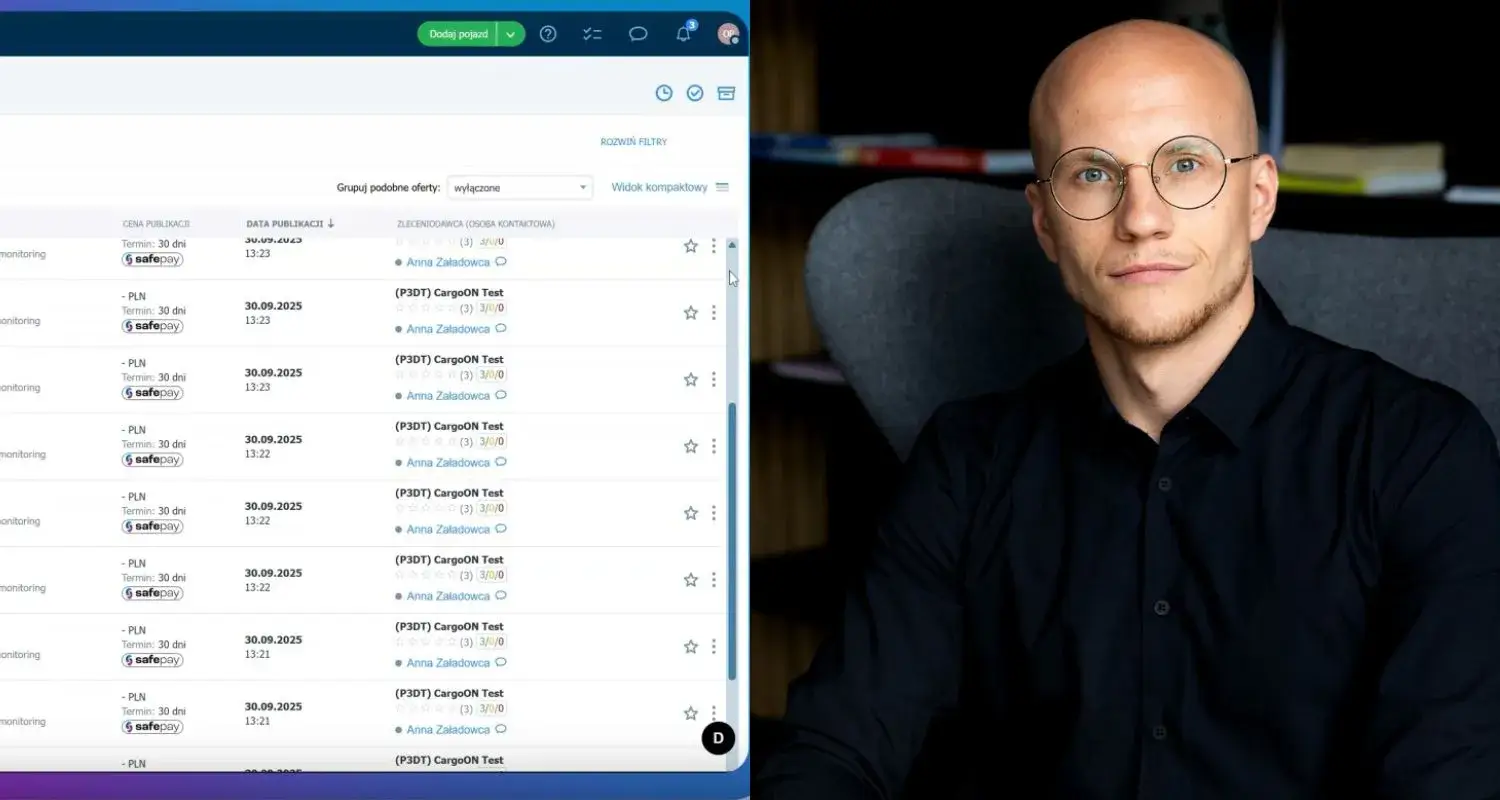
Damian Michalecki, Sales Customer Success & Marketing Field Leader at Pactus.eu: The key part happens even before a carrier applies for a payout — and in fact before the deal is made. It starts with verifying the customer’s payment reliability. Only after a positive assessment does the customer receive the SafePay label, visible next to their load offers on the platform.
If a carrier isn’t paid on time and submits a request to use the guarantee, we check whether the claim matches the facts: whether the transport was completed, whether the case is not in dispute, and whether the payment due date fell no more than 21 days before the request was filed.
When these conditions are met, Pactus.eu — on behalf of Trans.eu — presents the guarantee amount, and once it’s accepted, pays the carrier at least 90 percent of the freight value. After that, we contact the debtor ourselves to recover the amount and agree a realistic repayment date.
You guarantee 90 percent of the freight value with no upfront fees for the carrier. Where does the difference come from, and how do you make money from it?
SafePay isn’t designed as a purely commercial service — the goal is to protect platform users, not to generate profit for Trans.eu. The remaining 10 percent reflects the cost of taking responsibility for the counterparty’s insolvency risk. We take that risk on so the carrier can keep operating without the fear of losing liquidity.
Is the payout always 90 percent, or does it depend on the customer profile?
Ninety percent is the guaranteed minimum. The payout can be higher if the payer’s profile doesn’t indicate a high insolvency risk, but rather a temporary issue or a minor delay. We assess each case individually.
We also know speed matters — by the time a request is submitted, the invoice is already overdue. That’s why we treat every application as a priority.
The fastest payout so far took 2.5 hours from registering the request to initiating the bank transfer. The review time depends on the specifics of the case, so it can be longer in some situations — but fast handling is one of the core elements of the service.
How many companies can use SafePay today? Is it aimed at a specific group of carriers?
Around 60 thousand companies active on Trans.eu can currently use the guarantee payout option. We don’t limit access to a single group — SafePay is available to any load contractor, regardless of company size.
We also recognise that many businesses operate both as customers and as contractors. The intention was to build a universal solution that supports the entire transport ecosystem, not just one segment of it.
What share of loads on the platform are already covered by SafePay?
According to platform data, nearly two out of three load offers on Trans.eu now carry the SafePay label. It’s a clear sign of how quickly financial security is becoming a priority in transport.
We see this as the beginning of a broader shift in market standards. The ambition is that, in the near future, most loads will be posted by verified users, and mechanisms like SafePay will become a natural part of every transaction — a new safety baseline for the TSL sector.
How do carriers respond to SafePay? What concerns do they have, and what convinces them?
From interviews with carriers who used the guarantee and received a payout, we haven’t seen concerns. On the contrary, many were pleasantly surprised that cases they considered hopeless ended with payment. They most often highlighted three things: speed, the simplicity of the process, and the payout level — which helped them maintain liquidity.
It’s also worth noting that fewer applications from many users doesn’t mean the service lacks value — often it’s the opposite. SafePay-labelled counterparties tend to meet their payment obligations because they’ve been verified. In that sense, the guarantee also works as prevention.
How do customers react? Do they see it as extra friction, or as something valuable?
Customers’ response has been clearly positive. Since the programme has been communicated more widely, we’ve received hundreds of requests for verification and inclusion. Some companies have even publicly shared their status as reliable payers on social media.
That shows customers understand what the SafePay label signals — not only added security for carriers, but also a credibility marker for the wider market. Payment reliability is becoming a competitive advantage, not just a matter of good practice.
There are similar solutions on the market, for example on Timocom or Teleroute. What makes SafePay different?
The main difference is the financial model. Some solutions charge the carrier a fee that can range from 1.7 percent up to 4.99 percent of the freight value depending on the payment term. With low margins typical in transport, that cost can wipe out the profit from a job. SafePay works differently: the guarantee comes with no upfront cost for the carrier. For companies operating close to the profitability line, that distinction is fundamental.
Does SafePay apply only to jobs agreed on Trans.eu?
Yes. To use the guarantee, both parties must have concluded the transaction on Trans.eu. It’s available exclusively to platform users. We want membership in our ecosystem to mean more than access to loads — it’s also about financial security at every stage of cooperation.