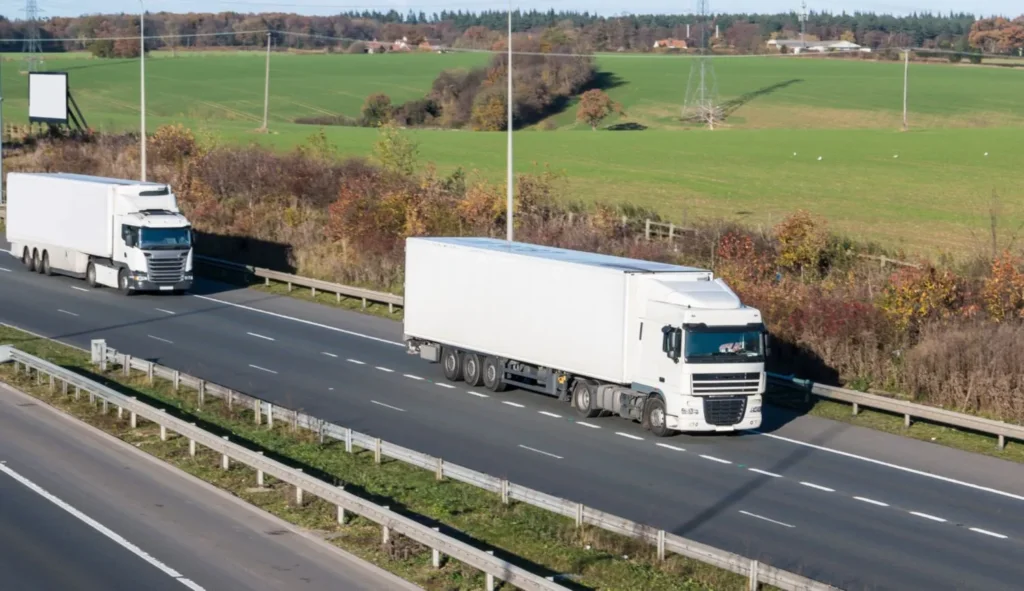
A striking example emerged on Monday on the A14 motorway, where, according to mdr.de, drivers of oversize trucks were forced to stop in prohibited locations because they could not find a legal place to pull over within the required driving time.
Three oversize vehicles stopped on the hard shoulder
On Monday morning, three oversize vehicles stopped on the hard shoulder of the A14 near Halle, in Saxony-Anhalt, because their drivers were unable to find a legal stopping place when they needed to take the break required under drivers’ hours rules. In the case of abnormal loads, this poses a serious road safety risk.
Industry experts stress that, particularly for oversize vehicles, any unplanned stop on motorway infrastructure can create major hazards, both for drivers and for other road users.
Service areas already full by the afternoon
According to figures cited by German industry organisations, the country is short of around 40,000 truck parking spaces. In practice, this means that drivers often begin looking for somewhere to take their mandatory break as early as the afternoon, with the search continuing late into the evening.
As the Bundesverband Güterkraftverkehr, Logistik und Entsorgung (BGL) points out, drivers are increasingly being forced to choose between breaking the rules and stopping in places not intended for parking.
At the same time, regulatory pressure is increasing. Across Europe, rules on driving and rest times are being enforced ever more strictly, while infrastructure remains inadequate.
€70 and penalty points for parking on the motorway
German rules are clear on this issue. Stopping and parking on the hard shoulder of a motorway is prohibited. However, the penalties for doing so remain relatively low.
According to Germany’s schedule of fines (Bußgeldkatalog):
- parking on a motorway or expressway: €70 and 1 penalty point
- driving on the hard shoulder, for example in order to stop or move off again: €75 and 1 penalty point
For more dangerous manoeuvres, the penalties are significantly higher:
- turning around, reversing, or driving the wrong way on an entry or exit slip road: €75 and 1 point
- on the hard shoulder or a service road: €130 and 1 point
- on the main carriageway: €200, 2 points and a one-month driving ban
In practice, this means that even a truck forced to stop on a motorway may still face a fine and penalty points unless the situation qualifies as a breakdown-related exception.
A structural lack of parking
The problem is not that drivers are unaware of the rules, but that they often have no alternative. They are left to choose between breaching parking rules and violating drivers’ hours regulations. The pressure is particularly acute in international transport, where schedules are tight and delays quickly build along the route.
Experts have been warning for years that Germany’s shortage of truck parking infrastructure is structural. In practice, this means that even drivers trying to comply fully with the rules may have no physical way of doing so.
The German motoring organisation ADAC warns that improperly parked trucks on motorways, including oversize vehicles, pose a real danger to traffic, especially at night and in poor visibility.
The result is a transport system operating under growing tension between legal requirements and operational reality. Cases such as the one on the A14 show that this gap is increasingly becoming visible at some of the most critical points on Germany’s road network.