Key takeaways:
- The tractor unit’s roadworthiness inspection expired in March 2026.
- The trailer has been without a valid inspection since July 2025.
- Police reported a brake system leak, a damaged air spring, faulty lights, an ABS fault and a tyre with exposed cords.
- Officers identified 19 infringements of driving and rest time rules.
- The entire vehicle combination was immediately removed from traffic.
- The trailer was given WOK status and can only return to the road after repairs and re-approval.
- According to police, the serious offences mean the carrier will receive several ERRU penalty points.
- If points accumulate, the company’s “good repute” and its transport licence may be called into question.
The Hague traffic police say the stop is a reminder that poor vehicle maintenance can have consequences beyond a roadside prohibition and a fine. When major technical faults coincide with repeated breaches of social rules, the fallout can reach a carrier’s compliance record and, in extreme cases, affect its ability to keep operating.
A combination that shouldn’t have been on the road
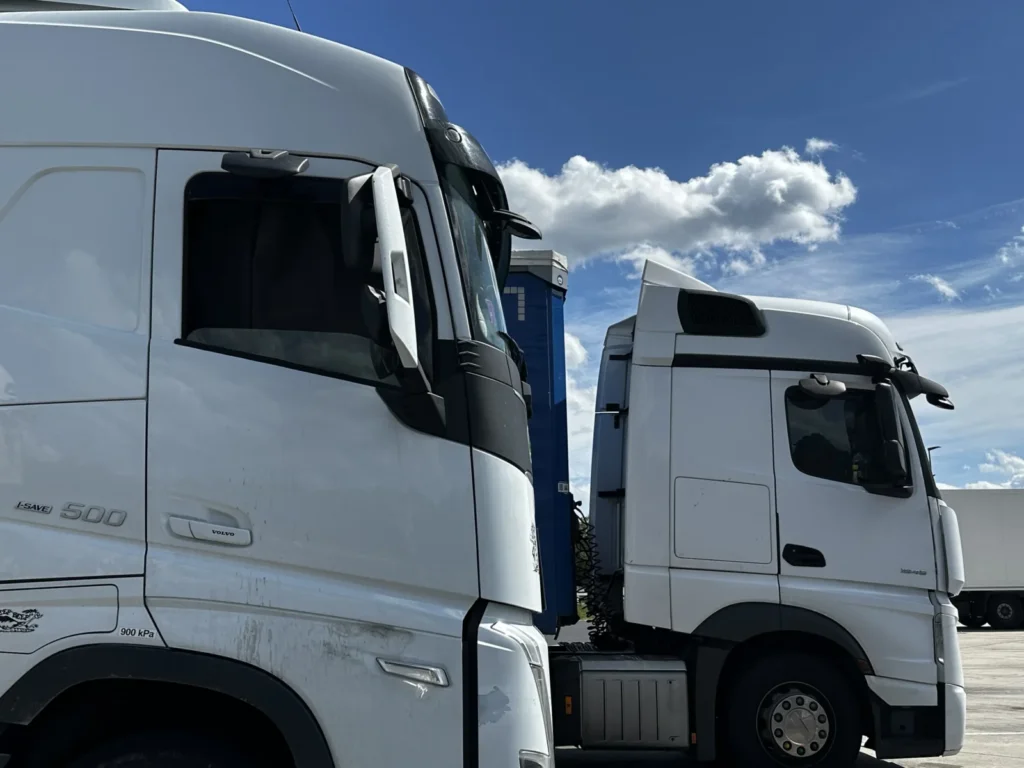
Officers stopped a Scania tractor unit with a trailer on the A4. The inspection showed that neither the tractor nor the trailer had a valid roadworthiness inspection.
Police said the tractor unit’s inspection expired in March 2026, while the trailer had not been inspected since July 2025.
The paperwork was only part of the problem. Officers also noted:
- A leak in the braking system.
- A damaged air spring.
- A tyre with visible cords.
- Faulty lights and lighting fixtures.
- An active ABS system fault.
With defects affecting brakes, suspension, tyres and ABS, the vehicle combination posed a serious road safety risk.
Police added that an unsafe vehicle combined with a fatigued driver creates an especially dangerous situation on the road.
Trailer given WOK status
Because of the defects found, the trailer was assigned WOK status (“waiting for inspection”). In practice, that means it is barred from traffic and can only return once the faults are repaired and the vehicle is re-approved by the Dutch RDW authority. The vehicle combination was stopped immediately.
Police also prepared a report against the carrier for operating professional road transport with a vehicle that lacked a valid inspection and had serious defects. A separate administrative report was drawn up covering the breaches of driving and rest time rules.
The driver received several separate reports. The exact level of penalties was not disclosed.
Nineteen drivers’ hours infringements
The roadside check also covered compliance with social regulations. Officers found 19 infringements related to driving and rest times.
Police said the number of infringements suggested this was not an isolated lapse. Combined with the vehicle’s technical condition, the consequences for the carrier may extend beyond financial penalties.
The Hague traffic police described the mix of operating an unroadworthy vehicle and driving while fatigued as an extremely dangerous combination. They also signalled continued enforcement, including in the interests of companies that properly maintain vehicles and comply with working-time limits.
Several ERRU points from a single stop
According to The Hague traffic police, the serious offences uncovered on the A4 will result in the carrier receiving several penalty points in the ERRU system.
ERRU — the European Register of Road Transport Undertakings — allows European Union countries to share information about infringements committed by carriers.
The register covers, among other things, serious technical defects, drivers’ hours and rest-time breaches, overloading and tachograph manipulation.
When serious offences accumulate, authorities may open proceedings to assess whether the operator still meets the “good repute” requirement. If the competent authority concludes the company no longer meets that condition, the Community licence can be suspended or withdrawn.
The point threshold that triggers a mandatory review depends in part on fleet size. Larger fleets have a higher limit, but several serious infringements recorded in a single inspection can quickly worsen a carrier’s position.
Licence risk is not just theoretical
In 2025, the Dutch licensing authority NIWO suspended a company’s Community licence for the first time after the ERRU points threshold was exceeded.
At the time, the Environment and Transport Inspectorate concluded the business had accumulated too many serious infringements and no longer met the “good repute” requirement.
The licence was suspended for six months, and the transport manager was deemed unfit to hold the role for two years. The sanctions were later temporarily halted by a court following the carrier’s appeal, but the decision itself showed Dutch authorities are prepared to go beyond fines.
One inspection, multiple proceedings
Following the A4 stop, the carrier may face consequences for expired inspections, serious vehicle defects and breaches of driving and rest time rules.
The most significant impact, however, may come from the administrative side — ERRU points and a “good repute” review.
A single check can end not only with an immediate driving ban and the requirement to have the vehicle re-approved, but also with fines, register points and an assessment of whether the operator still meets the conditions to operate as a road transport undertaking.
The A4 case underlines a straightforward lesson: delaying inspections and accepting a growing list of defects can cost far more than planned maintenance. When technical shortcomings are paired with repeated drivers’ hours breaches, the issue may no longer be limited to one vehicle, but could affect the future of the entire business, police said. Source: The Hague traffic police via trans.info.