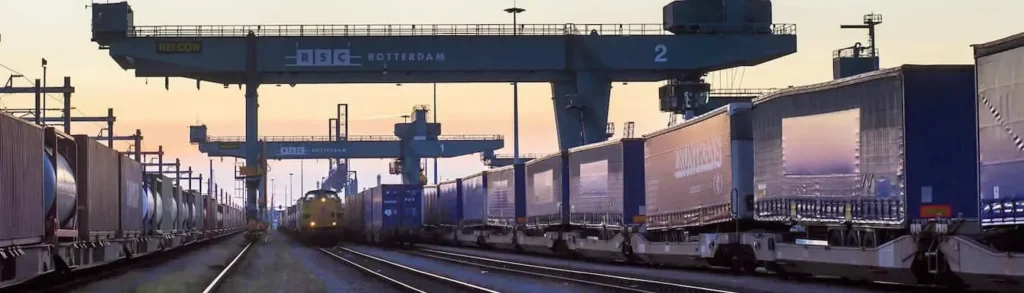
The closure of the Rolling Highway services between Germany and Italy at the end of 2025 has left a tangible gap in transalpine freight capacity, particularly for non-craneable semi-trailers. Against this backdrop, CargoBeamer has launched a new intermodal rail connection between Liège and Domodossola, positioning the service as an alternative route for north–south freight flows across the Alps.
Operations on the new link started last week. Initially, the service will run three round trips per week, with CargoBeamer planning to increase the frequency to six weekly round trips by the second quarter of 2026. At the same time, the company intends to extend the service further into northern Italy.
Filling the post–Rolling Highway gap
The timing of the launch is closely linked to recent structural changes in Alpine freight transport. With the end of the Rolling Highway services, capacity for accompanied transport of non-craneable trailers across Switzerland has disappeared, putting pressure on both road transport and alternative intermodal solutions.
CargoBeamer’s Liège–Domodossola service is designed as a non-accompanied intermodal option, allowing trailers to be transported by rail without drivers or tractors. According to the company, part of the volumes previously carried on the Rolling Highway are expected to shift to this model, which can be scaled by adding train paths rather than road vehicles.
With the new connection, CargoBeamer now operates three transalpine routes on the Rhine–Mediterranean corridor, running more than 50 trains per week across the Alps.
Belgium enters CargoBeamer’s network
The service also marks CargoBeamer’s first entry into the Belgian market. Belgium plays a central role in European freight flows, combining dense road networks with major logistics, port and air cargo hubs. Liège, in particular, has developed into a key intermodal node, serving both continental and UK-bound supply chains.
In Belgium, operations for the new route are handled at the Liège Logistics Intermodal Terminal. On the Italian side, trains are processed at the DB Cargo Transa / FLS Terminal in Domodossola, a long-established gateway for rail traffic crossing the Alps.
Rail traction on the route is provided by BLS Cargo, which operates extensively on transalpine corridors via Switzerland.
Broad range of loading units
CargoBeamer says the Liège–Domodossola service can accommodate a wide range of loading units. These include both craneable and non-craneable semi-trailers, refrigerated units, ADR and tank trailers, containers, swap bodies and other specialised equipment.
This flexibility is central to the company’s model. CargoBeamer’s system is built around specially designed wagons and terminals that allow non-craneable trailers – which still account for a large share of European road freight – to be transferred onto rail without modification.
Per shipment, the company estimates carbon dioxide emissions savings of around 86 per cent compared with diesel road transport. While decarbonisation is a stated objective, the immediate driver behind the new service is capacity and continuity of cross-Alpine freight flows following the withdrawal of Rolling Highway operations.
Industry response to capacity pressure
Commenting on the launch, Boris Timm, chief operating officer of CargoBeamer, said the new connection responds directly to changes in transalpine transport. According to Timm, the transport of non-craneable semi-trailers across Switzerland is undergoing a “paradigm shift” as accompanied services disappear and non-accompanied intermodal solutions take their place.
He added that the Liège–Domodossola route is intended to support forwarders and logistics companies seeking alternatives after the Rolling Highway’s closure, while also establishing a foothold for CargoBeamer in Belgium.
Read more: Electrification, the stiff collar of road transport: uncomfortable, costly, but no longer optional
A shifting Alpine freight landscape
The start of the Liège–Domodossola service illustrates how intermodal operators are adjusting to tightening Alpine capacity and stricter operating conditions. With road transport facing regulatory constraints, driver shortages and higher costs, and accompanied rail services no longer available on key corridors, non-accompanied intermodal links are increasingly being positioned as a practical substitute.
Whether CargoBeamer’s expansion will be sufficient to absorb displaced volumes remains to be seen. What is clear, however, is that the end of the Rolling Highway has accelerated investment and network expansion in this segment of the market, with operators moving quickly to secure paths and terminals along critical north–south routes.