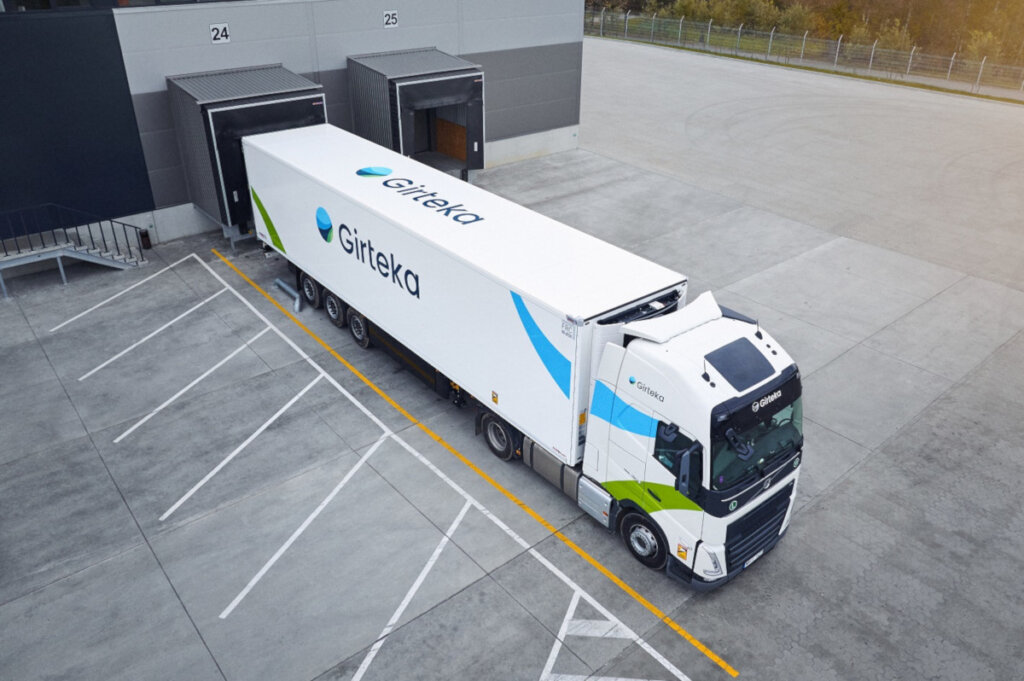
Industrial activity in the eurozone continues to hover on the boundary between expansion and contraction, while demand for transport services remains unstable and exceptionally sensitive to short-term impulses. At the same time, the European market no longer has a surplus of trucks capable of absorbing sudden spikes in volumes. This strain has become one of the defining characteristics of today’s logistics sector.
Limited capacity is the result of years of adjustment
The current decline in available transport capacity is not the result of a single shock. Rather, it reflects a multi-year adjustment process that began after the pandemic and intensified during the economic slowdown of 2023–2024.
During this period, the number of bankruptcies in Europe’s transport and warehousing sector increased by around 180% compared with historical baseline levels. A significant share of small and medium-sized carriers exited the market, while others reduced their fleets or postponed investment.
In practical terms, this meant the disappearance of the traditional “safety buffer” in the form of spare transport capacity. Crucially, capacity is not rebuilding at the same pace as demand. Operators remain cautious about purchasing new vehicles, facing rising regulatory costs and uncertainty around future tolls, new reporting obligations and evolving rules for cross-border transport.
“This isn’t a cyclical problem that will quickly resolve itself,” explains Tomas Šilinikas, Pricing Director at Girteka. “Even when demand weakens, there are no longer enough spare trucks on the market to smooth out fluctuations. That’s why spot rates do not fall the way they used to, despite the fragile state of domestic demand in the European Union.”
Driver shortages increase the pressure
Another factor limiting market flexibility is the persistent driver shortage. In 2024, Europe still faced around 426,000 unfilled driver positions, and the number continues to rise. An ageing workforce and an insufficient inflow of new drivers mean that even when vehicles are available, there are often not enough people to operate them.
As a result, supply-side flexibility remains severely constrained, amplifying volatility and making stable operational planning increasingly difficult.
Volatility as a structural feature of the market
A growing body of data suggests that the current instability is not temporary. Production activity in the eurozone continues to fluctuate around the stagnation threshold, while PMI indicators remain at levels signalling a weakening economic environment. Where economic growth does occur, it is driven mainly by domestic consumption rather than exports, making freight demand highly responsive to even minor shifts in market sentiment.
Cost and regulatory factors further contribute to volatility. Although diesel prices are more stable than during the 2022 energy crisis, geopolitical tensions continue to complicate planning. At the same time, operators are facing mounting regulatory pressure, increasingly described as “regulatory inflation”.
A clear early signal was the rise in tolls in Germany linked to carbon dioxide emissions. By mid-2026, the Netherlands plans to replace the Eurovignette with a distance-based tolling system, with other countries likely to follow. In many markets, tolls already account for around 14% of total transport costs on average, and on some routes as much as 23%.
Added to this are climate-related disruptions — from heatwaves to floods damaging infrastructure — which further increase operational unpredictability.
“Taken together, this shows that volatility is no longer driven solely by demand cycles, but by a complex interaction of economic, regulatory and environmental factors,” Šilinikas concludes.
Resilience instead of reactivity
Under these conditions, resilience no longer means simply reacting quickly to disruptions. Increasingly, it involves designing logistics networks that can absorb shocks without losing stability.
One key element of this shift is a renewed focus on long-term contracts. After spot rates declined at the end of 2025, the gap between spot and contract markets narrowed significantly, reinforcing the value of stable, long-term relationships.
“Long-term contracts are no longer just about price,” Šilinikas emphasises. “They are about guaranteed access to transport capacity. In a structurally tight market, being a preferred partner determines whether goods move smoothly or not.”
At the same time, digitalisation is playing a growing role. Predictive analytics, round-the-clock visibility and scenario modelling help carriers and shippers identify bottlenecks earlier and manage resources more effectively. Pricing models are also evolving, with flexible fuel and toll clauses, as well as shorter tender cycles, becoming increasingly common.
From cost optimisation to risk management
From the shipper’s perspective, market volatility is no longer just about potential cost savings, but above all about the risk of capacity shortages at critical moments. As a result, supply chain resilience is increasingly built through collaboration: joint forecasting, transparent volume commitments and planning that takes account of seasonality, promotions and regulatory changes.
The objective is no longer to secure the cheapest route, but to ensure continuity of deliveries in an environment defined by uncertainty.
Outlook for 2026: more stability, greater complexity
Most indicators point to a slow and gradual recovery rather than a sharp rebound. Economic growth in Europe is expected to remain modest and driven largely by household consumption. At the same time, market complexity is set to increase.
Regulatory costs, emissions reporting, tolling systems and ESG requirements will play an ever greater role in shaping prices and the availability of transport capacity. Companies that delay adapting to these changes risk sudden cost increases or operational capacity shortfalls.
The European logistics market is no longer characterised by simple cycles of boom and bust. Volatility and limited transport capacity are becoming permanent features. In 2026, success will depend on the ability to integrate macroeconomic signals, regulatory change and environmental factors into a coherent, forward-looking strategy.