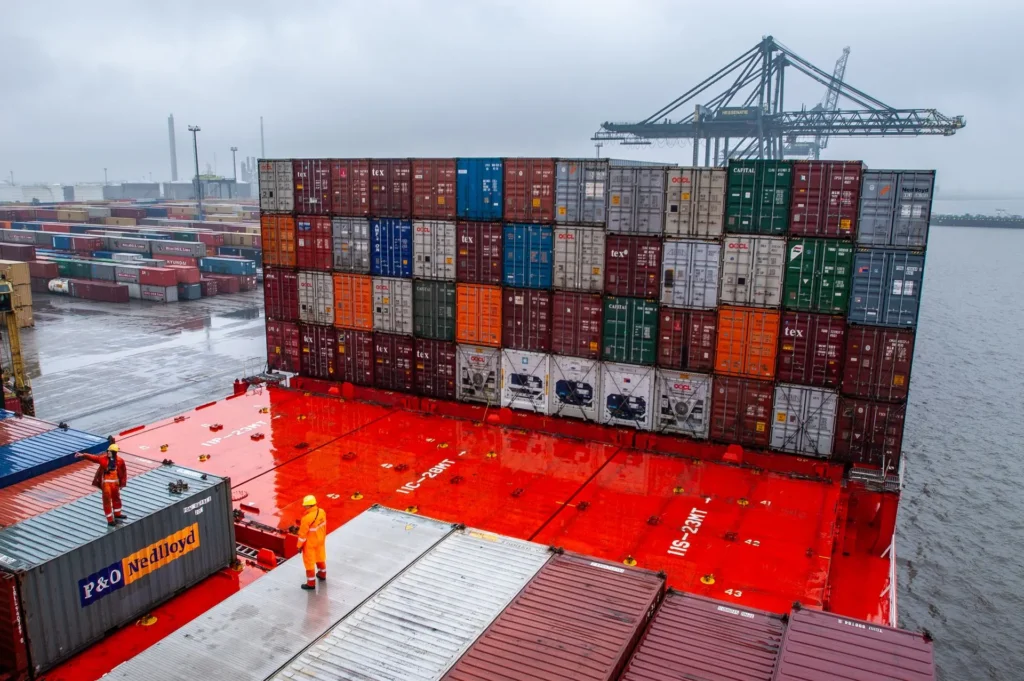
The Drewry World Container Index fell 4% week on week to $4,374 per 40ft container, with the sharpest falls recorded on routes from Shanghai to major US and Mediterranean ports.
Transpacific rates under pressure
Spot rates from Shanghai to Los Angeles dropped 6% to $5,878 per 40ft container, while prices from Shanghai to New York fell 4% to $7,598.
Drewry expects Transpacific rates to remain broadly stable next week, although carriers are set to operate fewer blank sailings. Six cancellations are planned, down from nine this week, meaning more capacity will return to the market.
Backhaul prices were comparatively steady. Rates from Los Angeles to Shanghai rose 2% to $839, while the New York–Rotterdam route increased 1% to $1,050.
Asia–Europe market weakens
Rates on the Asia–Europe trade also moved lower. The cost of shipping a 40ft container from Shanghai to Genoa fell 5% to $5,988, while Shanghai–Rotterdam rates declined 1% to $4,824.
Four blank sailings are scheduled on the Asia–Europe trade next week, compared with two in the previous week. Despite the additional cancellations, Drewry expects softer demand and available capacity to push rates slightly lower.
On westbound backhaul routes, Rotterdam–Shanghai rates remained at $607, while Rotterdam–New York prices eased 1% to $2,635.
Fuel surcharges add to uncertainty
The weakening spot market comes amid continued geopolitical and trade policy uncertainty.
Drewry said tensions between the United States and Iran, alongside concerns over the Strait of Hormuz, had prompted several carriers to introduce emergency fuel surcharges from August 2026.
Further uncertainty surrounds US import policy. The current 10% global tariff is due to expire on 24 July, with new tariffs expected to take effect in early August.
According to Drewry, these developments could continue to influence freight rates in the coming weeks, even as underlying demand and vessel supply place downward pressure on the market.