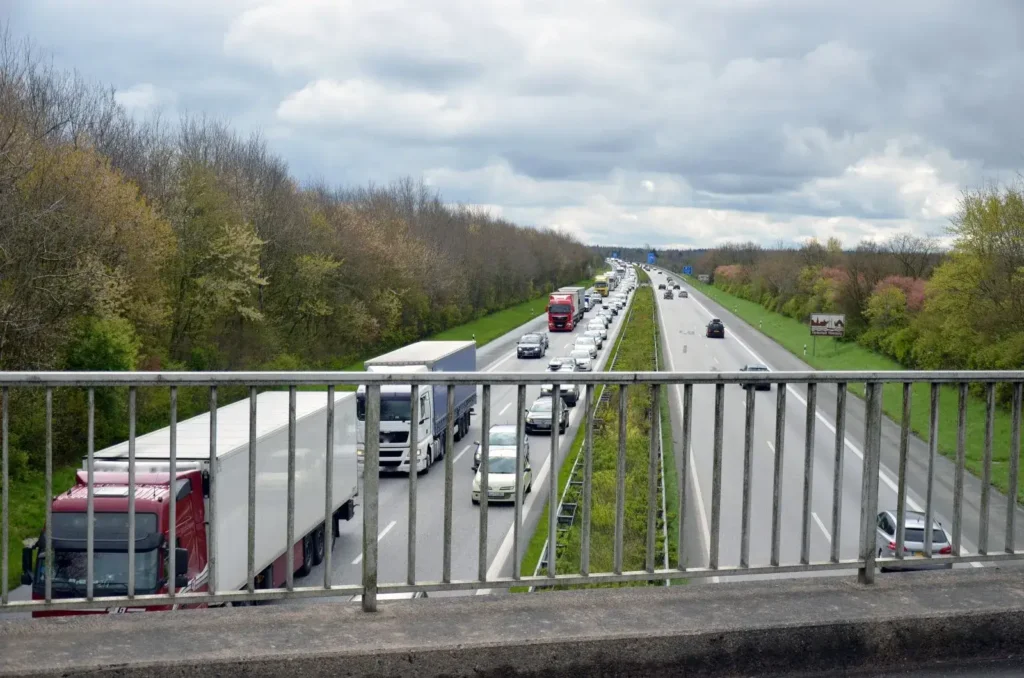
The revised tariff is in line with Czechia’s tightening environmental criteria. For transport companies, this translates into more complex calculation rules and substantial cost variations depending on vehicle characteristics.
Higher fees for trucks – lowest increases on motorways
The most important development for the sector is that motorway tolls for trucks will rise only moderately – by between 0.7% and 1.5%.
Much sharper increases, however, will apply to first-class roads, where the rise will be strongly felt. Rates for trucks on these roads will increase by between 10.2% and as much as 41.8%. This dramatic rise stems mainly from a higher CO₂ surcharge, which has become one of the key components of the toll calculation since last year.
The highest increases will apply to vehicles in the lower CO₂ classes – especially the heaviest configurations with four or five axles.
New toll sections from 2026
The toll system operator has also confirmed an expansion of the toll network. From 1 January 2026, the following motorway sections will be newly subject to tolls:
- D1 Říkovice – Přerov: 10.1 km
- D35 Vysoké Mýto – Džbánov: 6 km
- D35 Janov – Opatovec: 11.7 km
- D35 Hořice – Sadová: 10.45 km
- D35 Křelov – Slavonín 2: 3.2 km
- D55 Olomouc – Kokory: 7.6 km
- D55 Napajedla – Babice (bridge): 0.5 km
This means hauliers operating in Moravia and the Olomouc region will encounter toll-liable stretches more frequently.
Read more: Switzerland retires its truck toll device
Fees increasingly dependent on CO₂ emissions
The updated tariff further strengthens the climate component. Toll rates consist of four elements:
- infrastructure charge
- air pollution charge
- noise charge
- CO₂ emission charge – now the most variable element of the tariff
Vehicles are assigned to one of five CO₂ classes, from class 1 (highest emissions) to class 5 (zero-emission vehicles). In practice, the differences between classes can amount to several tens of per cent, significantly affecting operating costs for hauliers.
How toll rates are structured
The Czech toll system uses a highly detailed matrix. The rate per kilometre depends on:
- road type (motorway or first-class road)
- vehicle category (trucks over 3.5 t; buses)
- emission class (EURO 0–IV, EURO V/EEV, EURO VI, electric and hydrogen vehicles)
- permissible weight (3.5–7.5 t; 7.5–12 t; above 12 t)
- number of axles (2, 3, 4, 5+)
- CO₂ class (1 to 5)
The 2026 rate tables include several dozen entries and are far more differentiated than before. In practice, this means carriers should carefully check the technical data listed in their vehicle documents – in particular the assigned CO₂ class.
The full tariff tables for 2026 are available in several languages on the myto.cz website.