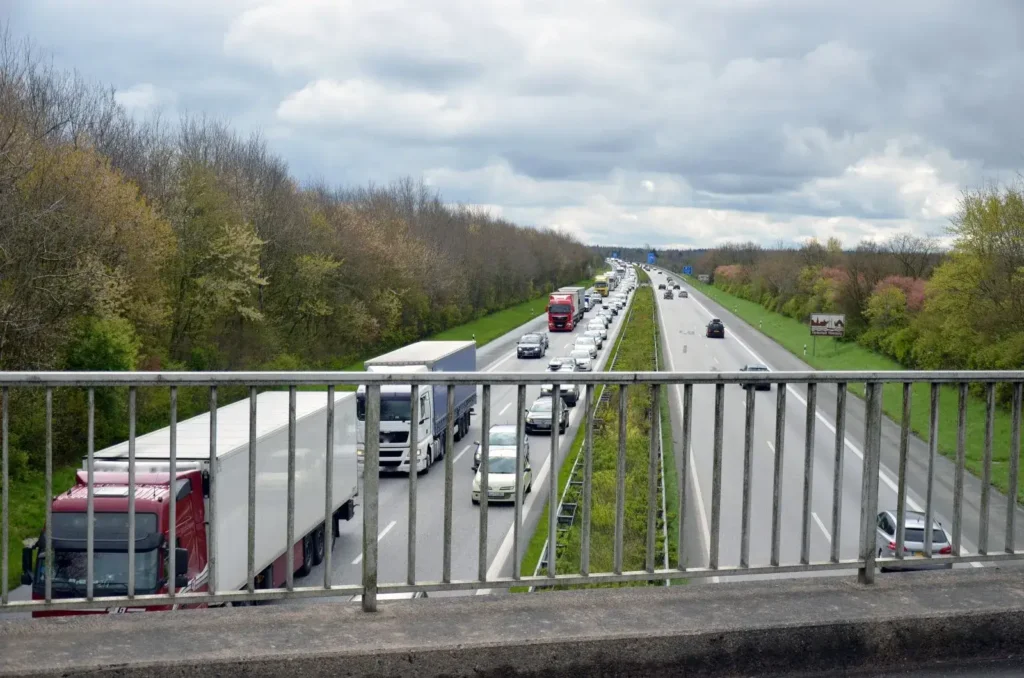
The year 2026 promises to be another turning point for road hauliers in Europe. Toll increases, the abolition of vignettes and new kilometre-based charging systems will affect key markets from Western to Central and Eastern Europe. Although the scale and mechanisms of change vary from country to country, the common denominator remains the same: road transport will pay more, and environmental costs will increasingly be passed on to road users.
Next year, hauliers will face toll increases, the extension of charges to more roads and changes to road charging systems in several European countries. For the transport industry, this means recalculating rates, routes and contract profitability.
Austria: higher emission fees and the end of sticker vignettes
From 1 January 2026, new toll rates for lorries will apply in Austria, depending on the number of axles, CO2 emissions and noise level of the vehicle. The lowest charges apply to zero-emission vehicles – e.g. €5.77 per 100 kilometres for a 2-axle lorry – and the highest to emission class 1 vehicles, up to €61.27.
The maximum fine for toll evasion will increase from €240 to €270. At the same time, traditional adhesive vignettes will be phased out from 1 December 2026 and replaced by a digital version.
The government emphasises that the changes are intended to encourage the use of zero-emission vehicles and the transfer of transport to rail, without increasing taxes. Critics, however, point out that the increases may raise the costs of road transport, including the prices of products transported by land.
Belgium: rate indexing and adjustments for zero-emission vehicles
Belgian toll rates for lorries in 2026: higher charges for diesel vehicles, adjustments for zero-emission vehicles
From 1 January and 1 July 2026, significant changes to the truck toll system will come into force in Belgium. Operators remind that all devices will be automatically updated to calculate tolls correctly from the new year.
In the Belgian region of Wallonia, the toll increase will come into force at the beginning of January 2026. Toll rates are indexed on the basis of the consumer price index for August 2025 and therefore take into account fluctuations in the prices of products and services in Belgium. The average adjustment of the index in January 2026 is +1.91 per cent.
| Vehicle category | Euro 0 | Euro 1 | Euro 2 | Euro 3 | Euro 4 | Euro 5 | Euro 6 |
| Trucks > 3.5 t and < 12 t (€/km) | 0.113 | 0.113 | 0.113 | 0.113 | 0.084 | 0.070 | 0.056 |
| Trucks ≥ 12 t and ≤ 32 t (€/km) | 0.220 | 0.220 | 0.220 | 0.220 | 0.191 | 0.177 | 0.163 |
| Trucks > 32 t (€/km) | 0.251 | 0.251 | 0.251 | 0.251 | 0.222 | 0.208 | 0.194 |
Road toll rates in Flanders and Brussels are indexed annually at the beginning of July.
However, the January increase in Wallonia is not the end of changes to Belgian road tolls. In Brussels and Flanders, rates for zero-emission vehicles will be adjusted from 1 January 2026. The external costs parameter will remain at EUR 0 until the end of 2029, while the infrastructure component will be increased to 80 per cent (after a 100 per cent reduction in 2024-2025). In Wallonia, zero-emission vehicles will remain in the Euro 6 emission category, and toll rates will be indexed by an average of 1.91%, reflecting the rising costs of infrastructure maintenance.
Toll system operators remind users that in order to avoid problems with toll collection, devices should be switched on and updated before using toll roads. The update procedure takes a few minutes at most, and in the case of OBUs that have been inactive for more than six months, several updates will be necessary.
Czech Republic: higher rates and stronger emphasis on CO₂ emissions
From 1 January 2026, a new road toll price list will come into force in the Czech Republic, resulting from the update of Czech Government Regulation No. 240/2014 Coll. The changes include both an increase in rates and an expansion of the network of toll sections, and the emission component will play a key role in the calculation of charges.
On motorways, the increases will remain moderate, ranging from 0.7% to 1.5%. However, much greater changes will affect Class I roads, where toll rates for lorries will increase from 10.2% to as much as 41.8%. Such a high level of adjustments is directly related to the increase in CO₂ emission surcharges, which have already become one of the most important elements of the Czech tariff.
The fees for vehicles with lower CO₂ emission classes will increase the most, especially in the segment of the heaviest combinations and four- and five-axle configurations. At the same time, the system operator has announced that new sections of motorways will be subject to tolls, including the D1, D35 and D55 routes, which will particularly affect carriers operating in Moravia and the Olomouc region.
The new price list further emphasises the ‘polluter pays’ principle. The rates consist of four components: infrastructure charges, air pollution costs, noise and CO₂ emissions – currently the most variable part of the tariff. Vehicles are assigned to one of five CO₂ classes, from class 1 with the highest emissions to class 5, which includes completely zero-emission vehicles. The differences between the classes can reach several dozen per cent, which significantly affects travel costs.
The new rate tables for 2026 include several dozen items and are significantly more diverse than before. For carriers, this means that they will have to carefully verify the technical parameters of their vehicles, in particular the assigned CO₂ class (which can be checked using a calculator).
France: moderate increase but the upward trend continues
From 1 February 2026, French motorway tolls will increase by an average of 0.87 per cent. Motorway concessionaires have proposed adjustments ranging from 0.82 to 0.95 per cent, depending on the network. The changes are in line with long-term concession agreements, which link tolls primarily to inflation and planned investments.
The expected adjustment remains close to inflation in 2025 and well below the Bank of France’s forecast for 2026, which is 1.3%. Compared to previous years, this is one of the mildest increases since the pandemic. For comparison: in 2023, fees increased by 4.75%, in 2024 by 3%, and in 2025 by 0.92%.
Netherlands: end of the Eurovignette and kilometre-based tolling
One of the most systemic changes will be introduced by the Netherlands. From 1 July 2026, the country will abandon the Eurovignette and replace it with a toll based on the number of kilometres travelled and the CO2 emission class of the vehicle. The new system will cover almost all motorways, selected national roads and local sections near large cities.
The system will cover N2 and N3 vehicles with a maximum permissible weight of over 3.5 tonnes, regardless of their country of registration. The amount of the charge will depend on the weight of the vehicle and its CO2 emission class – the lighter and less polluting the vehicle, the lower the rate per kilometre.
The toll rates for 2026 are final and have been set at the prices applicable in 2026. The average rate is 19.1 euro cents per kilometre.
Example rates:
- Euro 6 vehicle with a maximum technical weight of 16 tonnes – 16.0 euro cents/km,
- the same vehicle in a 100% electric version – 3.5 euro cents/km,
- Euro 6 vehicle with a maximum technical weight of over 32 tonnes – 20.1 euro cents/km,
- its zero-emission equivalent – 3.8 euro cents/km.
Once the system is launched, the rates will be adjusted annually for inflation. The amount of the charge will depend on the weight of the vehicle and its CO2 emission class, determined on the basis of data from the RDW register, which is currently being updated. On the RDW website, you will also find a toll calculator.
The new toll system will be fully electronic. Every lorry subject to tolls will have to have an On-Board Unit (OBU) device, which records the kilometres travelled and transmits the data to the service provider. The fee will be calculated automatically – physical gates and traditional toll collection points will disappear from Dutch roads.
Romania: shift from vignette to kilometre-based tolling
From 1 July 2026, Romania will move away from the vignette system for vehicles over 3.5 tonnes and introduce the TollRo electronic toll, based on the ‘pay as you go’ principle. The system will cover motorways, expressways, European routes and key routes outside cities.
Below are the proposed toll rates for lorries according to weight and emission class:
| Maximum GVW | Euro 6 (RON/km) | Euro 5–4 (RON/km) | Euro 3–0 (RON/km) |
| > 3.5 t and ≤ 7.5 t | 0.0535 | 0.0615 | 0.0695 |
| > 7.5 t and < 12 t | 0.0908 | 0.1044 | 0.1180 |
| ≥ 12 t | 0.1523 | 0.1752 | 0.1980 |
Poland: sharp rise in e-TOLL rates and network expansion
From February 2026, e-TOLL rates in Poland will rise by 40–42% for vehicles over 3.5 tonnes, with the tolled network expanding to approximately 5,869 km.
Poland: sharp rise in e-TOLL charges and network expansion
One of the most strongly felt changes in the region has been announced by Poland. On 1 January 2026, toll rates were indexed, and from February 2026 tariffs in the e‑TOLL system will increase by 40–42 per cent. The increases will apply to motorways, expressways and selected national roads for vehicles over 3.5 tonnes and for buses.
Electronic toll rates per kilometre for national roads of class A and S (or their sections) and class GP and G (or their sections), applicable from 1 January 2026:
Electronic toll rates per kilometre (from 1 January 2026)
| Vehicle category | Road type | EURO ≤2 | EURO 3 | EURO 4 | EURO ≥5 |
| 3.5–12 t vehicles | Motorways & expressways (A / S) | 0.6 | 0.52 | 0.43 | 0.31 |
| 3.5–12 t vehicles | Main national roads (GP / G) | 0.49 | 0.43 | 0.35 | 0.25 |
| ≥12 t vehicles | Motorways & expressways (A / S) | 0.8 | 0.69 | 0.56 | 0.42 |
| ≥12 t vehicles | Main national roads (GP / G) | 0.62 | 0.56 | 0.45 | 0.32 |
| Buses (>9 seats) | Motorways & expressways (A / S) | 0.6 | 0.52 | 0.43 | 0.31 |
| Buses (>9 seats) | Main national roads (GP / G) | 0.49 | 0.43 | 0.35 | 0.25 |
In addition, on 1 February the system will be extended by around 645 km of tolled routes, which were originally planned to be introduced in December 2025. From next month, the total length of the network will increase to approximately 5,869 km, including sections of the A2 motorway between Kałuszyn and Siedlce, as well as selected stretches of the S1, S3, S5, S7, S11, S12, S14, S16, S17, S52 and S61 routes, and national roads DK8, DK12, DK50 and DK91.
The Ministry of Infrastructure stresses that the increases are intended to reflect the costs of maintaining road infrastructure, and that after the changes average toll rates will still remain among the lowest in Europe. For example, the cost of travelling 1 km on a motorway for the heaviest EURO 6 vehicle will amount to PLN 0.56, significantly less than in the Czech Republic, Germany or Austria.
According to the Regulatory Impact Assessment, revenues from the e‑TOLL system in 2026 are expected to rise to nearly PLN 6.6 billion. However, the transport industry warns that such a steep increase in charges, combined with rising fuel costs, wage pressure and competition from the East, will lead to a further erosion of margins and force companies to seek savings that, in many cases, have already been exhausted.
Read more: Germany closes the loophole: every offence by foreign drivers will now be visible instantly
Hungary: kilometres more expensive than ever
In Hungary, new base rates for infrastructure charges in 2026 will increase for all vehicle categories. The changes will be most severely felt by 3-5-axle lorries, for which the cost of travelling one kilometre on the motorway may reach 150-170 forints.
| Toll category | Motorway (HUF/km) | Main road (HUF/km) |
| J2 | 65.89 | 53.30 |
| J3 | 105.32 | 88.15 |
| J4 | 163.26 | 150.97 |
| J5 | 170.94 | 157.05 |
This means that:
- travelling 400 km on the motorway in J4 may result in a charge of over 65,000 forints (approx. £170),
- while drivers and companies are already operating at record costs due to diesel, servicing, wages and insurance,
- and the condition of national roads is not in line with the toll increases on many sections.
In addition, the government has abandoned the fixed toll calculation formula, allowing for annual and even mid-year rate adjustments. A regional M1 vignette will also be introduced, but its significance for transit carriers remains limited.
The common denominator: higher costs and pressure on the fleet
Although the pace and scale of change vary from country to country, the direction is clear. Europe is consistently moving towards a ‘polluter pays’ model of charging, rewarding zero-emission vehicles and increasing the costs of diesel-based road transport.
For carriers, 2026 means not only more expensive kilometres, but also the need for even more precise route planning, investment in the fleet and renegotiation of rates with customers. In the reality of low margins, every euro cent per kilometre will become increasingly important.
Read more: Switzerland retires its truck toll device