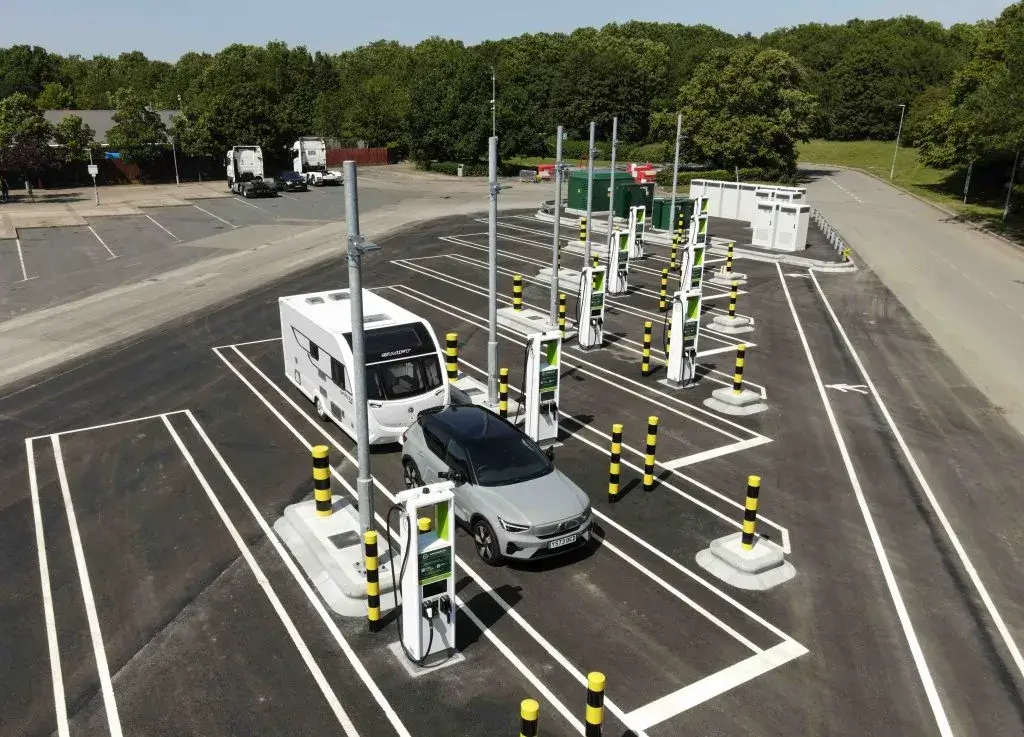
The study, published this week, maps where and when battery-electric trucks are likely to need electricity across the EU, Norway, Switzerland and the United Kingdom between now and 2045. Under the researchers’ moderate electrification scenario, annual truck-charging demand reaches around 100 TWh by 2035 and approximately 200 TWh by 2045.
Germany, France, the United Kingdom, Spain and Italy are expected to generate some of the largest absolute electricity requirements because of the scale of their freight markets.
But the researchers stress that demand will not be spread evenly even within individual countries. Instead, it is expected to cluster around major freight corridors, motorway junctions, industrial areas and logistics hubs.
The concentration can be particularly pronounced. In many countries, the busiest 1% of the geographical areas analysed account for roughly a quarter to a third of total charging energy demand. Prioritising the top 10% of locations could capture as much as 90% of overall demand, according to Fraunhofer ISI.
That could have significant implications for grid operators and governments trying to decide where electricity-network reinforcement should happen first.
Steffen Link, researcher at Fraunhofer ISI and first author of the report, said the analysis showed that electric truck charging would not develop uniformly across Europe.
Instead, he said, demand would concentrate in particular freight corridors, industrial hubs and logistics locations, meaning infrastructure and grid planning should focus on areas where demand is expected to be both strongest and most certain.
Depot charging remains dominant
Despite increasing attention on motorway megawatt charging hubs, the study expects depots to provide the majority of the electricity used by battery-electric trucks. Depot charging represents more than 70–80% of total charging-energy demand in most countries and scenarios, with regional trucks returning to base forming a substantial part of this requirement.
Public charging nevertheless becomes particularly important for long-haul freight and in countries carrying large volumes of transit traffic. In some smaller transit countries, en-route public charging could account for 30–50% of total truck-charging energy, according to the modelling.
The result means that Europe is unlikely to have a single infrastructure model that works everywhere. Countries dominated by depot-based regional operations may require a very different mix of grid connections and chargers from those located on heavily used international freight corridors.
The researchers therefore argue against uniform national or European charging strategies. Instead, infrastructure deployment should reflect individual countries’ freight activity, fleet composition and geography.
They also call for more proactive electricity-grid investment around identified charging hotspots. Grid development is often initiated only after connection requests emerge, while new substations or major reinforcement projects can take considerably longer than installing trucks and chargers.
The study suggests using predicted freight-charging hotspots to identify locations where strengthening the grid ahead of demand could reduce the risk of infrastructure becoming a bottleneck to electric truck deployment.
How the researchers calculated charging demand
The study uses a newly developed modelling framework called VESUVIO – Vehicle Energy Systems Utilizing Visualized Infrastructure Overlays.
The model covers the EU-27 together with Norway, Switzerland and the UK and separates truck operations into different use cases, including regional and long-haul transport. Regional operations are generally modelled as return-to-depot activity, while long-haul trucks can generate demand both at depots and at public charging locations along major freight routes.
Researchers combined freight-transport modelling, national statistics, truck-fleet composition, assumptions about future battery-electric truck uptake, trip patterns and charging behaviour.
Charging demand was then allocated geographically using a hexagonal grid covering Europe. Each cell represents roughly 250 square kilometres – around 17 by 20 km – allowing the researchers to identify individual corridors, logistics areas and urban or industrial hotspots rather than relying only on national averages.
The model also calculates charging demand in 15-minute intervals over a representative week, creating load profiles that indicate not only where electricity will be required but also when charging peaks are likely to occur.
Different scenarios are used for the speed of battery-electric truck adoption. The approximately 100 TWh figure for 2035 and 200 TWh for 2045 come from the moderate electrification scenario, which assumes supportive policies for the uptake of battery-electric trucks.
The published work represents the demand-modelling stage of the VESUVIO project. A subsequent phase is intended to compare predicted charging demand with available electricity-grid capacity at substation level in selected regions, with the aim of identifying where reinforcement could become necessary.