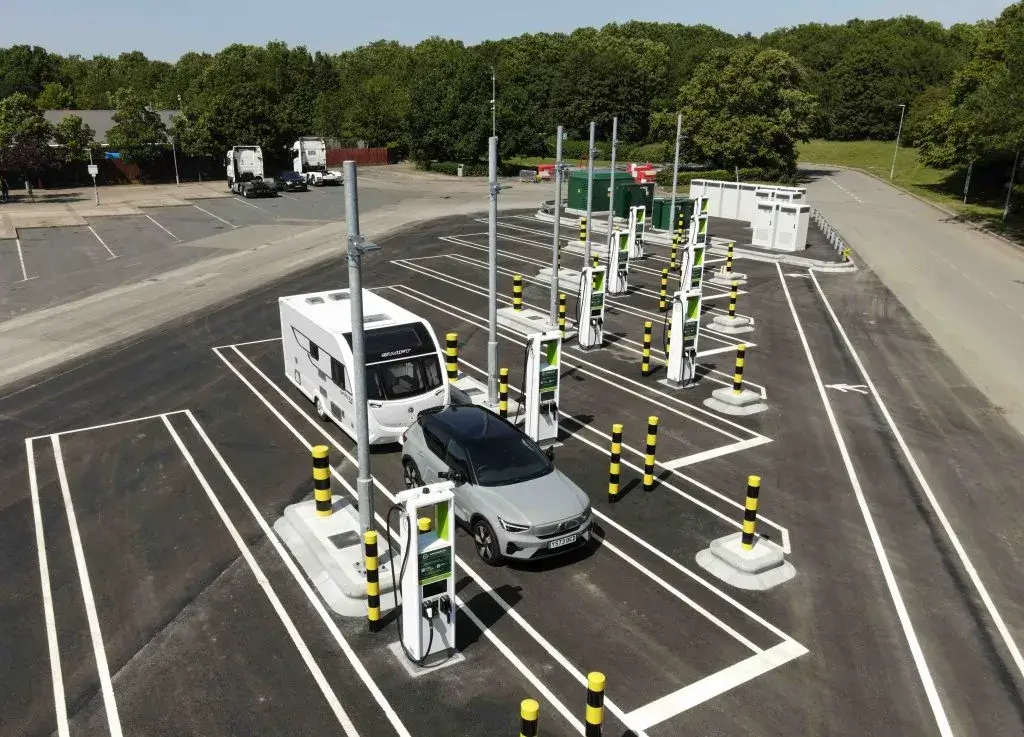

Of the 32 bays, 24 are for passenger cars, including three accessible bays. The remaining eight sit in a separate drive-through area, sized for extended-wheelbase vans, electric coaches, cars towing caravans, and electric HGVs. That drive-through layout matters for drivers: chargers are positioned on both sides, so vehicles with charging ports on either flank can pull straight through without manoeuvring, and anything towing a trailer or caravan can stay coupled while it charges.
Charging speed in the HGV bays tops out at 350kW. The car bays run faster still, at up to 360kW, which Gridserve says can add 100 miles of range in under 10 minutes on compatible vehicles — a benchmark that gives some sense of what drivers might eventually expect from the HGV side as truck charging technology catches up.
Behind the visible bays sits a new 14MVA primary substation, built with headroom for further expansion and to serve more than one charge point operator on the Moto estate. That scale of grid connection is the part of the story most likely to matter over the next few years: it’s what determines whether a site can keep adding capacity as electric HGV numbers grow, rather than hitting a ceiling after the first phase.
Tamworth is one of five eHGV hubs Gridserve has under construction, alongside Thurrock, Leeds, Chester and Strensham North, with Moto Knutsford North and Moto Medway East to follow. The first public hubs under the Electric Freightway programme have already opened at Moto Exeter and Extra Baldock. The programme itself is backed by £62.7 million in UK government funding through Innovate UK and the Department for Transport, aiming to get around 140 electric HGVs running on more than 200 high-power chargers, including at least two rated at 1MW.
Moto’s own ambitions go further still: up to 300 eHGV charging bays across 23 sites by 2030. If that lands, it would shift motorway service areas from being diesel-fuelling and rest stops into genuine infrastructure for zero-emission freight.
For hauliers, the practical impact today is modest — electric HGV numbers on UK roads remain small, and any operator running one still needs a route-specific charging plan rather than relying on passing hubs. But Tamworth is a marker of where motorway charging is heading: away from cars-only provision and towards infrastructure built with HGVs, coaches and long vehicles in mind from the start.
Daniel Kunkel, chief executive of Gridserve, said the project reflected the scale of investment needed to support electric transport, and that a stable policy framework had helped unlock private capital. Ken McMeikan, chief executive of Moto Hospitality, said the company remained committed to market-leading EV charging facilities across its sites, with capacity built in for rising demand.