The “Vehicles on European Roads” report paints a picture of a market that is growing in volume, but is not keeping pace in quality with Brussels’ climate and regulatory ambitions. European road transport therefore faces a dilemma: how to reconcile rising transport needs with the necessity of rejuvenating the fleet and achieving genuine decarbonisation.
6.2 million trucks on EU roads
At the end of 2024, 6.2 million medium and heavy commercial vehicles were on the roads of the European Union, representing an increase of 0.9% compared to 2023. Nearly half of the entire fleet was concentrated in three countries: Italy, Germany and Poland. These markets have the greatest influence on the realities of European road transport.
The increase in the number of trucks is not surprising. Road transport remains the backbone of trade in Europe, and demand for haulage – despite economic slowdowns – remains high. The issue, however, is not the number of vehicles, but their structure and age.
Trucks are the oldest of all
The average age of a truck in the European Union is 14 years, making this segment the oldest in the entire vehicle fleet. In extreme cases, differences between countries are enormous. Greece has the oldest truck fleet – an average of 22.9 years, while the youngest trucks are on the roads of Austria and Luxembourg, where the average age does not exceed 8 years.
Such a wide disparity shows that fleet modernisation is not progressing evenly. Countries with a strong economic position and a stable transport market invest in new vehicles faster. In peripheral countries with less capital strength, trucks remain in operation much longer, which has direct consequences for emissions, safety and maintenance costs.
Diesel without a real alternative
In terms of powertrains, the market picture is clear. As many as 96.3% of trucks in the European Union are powered by diesel. Petrol vehicles account for just 0.5% of the fleet, and electric trucks – only 0.3%.
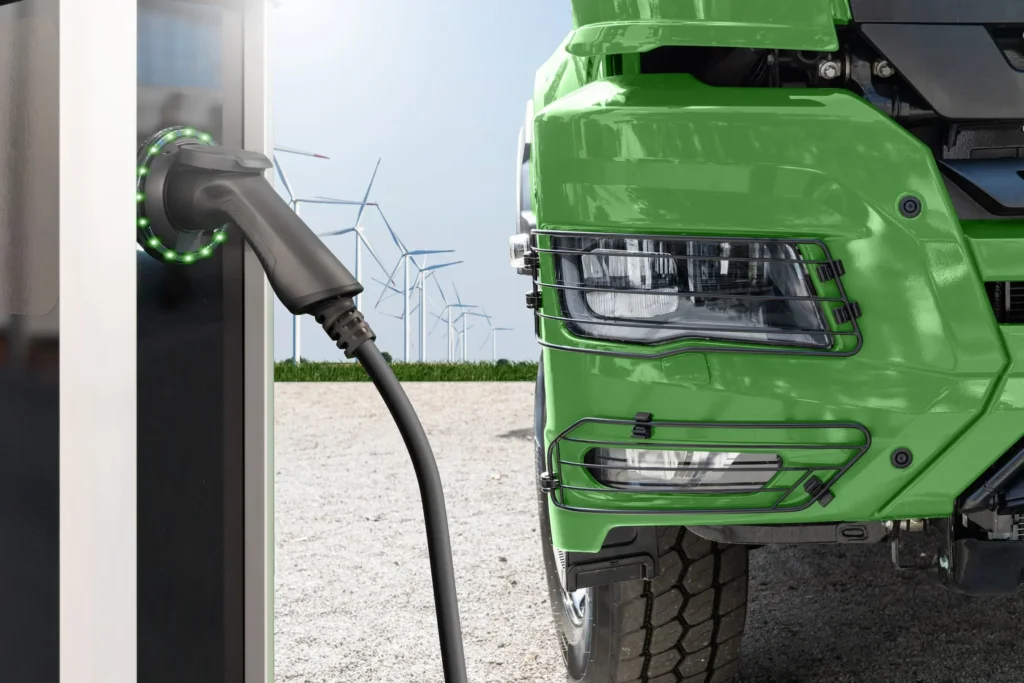
These figures show the scale of the challenge facing European road transport. Unlike passenger cars or buses, the electrification of heavy transport has barely gotten off the ground. A lack of adequate charging infrastructure, high purchase costs and technological limitations mean that for most carriers, diesel remains the only viable option.
An ageing fleet
Although Poland is among Europe’s leaders in terms of the number of trucks, the age structure of the fleet remains one of the key challenges. The average age of a truck in Poland is 13.3 years, slightly below the EU average, which in 2024 reached 14 years.
However, against the backdrop of the largest Western European markets, the Polish fleet performs worse than in Germany and France. In Germany, the average age of a truck is 9.6 years, and in France – 9.4 years, confirming a faster pace of vehicle replacement in those countries.
The fleet is clearly older in Southern European countries. In Italy, the average age of trucks is 19.8 years, and in Spain – 15.1 years. This means that in some of the European Union’s largest economies, a significant share of transport relies on vehicles that have been in service for a dozen, or even several dozen, years.
Central and Eastern Europe: growth in numbers, slower replacement
In Central and Eastern European countries, which in recent years have been dynamically increasing the number of trucks, the issue of fleet age is even more pronounced. In Romania, the average age of a truck is 16.5 years, and in Hungary – 13.2 years.
Against this backdrop, Lithuania looks relatively favourable, where the average age of a truck is 9.6 years, i.e. close to Germany’s level. This is an exception in the region, showing that rapid fleet renewal is also possible in smaller economies, provided market conditions and access to capital are supportive.
The oldest vehicle segment in Europe
ACEA’s overview confirms that trucks remain the oldest segment of road vehicles in the European Union. In many countries, a significant portion of the fleet is over 10 years old, and in Southern Europe and parts of Central and Eastern Europe, the share of such vehicles is dominant.
European road transport therefore faces a dual challenge: a growing number of trucks and a fleet that is ageing faster than it is being renewed. In practice, this means that without real investment incentives and stable regulatory frameworks, the fleet renewal process will remain too slow to keep up with the European Union’s climate targets.
Pragmatism instead of ambition alone
ACEA data shows that legislative targets are only one piece of the road transport decarbonisation puzzle. Without real market conditions – charging infrastructure, support schemes and investment incentives – the replacement of the truck fleet will progress too slowly.
The number of trucks is growing, but at the same time the fleet is ageing and remains almost entirely dependent on diesel. If this trend continues, the gap between climate ambitions and transport reality will only widen. For the transport industry, this means one thing: the coming years will be a test not only of technology, but above all of the economic viability of the green transition.