

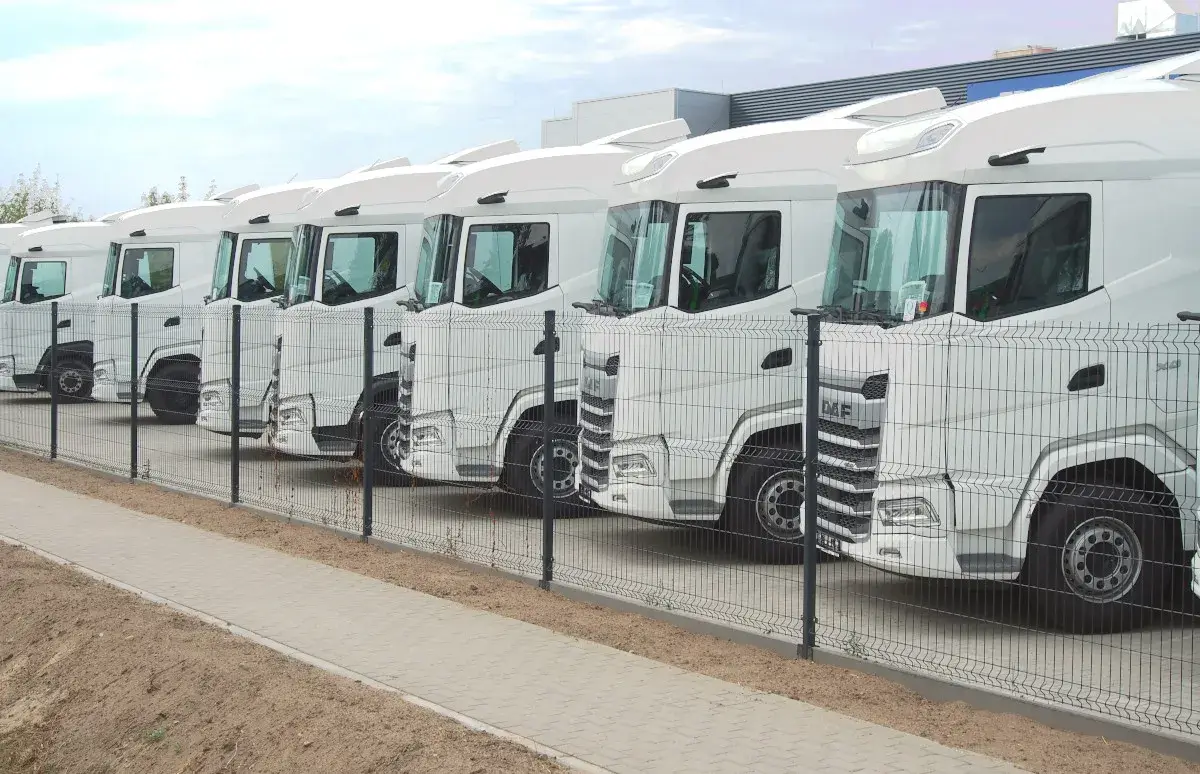

- 205,900 heavy trucks were registered in the EU between January and September 2026, 8.5% more than a year earlier.
- Poland: registrations of new trucks with a gross vehicle weight of at least 16 tonnes rose 19.5%, from 19,700 to 23,500.
- Lithuania grew 24.9%, Spain 13.4%, Romania 12.6%, Hungary 5.9%, Germany 3.9% and Italy 3.8%.
- France was the only major EU market in decline, down 1%. Registrations in the United Kingdom fell 2.3%.
- Electrification is accelerating: registrations of heavy vehicles that can be charged from an external power source increased 59.9% in the EU, but totalled only 5,120 vehicles.
- Diesel remains dominant. It accounted for 91.7% of new registrations in the EU truck market above 3.5 tonnes.
Latest figures from the European Automobile Manufacturers’ Association (ACEA) show that the EU recorded 205,857 new trucks with a gross vehicle weight of at least 16 tonnes during the first three quarters of 2026. The comparable figure for the same period a year earlier was 189,664, putting growth at 8.5%, according to ACEA. The association notes that the result follows a weaker period and partly reflects a rebound from a low base.
Poland’s growth rate was more than twice the EU average. From January to September, the country registered 23,549 heavy trucks, compared with 19,702 during the same period in 2025. That represents an increase of 19.5%.
Lithuania delivered an even stronger result among markets relevant to international road transport. Registrations there climbed 24.9%, from 8,780 to 10,963 vehicles.
The figures suggest that demand for new equipment is recovering faster in parts of Central and Eastern Europe than in several of Western Europe’s largest economies.
From Lithuania to Spain: Europe is moving at different speeds
The recovery varies considerably from one market to another.
Here is how registrations of trucks with a gross vehicle weight of at least 16 tonnes changed during the first nine months of 2026:
| Market | Registrations Q1–Q3 2026 (≥16 tonnes) | Year-on-year change |
|---|---|---|
| Germany | 41,275 | +3.9% |
| France | 27,389 | -1.0% |
| Poland | 23,549 | +19.5% |
| Spain | 19,884 | +13.4% |
| Italy | 17,868 | +3.8% |
| Lithuania | 10,963 | +24.9% |
| Romania | 6,851 | +12.6% |
| Hungary | 3,675 | +5.9% |
| United Kingdom* | 25,449 | -2.3% |
* The United Kingdom is not part of the EU, but ACEA includes its data in the same comparison.
Germany remains the largest market, with more than 41,000 heavy vehicles registered. Growth there was modest, however, at 3.9%. France was the only major EU market in the comparison to contract, falling 1%. Italy posted moderate growth of 3.8%, while Spain recorded a much stronger 13.4% increase.
Lithuania, Poland and Romania were the clear growth leaders in eastern Europe.
ACEA’s data therefore does not point to a single Europe-wide boom. Instead, it shows an uneven recovery shaped by the financial position of carriers and investment levels in individual markets.
Poland also leads when the wider truck segment is included
The same pattern emerges when medium-duty trucks weighing between 3.5 and 16 tonnes are added to the figures for heavy vehicles. Across the EU market for trucks above 3.5 tonnes, new registrations increased 7.5%, reaching 245,079 vehicles. Poland again outperformed the average, with growth of 20.5% to 26,168 vehicles. Spain grew 13.2% and Germany 2.5%, while France declined 1.6%.
ACEA identified Poland and Spain as the two large markets with the strongest growth.
Electric trucks up 60%, but from a small base
Registrations of vehicles with alternative powertrains grew even faster in percentage terms. Among heavy trucks, the number of vehicles classified by ACEA as electrically chargeable — those that can be charged from an external power source — increased by 59.9% in the EU. Registrations rose from 3,203 in the first nine months of 2025 to 5,120 in the same period of 2026. The growth rate is significant, but the absolute figures underline how early the transition remains.
Trucks in this category accounted for around 2.5% of the nearly 206,000 new heavy trucks registered in the EU. Across the wider truck segment above 3.5 tonnes, their share was higher, at 5.3%.
Germany is accelerating while Poland remains at the start of electrification
The divide between European markets becomes most visible when powertrains are considered. Germany registered 1,722 heavy trucks that can be charged from an external power source during the first nine months of 2026, 91.3% more than a year earlier.
France recorded 771 such vehicles, an increase of 36%.
For comparison:
- Poland registered 46 trucks in this category,
- Italy registered 60,
- Spain registered 54,
- Romania registered 23,
- Hungary registered 15,
- Lithuania registered 1.
Poland’s registrations in this category increased 27.8%. However, against a total of 23,500 new heavy trucks, vehicles in this category represented only about 0.2%. In Germany, the comparable share was already around 4.2%, and in France it was approximately 2.8%.
The concentration becomes even clearer when the entire truck market above 3.5 tonnes is considered. ACEA says that Germany, France and the Netherlands together accounted for 74% of all externally chargeable truck registrations in the EU.
This suggests that Europe’s shift in truck powertrains is progressing first in markets where charging infrastructure, support programmes and fleets willing to invest in new technology are developing in parallel.
Spain’s truck market grows while electric registrations fall
Spain offers a particularly striking example. Its heavy-truck market expanded 13.4% to almost 20,000 new vehicles. At the same time, registrations of heavy trucks that can be charged from an external power source fell from 106 to just 54 vehicles, a decline of 49.1%.
The example shows that growth in the overall truck market does not automatically translate into a faster transition to alternative powertrains.
Romania displays a similar gap. Its heavy-vehicle market grew 12.6%, while the number of vehicles in this category fell from 39 to 23.
Lithuania: a fast-growing truck market with almost no electrification
Lithuania presents an even sharper contrast. Heavy-truck registrations rose 24.9%, one of the strongest results among the markets analysed. Yet ACEA recorded just one registration in the category of externally chargeable vehicles. The market therefore remains almost entirely reliant on conventional powertrains.
The figures highlight the different needs of fleets operating in international long-haul transport and those working in segments where electric trucks are currently gaining traction fastest.
Diesel still powers more than nine in ten new trucks
Despite the rapid percentage growth recorded by externally chargeable vehicles, conventional powertrains remain the clear standard in European road transport. During the first three quarters of 2026, 91.7% of all newly registered trucks in the EU were diesel-powered. Diesel registrations also increased by 6.6% year on year.
In the heavy-truck segment, ACEA recorded 193,696 diesel vehicles, compared with 178,856 a year earlier. That represents growth of 8.3%.
Electrification is therefore advancing quickly in percentage terms, but it has not yet reduced the number of new diesel trucks entering the market.
The market is recovering, but the biggest decision still lies ahead
The first nine months of 2026 marked a clear turnaround after a weaker 2025. Demand for heavy trucks is growing again, with Poland, Lithuania, Spain and Romania among the markets showing the strongest recovery.
At the same time, ACEA’s data makes clear that Europe is still far from a uniform transition to alternative powertrains. Germany, France and the Netherlands account for a substantial share of demand for electric trucks, while their presence remains marginal in many important transport markets across Central, Eastern and Southern Europe.
That is why the growth rate for electric-truck registrations can be misleading on its own. The key fact in 2026 is that the heavy-vehicle market is growing again — but most carriers are still investing in diesel.


