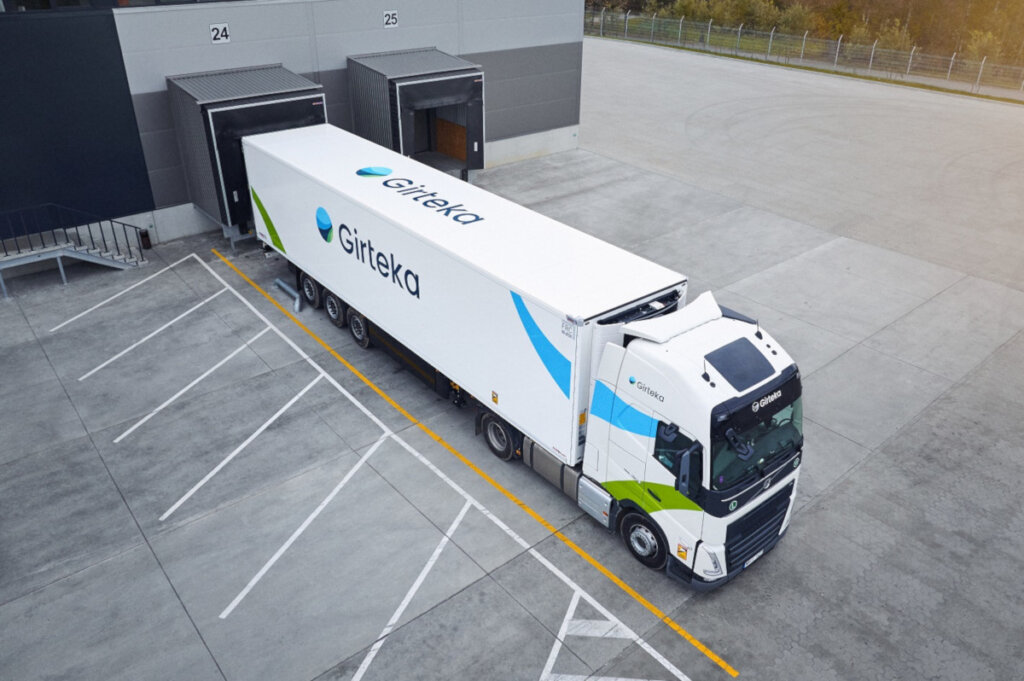
The case concerns a guarantee issued in support of the German banking consortium AKA Bank, which is financing Girteka’s purchase of new vehicles. According to UBT-FGTB, the decision could have wider consequences for competition in the EU road transport market, including for companies operating in Belgium.
The Belgian union says the guarantee provided by Credendo enabled Girteka to secure financing to purchase 1,200 new trucks. The €74 million facility was made available through the German banking consortium AKA Bank.
UBT-FGTB argues that the support is going to a company it claims has been violating EU road transport rules for years, including cabotage regulations — which, the union says, is squeezing local operators.
The union also points to Girteka’s broader investment activity. It notes that at the beginning of 2026 the company raised €173 million to purchase several thousand more trucks, further strengthening its position in the European market.
‘A model based on social dumping’?
UBT-FGTB claims Girteka’s operating model relies on employing lower-cost labour from outside the European Union. The union statement recalls earlier media reports, including coverage by the British newspaper The Guardian in 2022, which reported cases of alleged exploitation of drivers from third countries.
The union also points to Girteka opening new branches in Kazakhstan and Kyrgyzstan at the beginning of 2023. According to UBT-FGTB, the aim was to recruit additional drivers from Central Asia, including countries such as Turkmenistan.
“It is simply unbelievable that Credendo is providing a guarantee to a Lithuanian transport company that has been organising social dumping across the entire European Union for years, using cheap drivers from third countries such as India, the Philippines, Congo, Uzbekistan or Turkmenistan,” said Frank Moreels, chairman of UBT-FGTB.
Allegations of unfair competition
According to the Belgian union, Girteka’s scale and access to lower-cost labour allow it to offer services on terms that are difficult for operators in Belgium and other Western European markets to match.
UBT-FGTB also argues that granting public guarantees to companies accused of breaching road transport rules risks deepening competitive imbalances in the market.
‘Double standards’, unions say
UBT-FGTB is calling for the guarantee to be withdrawn and for a change in how public support is granted in the road transport sector. In the union’s view, public institutions should not back businesses that it claims violate market rules or contribute to social dumping.
“Credendo must stop applying double standards. You cannot, on the one hand, claim that as a specialised export credit insurer you carry out detailed due diligence, and on the other hand finance a business model based on social dumping,” said Tom Peeters, deputy federal secretary of UBT-FGTB for road transport and logistics.
The union is calling for public guarantees and financial instruments not to be granted to companies that, in its view, break the rules or contribute to worsening social dumping in European road transport.
Girteka responds
The trans.info editorial team contacted Girteka for comment on the criticism from the Belgian trade unions. The company said it operates in full compliance with EU and national regulations in all markets where it is present.
Girteka said:
“Girteka operates in full compliance with EU and national regulations in all markets where we are present. This includes strict adherence to the EU Mobility Package, labour law requirements, posting of workers rules, and applicable collective agreements.
We employ international drivers through fully compliant and transparent employment structures, ensuring proper contracts, social guarantees, remuneration aligned with legal standards, and full respect for rest and working time regulations. Our operations are regularly subject to inspections and audits across multiple jurisdictions.
As one of Europe’s largest asset-based transport companies, operating with our own fleet, we maintain clear governance standards and a strong focus on compliance, accountability, and responsible employment practices.”