This shift represents more than a geographic rebalancing. It marks the transformation of used equipment from a regional commodity into a truly global asset class, with digital platforms serving as the infrastructure connecting Western European supply with emerging-market demand.
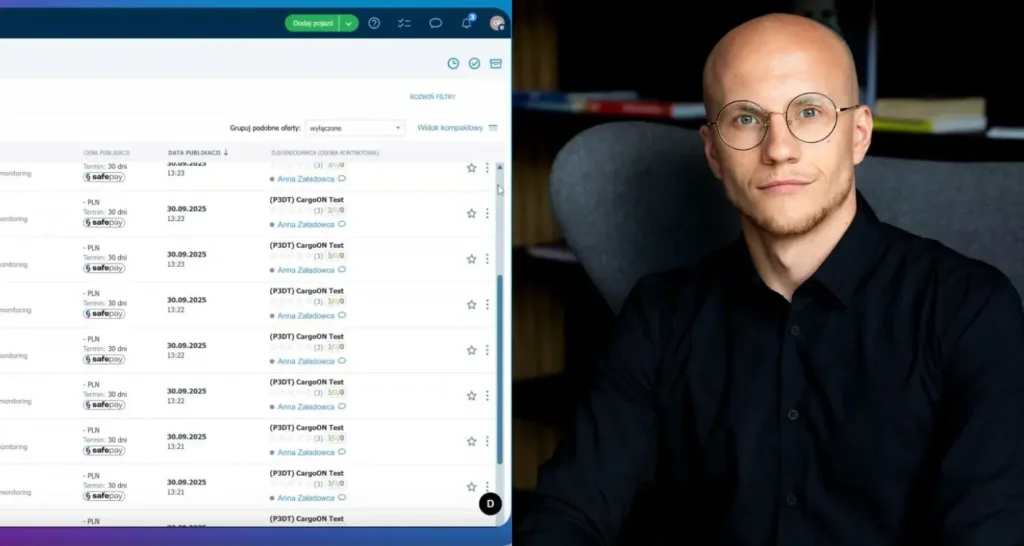
Mateusz Żurawski, PR Manager of Truck1.eu, one of Europe’s largest digital marketplaces for commercial vehicles, has been at the forefront of this evolution. His platform lists roughly 200,000 units annually and generates over 400,000 sales leads across 30 countries—connecting dealers with buyers they could never have reached a decade ago.
In a recent interview, Żurawski outlined how new trade routes are creating opportunities for savvy dealers, why AI-powered search is enabling more efficient matches between buyers and sellers, and how his platform is helping the industry capitalize on shifting demand patterns.
Trans.INFO: The used equipment market has changed dramatically over the past few years. How would you characterize where we are now?
Mateusz Żurawski: We’re in a fascinating transition period. The market has evolved from the post-pandemic scarcity—when dealers had empty yards and buyers were competing for limited inventory—to what I’d call a mature, buyer-driven marketplace.
What’s exciting is that as new machinery remains overpriced, the secondary market has become the primary engine for fleet renewals across Europe. Smart dealers are recognizing this isn’t a problem—it’s an opportunity to serve more selective, informed buyers who understand the value proposition of quality used equipment.
The key shift is that power has moved to the buyer, which means dealers who can access broader markets and compete effectively have a significant advantage. That’s where platforms like ours become critical infrastructure.
How has buyer behavior actually changed?
Instead of defaulting to new equipment purchases, fleet operators are actively seeking younger used machines with low hours to optimize their capital deployment. High interest rates have made CFOs more strategic about equipment acquisition.
We’re also seeing sophisticated demand for compact, versatile machinery—mini-excavators, for example—as urban construction and small-scale infrastructure projects take priority. The buyers entering the market today are more informed, more specific about their requirements, and more willing to look across borders to find exactly what they need.
For dealers who understand how to reach these buyers, it’s a substantial opportunity.
You’ve talked about equipment migration patterns. Can you walk us through how that works?
Absolutely. It’s what we call multi-tier migration, and it’s a fascinating value chain. A truck that starts in a high-tier fleet in Germany or the Netherlands—say, a seven-year-old Mercedes Actros—finds its next life serving a mid-sized logistics firm in Poland or Romania. As it ages further, it moves to what we call tier-three markets: the Balkans, Central Asia, or North Africa.
In these markets, lower repair costs and different regulatory environments extend the vehicle’s productive life for another decade. It’s not about dumping old equipment—it’s about matching machinery to the right economic context. The mechanical quality of European brands like Mercedes, MAN, DAF, Volvo, and Scania means these trucks can deliver value across multiple lifecycles.
What’s emerged is a sophisticated global supply chain, and platforms like ours are the logistics backbone that makes it efficient.
Let’s talk about the geographic expansion you mentioned—particularly Africa. What’s driving that growth?
Central and Eastern Europe remains strong, but it’s increasingly acting as a gateway to frontier markets rather than a final destination. We’re seeing tremendous growth in North and Central Africa—Egypt, Nigeria, Morocco—driven by massive state-funded infrastructure projects.
This has transformed the traditional East-West trade route into a North-South corridor. Countries like Czech Republic and Bulgaria have evolved into sophisticated transit hubs that aggregate Western inventory before it moves further south or east.
From the EU alone, over 20% of used heavy-duty vehicles now flow to Africa and the Middle East. That’s not a niche anymore—it’s a primary market. For dealers who can access these buyers efficiently, it represents substantial volume opportunity.
What specific equipment are these markets demanding?
The European majors dominate because of their global parts networks and mechanical reliability. Mercedes-Benz Actros leads because you can service it anywhere from Cairo to Casablanca. MAN’s TGX series and DAF’s XF are prized for robust engineering and maintenance simplicity. Volvo FH and Scania R-series serve the premium segment in modernizing logistics markets.
In terms of body types, we’re seeing strong demand for tractor units for long-haul, plus notable growth in tippers and refrigerated trucks. The sophistication of buyer requirements is actually increasing in these markets—they’re not just taking whatever’s available; they’re specifying models, vintages, and configurations.
Beyond Africa, where else is demand expanding?
It varies by equipment class. For earthmoving and asphalt equipment, we’re seeing aggressive growth in Southeast Asia—Vietnam, Indonesia—and the Middle East, particularly Saudi Arabia and UAE. These are massive state-funded infrastructure and smart city projects that need equipment at scale.
For agricultural machinery—tractors and combine harvesters—demand is accelerating in sub-Saharan Africa and South America, where large-scale farming consolidation creates need for the proven reliability of European models.
The common thread is that Europe remains the supply engine, and platforms that can connect that supply with global demand efficiently are becoming essential infrastructure.
Your platform generated over 400,000 leads last year. You’re projecting 30-35% growth for 2026. What’s behind that confidence?
Three factors. First, the geographic expansion we’ve discussed—Africa and Southeast Asia are growing for us, and we’re investing heavily in those markets.
Second, we’re deploying advanced programmatic advertising that targets high-intent buyers with dynamic inventory. If someone views a specific Scania model on our site, we can reach them across the web with real-time updates on that unit or similar inventory. This dramatically improves conversion efficiency for our dealer clients.
Third, the industry is consolidating. The dealers who are succeeding are multi-site operators who need platforms like ours to move inventory across borders quickly and access international buyers at scale. We’re evolving from a marketplace into strategic infrastructure—a critical tool for dealers who want to compete globally.
How exactly are platforms like Truck1 changing the competitive landscape?
We’re fundamentally shifting the industry from a localized model to a data-driven global network. We serve as what I call a logistics highway—removing geographical barriers so a dealer in Germany can reach qualified buyers in Africa or Asia within days.
By providing tools in over 30 languages, international SEO, and targeted advertising, we transform a local dealership into a global showroom. This creates price transparency and verified lead generation that simply wasn’t possible a decade ago.
The result is that heavy equipment has become a mobile, global commodity. For dealers, this means access to liquidity and the ability to clear inventory efficiently regardless of local market conditions. Speed matters tremendously for maintaining cash flow, and that’s what we enable.
What’s the value proposition for buyers?
Total transparency and access. Buyers can now see diverse inventory across borders, compare specifications and pricing in real-time, and connect directly with sellers—all without expensive intermediaries.
We’re also facilitating the financial side through partnerships with major leasing and financial companies, offering integrated financing options directly on our platform. This helps buyers secure capital efficiently and close transactions faster.
Essentially, we reduce friction and transaction costs on both sides, making the global market more accessible and efficient for everyone.
You mentioned you don’t provide vehicle history or service records. How do you build trust without that data?
We’re a marketplace platform rather than a direct dealer, so we don’t own the inventory or have access to individual vehicle histories. But we’ve built a comprehensive verification system that monitors both sides of the transaction.
We actively vet sellers through mandatory profile and ad quality checks. On the buyer side, we filter inquiries to protect dealers from fraudulent contacts and bots. By maintaining marketplace integrity from both directions, we create an environment where legitimate businesses can transact with confidence.
It’s about creating a trusted infrastructure rather than trying to control every data point.
Are you seeing regional differences in how dealers adopt digital tools?
Definitely. Western European dealers are rapidly embracing paid media and programmatic advertising for precision targeting. Eastern markets are advancing quickly through mobile-first adoption.
But the most significant shift globally—and this is critical for dealers to understand—is the evolution from traditional SEO to AI-driven search. We call this LLM or GEO: instead of ranking for keywords, the focus now is on structuring data so AI answer engines can synthesize and present it to buyers.
In the near future, a buyer won’t search Google and click through listings. They’ll ask an AI assistant, “Find me the best used Volvo excavator in Southeast Asia,” and the AI will present curated options based on data from authoritative sources.
Dealers whose inventory is properly structured and visible to these AI systems will win. Those who aren’t will simply be invisible, regardless of what equipment they have in stock.
How is Truck1 positioning for that shift?
We’re restructuring our entire catalog around what’s called E-E-A-T—Experience, Expertise, Authoritativeness, and Trustworthiness. This ensures that when AI assistants search for equipment recommendations, Truck1 is cited as the authoritative source.
We’re also moving beyond basic retargeting to predictive programmatic advertising. Using first-party behavioral data, we can follow high-intent buyers across the web with dynamic creative—showing them the exact equipment they viewed, with real-time pricing updates or similar available units.
This ensures our dealers’ advertising spend targets only buyers with high conversion probability, maximizing return on investment. It’s about using technology to make every marketing dollar more effective.
How do you adapt this global platform to serve such diverse regional markets?
Through what we call localized globalization. First, we provide linguistic and cultural localization across 30+ languages—not just translation, but localized search experiences. A buyer in Lagos can communicate seamlessly with a seller in Munich, with technical specifications clear in their native language.
Second, we tailor inventory visibility based on regional demand. In Western Europe, we prioritize eco-friendly Euro 6 and electric machinery to match emission standards. For emerging markets, we highlight robust, mechanically simple models and specialized equipment like tippers and earthmovers that serve local infrastructure needs.
Third, we’re investing in AI-enhanced discovery to ensure that when buyers anywhere ask for equipment recommendations, Truck1 inventory is the primary source.
We also maintain physical presence—our Warsaw hub, participation in trade shows from Bauma China to European agricultural exhibitions—so we understand local dealer challenges and can adapt our partnerships to regional financial regulations.
It’s about being genuinely global while remaining locally relevant.
ESG—environmental, social, and governance factors—how much does that actually matter in used equipment?
It’s becoming critical, particularly around financing. Environmental regulations are creating differential demand—Euro 6 and high-efficiency machinery now commands significant price premiums in Western markets.
More importantly, ESG compliance is increasingly required by banks to secure trade finance for international deals. We’re seeing this become a gatekeeper for capital access. Dealers who understand this and can offer cleaner equipment have a financing advantage that translates directly to competitive advantage.
This also creates opportunity in the market. Older equipment that can’t meet Western standards still has substantial value in markets with different regulatory environments. Dealers who can navigate that complexity—matching equipment to appropriate markets—can capture value others miss.
Looking forward, how do you see the market evolving over the next few years?
The market is transitioning from a simple buy-and-sell model to a circular, technology-enabled ecosystem. Three developments will define success:
First, AI-driven discovery. As search moves to AI agents that synthesize recommendations, dealers whose inventory is properly structured and authoritative will dominate. Those who aren’t prepared will lose visibility regardless of what they stock.
Second, asset lifecycle digitization. Sophisticated buyers will increasingly demand integrated telematics and digital passports that verify equipment condition and remaining life. This is especially important as electrification enters the used market. Transparency will become a competitive advantage.
Third, green-linked trade finance. ESG compliance will increasingly determine access to capital. Financing for used equipment will depend on emission standards and efficiency ratings, favoring Euro 6 and hybrid models. Dealers who position themselves on the right side of this shift will have structural advantages.
What’s your advice for dealers navigating this environment?
Embrace the geographic expansion. The buyers who will drive volume growth over the next five years aren’t necessarily in your traditional markets. Building the capability to serve international buyers efficiently—through platforms, financing partnerships, and logistics—is essential.
Second, invest in digital infrastructure. Your inventory needs to be visible not just to human searchers, but to AI systems. That means proper data structuring, authoritative positioning, and smart advertising.
Third, understand that this market rewards specialists who can match equipment to appropriate markets and provide the full transaction support—financing, logistics, verification—that today’s buyers expect.
The dealers who are thriving aren’t necessarily the biggest—they’re the ones who’ve recognized that this is now a global, digital, data-driven business and have built capabilities accordingly. That’s the opportunity in front of us.
Global equipment markets in transition
Key market dynamics (2023-2026)
- Market evolution: from scarcity-driven to mature, buyer-selective marketplace
- Primary growth opportunity: secondary market as main engine for fleet renewal
- Export expansion: over 20% of EU used heavy vehicles flowing to Africa/Middle East
- Emerging high-growth markets: Egypt, Nigeria, Morocco (Africa); Vietnam, Indonesia (Southeast Asia)
- Most-traded brands: Mercedes-Benz (Actros), MAN (TGX), DAF (XF), Volvo (FH), Scania (R-series)
- Equipment demand shift: increasing sophistication toward compact, versatile machinery
- Platform infrastructure: 30+ languages enabling cross-border transparency
- Annual marketplace activity (Truck1.eu): 200,000 units listed, 400,000+ qualified leads generated
- Projected growth (2026): 30-35% increase in lead volume