Key takeaways:
- A one-hour reduction in average truck waiting times at Spanish port gates could have an annual economic impact of more than €400 million, according to Ocean Capital Partners.
- Spanish ports handle more than 550 million tonnes of freight each year.
- Many bottlenecks are increasingly found beyond the quayside, on road and rail approaches and at inland terminals.
- Concentrated activity at Algeciras, Valencia and Barcelona is putting additional pressure on the wider logistics network.
- Recommendations include systematic waiting-time tracking, stronger rail links, better operational coordination and predictive tools to manage arrivals.
Port efficiency does not end when a container is discharged at a port. For a haulier, the journey continues until the truck reaches the terminal, completes its loading or unloading operation and leaves the site. A report prepared by Ocean Capital Partners, titled How to strengthen the role of Spanish ports in the logistics chain, says this link between the port and inland transport is where a significant share of current inefficiencies can be found.
More than €400 million linked to one hour of waiting
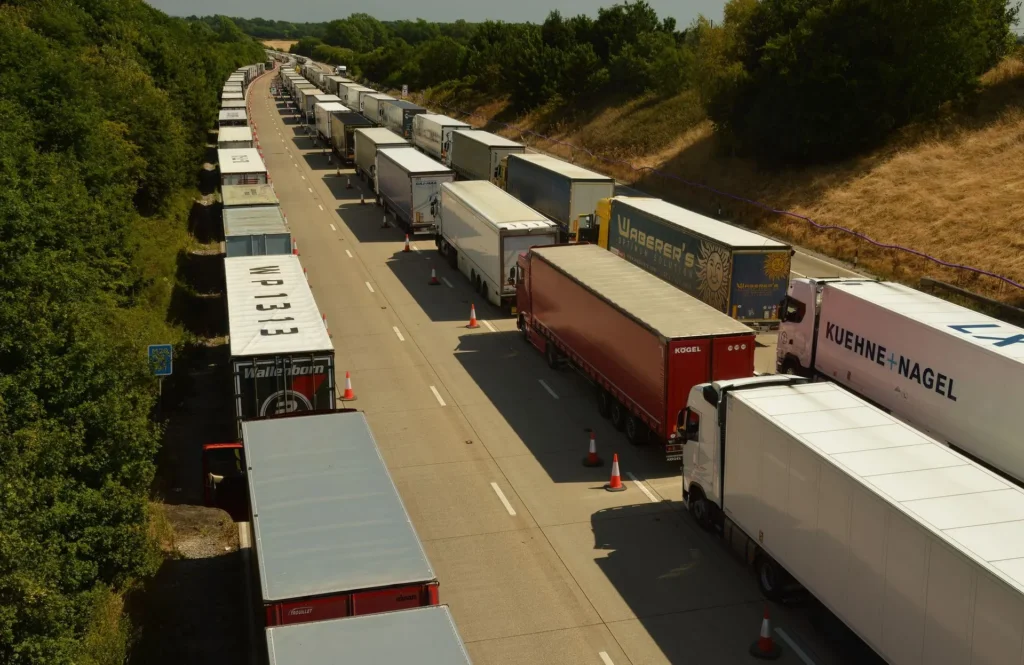
The report, cited by Europa Press, estimates that cutting average truck waiting times at port gates by one hour could have an annual economic impact of more than €400 million.
The estimate connects waiting times with logistics costs, transit times and business competitiveness. However, the publicly available material does not set out the full methodology behind the figure. It should therefore be treated as an estimate from the report, rather than as a verified saving already achieved across Spain’s port system.
The scale of the issue becomes clearer when considering the size of the network: Spanish ports handle more than 550 million tonnes of freight each year, as well as nearly 40 million passengers.
Bottlenecks are moving beyond the quayside
One of the report’s central conclusions is that logistics pressure is no longer concentrated inside port terminals.
Ocean Capital Partners says that some of the pressure has shifted to port approaches, road and rail links, and inland terminals. Concentrated activity at major hubs such as Algeciras, Valencia and Barcelona is also putting additional pressure on the wider port and transport network.
This is particularly important for road transport. Productivity gains inside a terminal have less value if a truck is stuck outside the gate, faces congested access roads or cannot move cargo into the hinterland at the same pace. An efficient terminal cannot compensate for delays elsewhere in the supply chain.
Measure every truck’s waiting time
OCP recommends starting with a systematic effort to identify and measure bottlenecks across the network.
Suggested indicators include vessel turnaround times, cargo dwell times, truck waiting times and the reliability of rail connections.
Waiting times are particularly costly for hauliers because an idle vehicle continues to generate expenses. These can include the driver’s time, fuel consumed during related operations, vehicle financing costs and the lost capacity to complete other jobs.
The publicly available information does not break down waiting times by port or identify which locations experience the longest delays. As a result, the data cannot show which Spanish port currently has the longest truck delays.
More rail and stronger landside links
Another key recommendation is to expand rail freight and rail highways, while improving connections between ports and inland logistics hubs.
The principle is straightforward: an efficient terminal loses part of its advantage if cargo cannot leave the port smoothly.
This does not necessarily mean replacing road transport with rail. In an intermodal supply chain, both modes depend on coordinated port operations, access arrangements and schedules. When one part of the process fails, congestion is simply passed on to the next link.
Operating windows and predictive management
Ocean Capital Partners also calls for a more predictive approach to port operations, supported by digital tools and better information sharing.
The aim would be to anticipate congestion, organise arrivals more effectively and allocate operating windows further in advance, reducing simultaneous arrivals and unproductive waiting.
Making these systems work will require close coordination among terminals, hauliers, shipping lines, rail operators and other stakeholders. The report identifies operational coordination across these groups as another area requiring improvement.
It also supports more flexible labour arrangements in activities such as stevedoring, allowing the sector to respond to peaks in demand. In addition, it proposes reducing certain entry barriers in tenders and concessions to encourage greater competition.
Port infrastructure cannot be assessed in isolation
The report ultimately broadens the discussion to the resilience of the entire network.
Geopolitical disruption, extreme weather and changes to maritime routes can quickly alter the volumes arriving at a port. OCP therefore argues that port investment should be coordinated with adequate landside access and energy networks capable of supporting future growth.
The estimate of more than €400 million reflects a much broader challenge. The issue is not simply whether a truck spends one less hour in a queue, but how much time and productive capacity road transport loses when port operations and external connections move at different speeds.
In a system handling more than 550 million tonnes each year, shorter waiting times and more predictable truck movements can improve productivity across the entire logistics chain, not just within port terminals.