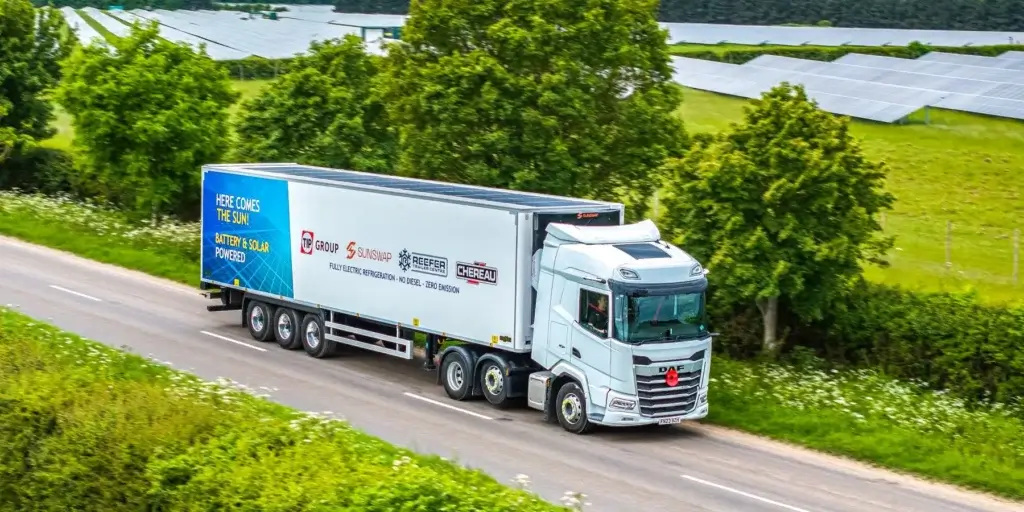
The SolarMoves project ran for three years, covered 1.2 million kilometres of European roads, and tested everything from urban delivery vans to long-haul tractor-trailers. Its final report, published in December 2025, reaches a conclusion that is more useful than a simple verdict: the business case for solar panels on commercial vehicles is not determined by the technology itself, but by the vehicle type, the operating pattern, and — critically — what the panels are actually being asked to power.
The study covered 23 vehicle archetypes across two climate zones, deployed irradiance sensors on 18 vehicles for a measurement campaign between March 2024 and September 2025, and combined the data with a full total cost of ownership (TCO) analysis and stakeholder interviews.
The clearest finding in the report concerns diesel trucks, not electric ones.
Solar panels fitted to diesel tractor-trailers to power auxiliary systems — refrigeration, air conditioning, cab electronics — pay back their investment in under a year, according to the report’s 2030 TCO modelling. For a long-haul tractor-trailer on regional distribution routes, the model shows a five-year TCO saving of €32,452 and a payback period of 0.7 years. For urban rigid lorries, payback is around 1.1 years, with a five-year TCO saving of €5,239. CO₂ reductions across diesel archetypes range from 4.4% to 9.2% per vehicle.
The mechanism is straightforward. Refrigerated lorries must keep cargo cold during driver rest periods. Without solar, this means idling the engine or running a diesel auxiliary power unit. Solar panels with a buffer battery can eliminate or substantially reduce that draw. The Netherlands already subsidises solar-equipped trailers on this basis; the SolarMoves report recommends that other member states consider similar measures, given the payback periods involved.
This is not a new idea — PACCAR Parts introduced lightweight flexible solar panels for truck cabs in early 2025, targeting battery charging and alternator load reduction — but the SolarMoves data provides the strongest quantified basis to date for the business case in refrigerated logistics.
The electric truck picture
For battery-electric trucks, the report’s findings are more varied. The TCO modelling covers four EV truck archetypes, and the results split almost evenly.
Two archetypes, a regional rigid lorry and a long-haul tractor-trailer, showed positive five-year TCO figures, with payback periods of 4.6 years and 2.8 years, respectively. The other two, an urban rigid lorry and a regional tractor-trailer, did not reach payback within five years.
These results are shaped significantly by real-world measurement data. An electric food delivery truck operating in the Netherlands with a roof-mounted solar system contributed an average of 12.4% of its daily energy demand from solar between March and July 2025. That is considerably higher than the 2–4% figure that dominated earlier coverage, and it reflects the operating pattern: urban delivery trucks spend much of the day in stop-and-go conditions and at loading points, where the main motor draws intermittently, and the solar system charges a buffer battery that feeds auxiliaries and reduces grid charging.
The report also measured three long-haul trucks with roof sensors across Europe during late summer and autumn 2025. Truck 1, which operated in southern and central Europe under late-summer conditions, accumulated nearly twice the solar harvest of the other two, which ran mainly in northern Europe in autumn. Season and latitude are the dominant variables in yield, but even autumn operations in northern Europe can produce measurable energy from trailer roofs on clear days.
For long-haul electric tractor-trailers, the report estimates that the trailer roof and sides together could generate 90–110 kWh per day in summer. That represents a meaningful contribution to the roughly 1.2 kWh/km energy consumption of a loaded tractor-trailer, adding up to around 50 km of additional effective range.
What the 2–4% figure was actually measuring
The figure used in earlier coverage was not wrong, but it described a specific and unfavourable context: the share of traction energy that solar panels can supply to high-mileage long-haul electric trucks across all conditions and seasons. In that framing, 2–4% is accurate.
The final report consistently distinguishes between traction energy, where the contribution is small for high-demand vehicles, and total energy demand, including auxiliaries and charging flexibility, where the contribution is more substantial. It also separates summer and winter performance, and distinguishes southern from northern European conditions. For urban distribution trucks with predictable routes and daytime parking, the solar contribution in warmer months is measurably higher than that headline figure suggests.
The researchers are direct about the limits: shading from loading bays reduces yield, side-mounted panels underperform roof panels, and high-mileage long-haul operations see the smallest percentage gains. None of that has changed. What the final report adds is a clearer picture of which use cases sit outside that worst-case framing.
A regulatory gap that is slowing everything down
Beyond the technology itself, the report identifies a structural barrier that goes some way to explaining why adoption has remained limited even where the economics are positive.
EU CO₂ reduction targets for heavy-duty vehicles are imposed on truck manufacturers and measured through the VECTO certification tool. VIPV is not currently recognised in VECTO. When a fleet operator retrofits a trailer with solar panels and reduces CO₂ emissions by 5% per vehicle, none of that reduction counts towards the manufacturer’s compliance targets. Manufacturers, therefore, have no regulatory incentive to integrate solar at the point of production, even if the fleet operator would benefit.
A second problem arises from split ownership. Trailers and tractors are frequently owned by different entities. The trailer owner bears the upfront cost of installation; the fuel and charging savings flow primarily to the truck operator. This misalignment further slows adoption, because the party that pays is not the party that benefits.
The report recommends that the European Commission include VIPV in the VECTO trailer module, thereby allowing manufacturers to count solar generation towards their CO₂ compliance obligations. It also recommends classifying vehicle-generated electricity as renewable energy under the EU Renewable Energy Directive (RED III), thereby formally recognising solar energy from vehicles in national accounting frameworks, where it currently goes uncounted.
Whether those recommendations are acted upon will determine, more than any technical refinement, whether solar panels move from a niche retrofit option into mainstream commercial vehicle specification.