Right now, policymakers and truck makers are largely betting on megawatt charging (MCS) and high-power charging hubs. Fraunhofer IML, however, has teamed up with DHL, DSV , Greiwing, Nagel-Group, Remondis and Rewe to examine whether automated battery swap stations could solve additional pain points in freight transport. The project was supported by DSLV, the German Freight Forwarding and Logistics Association.
The white paper also looks at whether battery swapping can pay off. Fraunhofer IML sees the main advantage in dramatically shorter downtime. Even megawatt charging still leaves trucks stationary for longer than an automated battery swap would. With an automated system, a battery swap could take around five to ten minutes, depending on the setup.
That time saving matters most on predictable operations — fixed loops, hub-to-hub lanes or round-the-clock shuttle services. Instead of queuing at fast chargers, vehicles could get back on the road much sooner.
According to the authors, this raises vehicle utilisation and makes scheduling easier. Another benefit: batteries can be charged outside the truck at a slower, grid-friendly pace. That can reduce peak loads and may extend battery life.
Fraunhofer also points to economic upside on established corridors with regular swapping. In those scenarios, trucks may be able to run with smaller onboard batteries, lowering the amount of capital tied up per vehicle.
At the same time, the institute highlights high upfront costs. Automated swap stations and large battery pools are currently seen as the biggest financial barrier. That’s why the paper considers operator models likely — where battery manufacturers or infrastructure providers supply the batteries and lease them to logistics companies.
German trials have already tested the concept
The technology is no longer entirely new in the commercial vehicle world. In 2023, Germany’s first fully automated battery swap station for heavy electric trucks opened on the A13 near Lübbenau. As part of the “eHaul” research project, two converted e-trucks operated by Reinert Logistics automatically exchanged their 440-kWh batteries for charged units in about ten minutes.
The project, funded by the Federal Ministry for Economic Affairs and Climate Action, was delivered with partners including TU Berlin, Fraunhofer IVI, Bosch and Reinert Logistics. The goal was to test whether battery swapping can work reliably in day-to-day long-haul operations.
Work is also moving forward on swap concepts in the trailer segment. Trailer Dynamics, together with DB Schenker and Chinese battery maker CATL, presented a 2024 concept for electrified trailers using swappable batteries.
The North Rhine-Westphalia-based company is developing e-trailers with an electrified axle and an additional traction battery integrated into the trailer. Trailer Dynamics says the electric assist drive could cut diesel consumption in long-haul operations by an average of 40 percent — or significantly extend range when used with battery-electric tractors.
According to the company, swapping a battery module on the trailer takes about five minutes. The batteries are also intended to be charged more slowly, which can increase service life and reduce grid peaks.
China is already scaling up
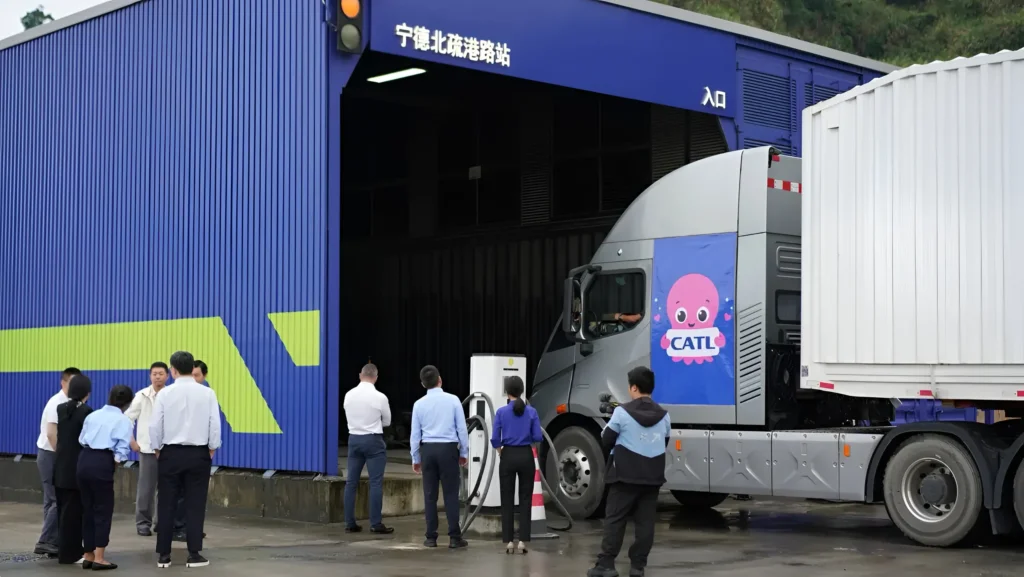
While Europe is still mostly in test mode, China is much further along, the white paper notes. In 2024, around 28,700 swap-capable heavy commercial vehicles were newly registered — roughly 35 percent of all heavy new-energy trucks.
A key driver is CATL, which is building out swap corridors for heavy trucks. The company announced plans to add 300 more swap stations in China in 2025. In some locations, up to 192 swaps per day are said to be possible.
Japan, India and Australia are also testing or using battery swapping in commercial vehicles. Europe, by contrast, remains largely at the pilot stage, according to Fraunhofer.
Lack of standards is still the biggest hurdle
The white paper lists several obstacles, with standardisation at the top. There are still no common formats for batteries, locking mechanisms or high-voltage interfaces.
Without cross-manufacturer standards, the authors warn of fragmented solutions, extra costs and high investment risk. Open questions also remain around ownership, liability, battery condition and legally compliant billing.
Fraunhofer adds that vehicle manufacturers are cautious. Several OEMs argue that today’s battery systems are engineered to match specific vehicle designs, and standardised swappable packs could limit that optimisation. They also point to improving ranges and the ramp-up of megawatt charging.
Charging infrastructure is lagging behind plans
The paper also flags the slow rollout of public charging for heavy commercial vehicles.
According to Germany’s National Control Centre for Charging Infrastructure, as of early March 2026 there were only 69 publicly accessible truck-charging locations nationwide, with a combined installed capacity of about 50,160 kilowatts. The planned Deutschlandnetz, by comparison, includes 351 sites.
On top of that, grid connections can take a long time. Network operators cited lead times of up to five years for new connection capacity, the study says. This is also why depots are increasingly seen as a bottleneck for heavy-duty electrification.
Battery swapping is an add-on, not a replacement
Fraunhofer IML is clear that battery swapping is not meant to replace depot charging or public fast charging. But in certain use cases, it could add flexibility and help speed up the transition to electric fleets.