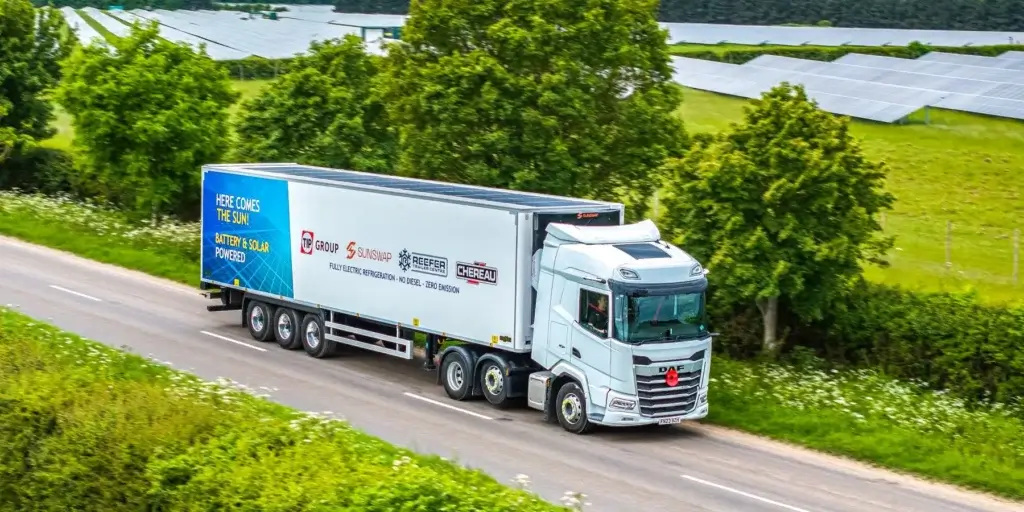
Despite years of testing, pilot projects and commercial offers, solar panels on heavy vehicles remain a niche technology with uncertain benefits. A new Swedish research project will now reassess whether solar integration can play a meaningful role for electric trucks — or whether the limits identified so far remain decisive.
The pre-study, led by the Swedish National Road and Transport Research Institute (VTI), has received funding from the Swedish Energy Agency and will run through 2026. Its aim is to evaluate whether solar panels installed on heavy electric trucks can reduce charging needs under real operating conditions and whether the concept makes sense from a system and operational perspective.
A question that keeps returning
Interest in solar-equipped trucks is not new. Over the past decade, manufacturers, suppliers and fleet operators have repeatedly tested the technology in different forms — from prototype vehicles and research projects to auxiliary power systems and off-the-shelf solar panels for truck cabs.
One of the most comprehensive assessments to date came from the European SolarMoves project, which analysed solar-equipped lorries across roughly one million kilometres of operation. The results were sobering: solar panels typically covered only 2–4% of heavy-duty vehicles’ total energy demand. While charging stops for battery-electric vehicles could be reduced, the overall impact on total cost of ownership was limited, particularly for high-mileage long-haul operations.
Researchers also highlighted structural constraints. Long-distance trucks spend much of their operating time in motion, while parked vehicles are often stationary in loading bays or depots where shading significantly reduces solar yield. Side-mounted panels performed especially poorly compared with roof-mounted systems.
Read more: EU realises Euro 7 truck rules went too far
From traction energy to auxiliary power
At the same time, several operators have continued to explore solar technology for more modest use cases. In Sweden, DHL Freight launched a 12-month pilot in 2025 to test roof-mounted solar systems on trucks powered by HVO and liquefied biogas. Rather than contributing to propulsion, the panels are used to supply auxiliary systems such as cooling units and tail lifts.
According to the technology supplier, earlier deployments on diesel fleets showed fuel and CO₂ reductions of 4–7% by reducing alternator load and idling. The Swedish pilot aims to verify whether similar benefits can be achieved on alternative-fuel trucks across different climatic regions.
This auxiliary-power approach has also been reflected in commercial offerings. PACCAR Parts, for example, has introduced lightweight, flexible solar panels designed to continuously charge vehicle batteries and reduce engine running while parked. The panels are aimed primarily at improving energy efficiency and battery life, not extending driving range.
Prototype testing, but no breakthrough
Manufacturers have also explored more ambitious configurations. Scania previously tested a hybrid-electric truck with a solar-panel-equipped trailer in cooperation with Uppsala University and haulage company Ernst Express. That project demonstrated that solar panels can make a measurable contribution under Swedish conditions, but it was explicitly framed as research rather than a near-term commercial solution.
The core limitation remained unchanged: available surface area and variable irradiance restrict how much energy can realistically be harvested, especially for heavy vehicles with high and continuous energy demand.
Why the VTI study matters
Against this backdrop, the VTI-led pre-study represents a step back from pilots and products to reassess the fundamentals. The project brings together VTI, Uppsala University, Traton/Scania and Ernst Express to examine whether solar integration can offer meaningful benefits specifically for electric trucks — and under which operational conditions, if any.
Rather than delivering a prototype, the study will analyse realistic energy yields, suitable vehicle configurations and transport tasks, as well as potential impacts on charging infrastructure and grid demand. Its main output will be a technical and economic assessment and a plan for a possible large-scale demonstrator project, which could be proposed in late 2026.
No silver bullet — but unresolved questions
So far, research and pilots suggest that solar panels are unlikely to transform heavy-duty road transport on their own. For long-haul electric trucks, their contribution to propulsion energy remains marginal, while economic returns are uncertain.
However, the persistence of new studies reflects an unresolved question: whether there are specific niches — such as lower-mileage operations, predictable parking patterns or combined auxiliary and traction use — where solar integration could still make sense.
The VTI study will not provide immediate answers. But it may help determine whether solar panels on electric trucks represent a marginal optimisation worth pursuing — or a technology that, despite repeated trials, remains fundamentally constrained.