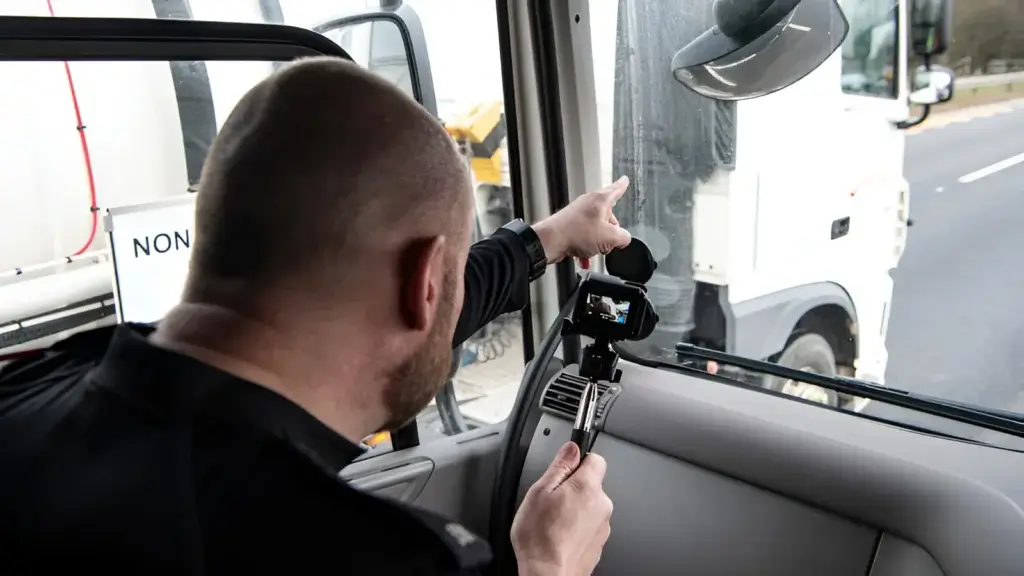
Footage shared on social media shows four individuals emerging onto the roof, jumping down and running off. Police initially arrested the driver on suspicion of facilitating unauthorised entry into the UK, but he was later released and no further action was taken against him.
Key points:
- The incident happened on Monday, 3 August 2026, near the A414 in Maldon.
- Algarve Removals handles international moves between the UK, Spain and Portugal.
- The company believes the stowaways entered via a large hole cut in the roof during an overnight stop at a secure truck park near Rouen.
- Before crossing into the UK, the truck was checked in Calais; the owner says dogs and carbon monoxide detection devices were used.
- Essex Police released the driver and confirmed no further action would be taken against him.
- UK rules allow penalties of up to £10,000 per person found in a vehicle.
A roof breach, while doors stayed secured
The incident took place near Algarve Removals’ warehouse in Maldon. The business specialises in removals between the UK, Spain and Portugal.
Company owner John Scott said the four people may have entered the truck during an overnight stop at a guarded lorry park near Rouen — around a two-hour drive from Calais. A large opening was later discovered in the vehicle’s roof.
He added that the rear doors and side curtains were closed and secured with a locking device.
According to the company, once the truck left the Rouen parking area it did not stop again until it reached Essex.
Before entering the UK, the vehicle underwent checks in Calais. Scott said dogs and carbon monoxide detection devices were used during the inspection. No issues were found and the truck was cleared to continue.
Driver released as company denies any involvement
After the incident was reported, police searched the area but did not locate the four people shown in the video.
The driver — a man in his sixties — was initially detained on suspicion of assisting unauthorised entry into the UK. Essex Police later said he had been released and would face no further action.
Algarve Removals said the driver was questioned overnight and then released. The company added that police confirmed neither the driver nor the business was involved. The investigation into the four people seen in the footage is ongoing.
We do not support this kind of activity and will do everything possible to ensure it does not happen again with our vehicles, the company said.
The firm said it has been operating for more than 30 years and had not encountered a similar case before, adding that it would introduce additional security measures.
It also said there is no evidence to support claims made by some politicians and media outlets that the people in the video arrived from Ceuta. This has not been indicated by police, border services or the company.
Up to £10,000 per stowaway
UK regulations require drivers and operators to take steps to prevent unauthorised access to vehicles. Not knowing someone is hidden inside is not necessarily enough to avoid liability.
Under rules in force since 2023, the maximum penalty can reach £10,000 for each person found in a vehicle. Fines may be issued to the driver, the operator or the vehicle owner.
As lawyers Paulina Eliasz-Pietrusewicz and Patrycja Szostek of Trans Lawyers note, Border Force will closely examine whether a company genuinely followed the required procedures.
Checks may include, among other things:
- Properly completed checklists.
- Seal and lock numbers.
- Dates and times of vehicle inspections.
- Records of driver training.
- Instructions on what to do if a trailer intrusion is suspected.
Arguing that stowaways cut through the roof, damaged a customs cord, or entered without the driver’s knowledge may not be sufficient if the operator cannot show that procedures were applied correctly and consistently.
Border Force accreditation can help reduce penalties
Operators running services between continental Europe and the UK can apply for Border Force accreditation. This requires security procedures, staff training and evidence that preventive measures are carried out on a regular basis. Accreditation does not remove all risk. However, it can be taken into account when setting the level of a penalty and may improve the chances of receiving available reductions.
The rules also allow appeals against penalties. When reviewing a case, Border Force may consider a company’s financial position and its size. Micro-businesses can, in certain cases, obtain a reduction of up to 75%.
Pressure on operators remains
The Essex case underlines how difficult it can be to fully protect a load space — even when doors are secured and border checks have been completed. In this case, the individuals may have bypassed standard security by entering through the roof.
The challenge remains especially acute for operators travelling through northern France to the UK. Attempts to hide in vehicles can lead to trailer and cargo damage, driver detention, delays and steep administrative penalties.
The European Commission said in 2026 it would strengthen oversight on the Channel route, increase the involvement of Europol and Frontex, and step up action against smuggling networks.
Even so, much of the responsibility for securing vehicles — and documenting every check — still sits with carriers.
Why fines are worth challenging
A Border Force fine does not have to be the end of the matter. Operators that can demonstrate they were unaware of stowaways and that the vehicle was properly secured should consider filing an objection or appeal.
UK law firm JMW Solicitors has described cases where penalties were overturned. In one example, a Slovenian operator was fined after six people were found inside a trailer.
Lawyers were able to show the individuals entered the vehicle after it was already in the UK, on the return leg. As a result, they could not be treated as people brought into the country under the rules used to impose the penalty.
It is for Border Force to prove there are proper grounds for penalties, and operators should not hesitate to challenge them — both at the objection stage and on appeal, said Laura Hadzik, a partner at JMW Solicitors.
The firm has also pointed to cases where Border Force did not apply reductions that carriers may be entitled to. Factors can include a clean compliance history, correct use of security and inspection procedures, participation in accreditation schemes, and the financial circumstances of both the business and the driver.
Findings from a report by the Independent Chief Inspector of Borders and Immigration also highlighted inconsistencies in how penalties are applied. In some instances, drivers were fined even after reporting stowaways themselves and using the required checklists.
The UK Road Haulage Association has previously argued that some officers did not use discretion available to waive penalties in certain circumstances.
That is why the Maldon case may prove important: the driver was released with no further action, the truck passed border checks, the rear doors and side curtains were said to be secured, and the individuals may have gained access through a roof opening.
These details do not automatically determine the outcome of any administrative process, but they may be relevant arguments when contesting a penalty.