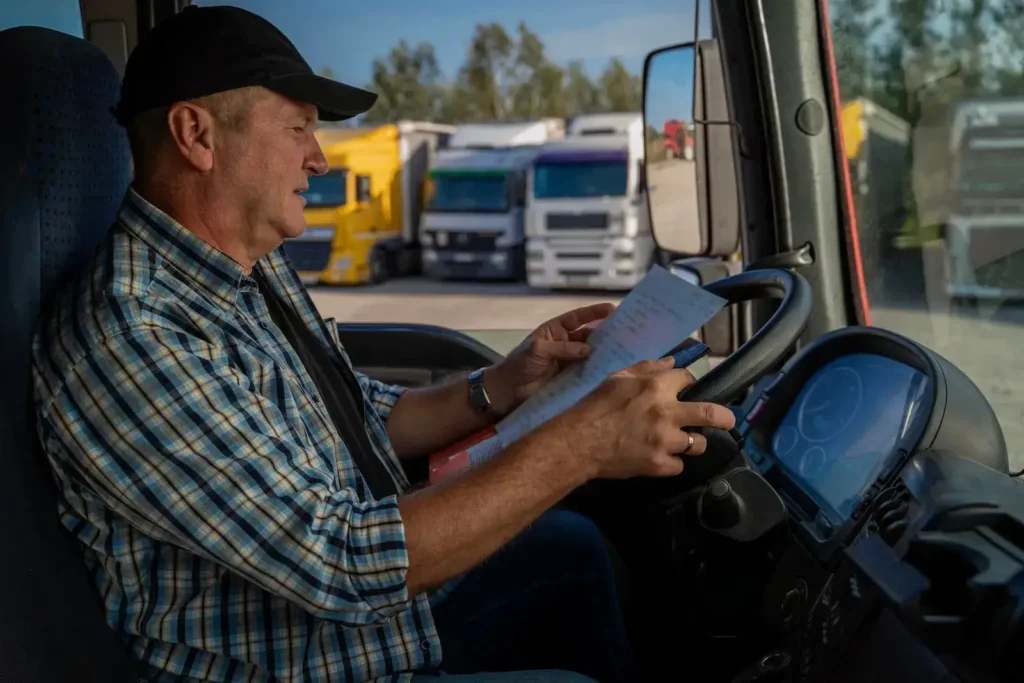
The startup behind the concept, Truckly, is trying to blend freight transport with the ride-sharing market. The premise is straightforward: a truck driver lists an available seat in the cab, a passenger books via an app, and the carrier and driver earn extra income.
Truckly’s founders say the goal is to make better use of trips that are already happening on the road — and to offer a cheaper alternative to rail or coach services, especially on routes where public transport is limited or overpriced.
“Truckpooling” – a freight-sector version of carsharing
Truckly was created by Marion Choppin and Diana Bajora in Marseille. The company markets itself as the “first European truckpooling platform.”
In Truckly’s vision, passengers would travel alongside a professional driver on routes where public connections are scarce or simply too expensive. The startup says pricing should be in line with traditional carpooling.
The founders argue that trucks cover billions of kilometres every year with an unused passenger seat — and they want to tap into that capacity.
“It’s a gigantic waste,” Marion Choppin said, quoted by the French outlet “La Provence”.
Truckly also says it wants to improve the public image of professional drivers and “make visible a sector we all depend on.”
The first trip has already happened
In late April, Truckly announced on social media that it had completed its first passenger ride.
The trip took place near Clermont-Ferrand in an electric truck owned by GROUPE GTY, which the startup describes as a carrier committed to low-emission transport.
According to Truckly, the first ride was intended as a symbolic milestone. One platform user gifted the trip to his father. The company highlighted the emotional side of the moment, talking about “pride”, “a dream turned into reality”, and a “bond between generations.”
Truckly also stressed that the inaugural run was completed in a fully electric truck.
“Mobility can create emotion, build human connections, and at the same time reduce the carbon footprint,” the project’s founders wrote.
The startup’s pitch is that shared truck travel can combine extra revenue for carriers with lower emissions and better use of journeys that are already being driven.
Extra revenue for carriers?
Truckly puts the financial upside front and centre. The platform promises carriers an additional income stream without having to restructure their operations. The company even offers a profit calculator on its website for fleets, arguing that ride-sharing can help operators “maximise returns on their routes.”
The app is designed not only for passengers, but also for drivers and transport companies. Truckly says the workflow is meant to be simple: the carrier posts a route, a passenger books, and payment is released to the driver or the company once the trip is completed.
When freight drivers become passenger carriers
From day one, however, the idea has raised serious doubts within the transport sector. The French outlet TRM24 openly asks whether this is an “absurd uberisation of road transport.”
Much of the criticism focuses on legal and operational issues. A truck is built and regulated for moving goods, not people. That immediately raises questions around carrier liability, insurance coverage, and drivers’ working-time rules. It is also unclear who would be responsible for a passenger in the event of an accident — and how carrying a paying rider would be formally integrated into a professional driver’s duties.
TRM24 also warns that the model could turn trucking into a hybrid role that blends freight transport with passenger mobility services.
“The driver becomes both a freight transport worker and part of a mobility service for passengers,” the French site notes.
Startup ambition meets transport reality
Sceptics argue that Truckly is applying a familiar platform-economy logic: monetise every unused space — even the spare seat in a truck cab. The challenge is that road transport operates under tight regulation, including rules on drivers’ hours, transport safety, and carrier responsibility.
And while Truckly points to cooperation or contacts with industry bodies and transport companies, that does not automatically mean the business model has formal backing.
This isn’t the first attempt
The concept itself is not entirely new. A similar service was tried roughly a decade ago. The WeTruck platform also attempted to arrange passenger rides in truck cabs. Prices were extremely low — with some journeys costing less than eight euro for around 200 kilometres.
But the project didn’t last. According to TRM24, despite media interest and cooperation with several dozen transport companies, it ultimately collapsed due to economic issues.
Safety concerns
The new platform also raises questions about safety and the risk of abuse. Europe’s transport sector has been dealing for years with growing cargo crime, and theft groups increasingly use new tactics — from impersonating carriers to fraud and infiltrating digital logistics platforms.
Figures from the organisation TAPA (Transported Asset Protection Association) illustrate the scale: in February 2026 alone, the EMEA region recorded 1,168 cargo thefts, with reported losses totalling nearly 166.5 million euro. Against that backdrop, some in the industry are asking whether a platform that lets people book seats in truck cabs could become another entry point for organised crime. The concern is not only about gathering information on routes and loads, but also about criminals using rides directly — for example, to observe a carrier’s security routines, plan thefts, or gain access to vehicles and transport infrastructure.