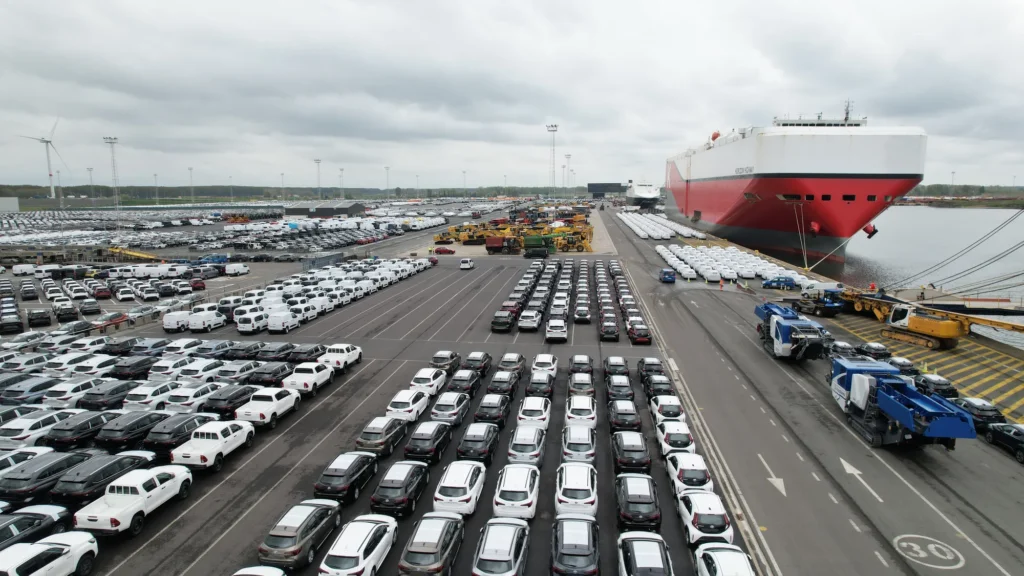
The terminal processed 2,470,700 TEU over the year, with December recorded as its second-busiest month at 224,700 TEU. However, these volumes were achieved against a backdrop of significant logistical friction. The Port of Antwerp-Bruges noted that 2025 was defined by 25 days of industrial action, geopolitical volatility, and shifting trade patterns that have placed the entire supply chain under sustained pressure.
Market share and infrastructure constraints
While Antwerp Gateway reported growth, the broader port environment showed signs of strain. Total container throughput for the Port of Antwerp-Bruges rose by only 0.7% in 2025. Furthermore, the port’s market share within the Hamburg–Le Havre range dropped by 1.2 percentage points to 29.3% during the first nine months of the year.
The divergence between the terminal’s record growth and the port’s flagging market share suggests that capacity and landside flow are becoming critical bottlenecks. For hauliers and logistics providers, the stability of the gateway remains tied to the ongoing expansion programme. Launched in 2020 and due for completion in 2026, the project involves retrofitting stacking crane modules to increase yard capacity by 30%.
Operational shifts
To mitigate the effects of congestion, the operator is moving toward increased automation and a “night logistics” model to spread cargo distribution across a 24-hour cycle. Current infrastructure at the site includes:
- 15 quay cranes and 23 automated stacking crane (ASC) modules.
- 63 straddle carriers, with a transition toward hybrid units.
- Three large berths capable of accommodating vessels with a 16-metre draft.
Global financial results
The Antwerp figures coincide with a broader financial report from DP World, showing group revenue of $24.4 billion for 2025, up 22%. Adjusted EBITDA rose 18% to $6.4 billion, while total gross throughput across its global portfolio reached 93.4 million TEU.
Despite the record revenue, the group’s outlook for 2026 remains tempered by external risks. Management cited US tariff policies, disrupted sailing schedules, and continued economic uncertainty in Europe as factors that could weigh on performance. The group has allocated $3 billion in capital expenditure for 2026 to address these productivity concerns at key assets, including Antwerp and London Gateway.