The 2025 results from several of Europe’s key ports show a split between rising container activity and weaker bulk volumes, with tariff-related volatility and energy-market restructuring shaping flows. Rotterdam and Antwerp-Bruges both reported lower overall tonnage, mainly due to declines in dry and/or liquid bulk, while Hamburg posted growth driven by containers and Slovenia’s Luka Koper combined record box volumes with stronger profits.
Total maritime throughput: 2025 performance snapshot
| Port | 2025 throughput (m tonnes) | Annual change |
| Rotterdam | 428.4 | -1.7% |
| Antwerp-Bruges | 266.5 | -4.1% |
| Hamburg | 114.6 | +2.6% |
| Luka Koper | 23.0 | ~0% (stable) |
Hamburg and Koper: container growth drives the headline
Hamburg reported 114.6 million tonnes (+2.6%), with the uplift attributed primarily to the container segment. The port handled 8.3 million TEU (+7.3%), while container throughput measured in tonnes rose 4.6%.
According to the port’s figures, growth was supported by stronger traffic with Asian markets, including China (+6.5%), India (+49.2%) and Malaysia (+84.3%). In contrast, Hamburg said container handling with the United States fell 25.6%, citing “far-reaching” US customs measures as a driver.
Luka Koper’s performance followed a similar pattern in containers and vehicle logistics. The group reported record container throughput of 1,272,161 TEU (+12%), while total maritime throughput remained flat at 23,003,522 tonnes.
On the financial side, Luka Koper reported net sales of €380.3 million (+15%), EBIT of €96.3 million (+44%), and net profit of €81.5 million (+35%), attributing the improvement mainly to higher container and vehicle throughput and increased storage revenue.
Rotterdam and Antwerp-Bruges: bulk weakness drags overall tonnage
Rotterdam reported total throughput of 428.4 million tonnes (-1.7%). The port’s own breakdown shows dry bulk down 6.5% (66.6 million tonnes) and liquid bulk down 1.5% (197.0 million tonnes), while containers measured by TEU increased.
Rotterdam handled 14.245 million TEU (+3.1%), but container throughput in tonnes slipped 0.2% (to 133.2 million tonnes). In its press material, the Port of Rotterdam linked the TEU increase to a 9.3% rise in imports from Asia, and noted that a shift towards more import boxes, lower export volumes and reduced transhipment contributed to more empty container throughput.
The port also reported that throughput fluctuated during the year due to poor weather and strikes, and said congestion at container quays led to the diversion of a “significant” volume to other ports, contributing to a 15.9% fall in transhipment TEU.
Antwerp-Bruges reported total maritime throughput of 266.5 million tonnes (-4.1%), stating that the decline was entirely due to bulk traffic (-12.8%), while general cargo (including containers, conventional general cargo and RoRo) grew 0.7% over the year.
In containers, Antwerp-Bruges reported 13.6 million TEU (+0.7%) and 149.4 million tonnes (+0.4%). The port said performance was affected during the year by adverse weather and industrial action, and noted that its market share in the Hamburg–Le Havre Range fell to 29.3% in the first nine months, citing congestion, industrial action and changes in alliances.
The “US factor”: tariff volatility and diverging impacts
All four sets of results point to a more volatile environment for trade lanes, but the US angle played out differently across ports.
Antwerp-Bruges reported that the United States became its largest trade partner in 2025, with 31.3 million tonnes (19.7 million tonnes inbound and 11.7 million tonnes outbound), overtaking the UK. It also said container traffic with the US was broadly stable over the year (-0.6%), but with “significant fluctuations” linked to announcements and adjustments of import tariffs.
Hamburg, by contrast, reported a sharp decline in US container traffic (-25.6%) and directly attributed this to “far-reaching” US customs measures.
Rotterdam’s press release also flags the changing trade pattern behind its TEU growth (higher imports from Asia) and notes that deteriorating European competitiveness weighed on exports, alongside changes in alliance structures and quay congestion.
Automotive flows: Chinese imports remain a major driver in vehicle logistics
Vehicle handling remained a key logistics segment, particularly for ports with large RoRo and car-terminal operations.
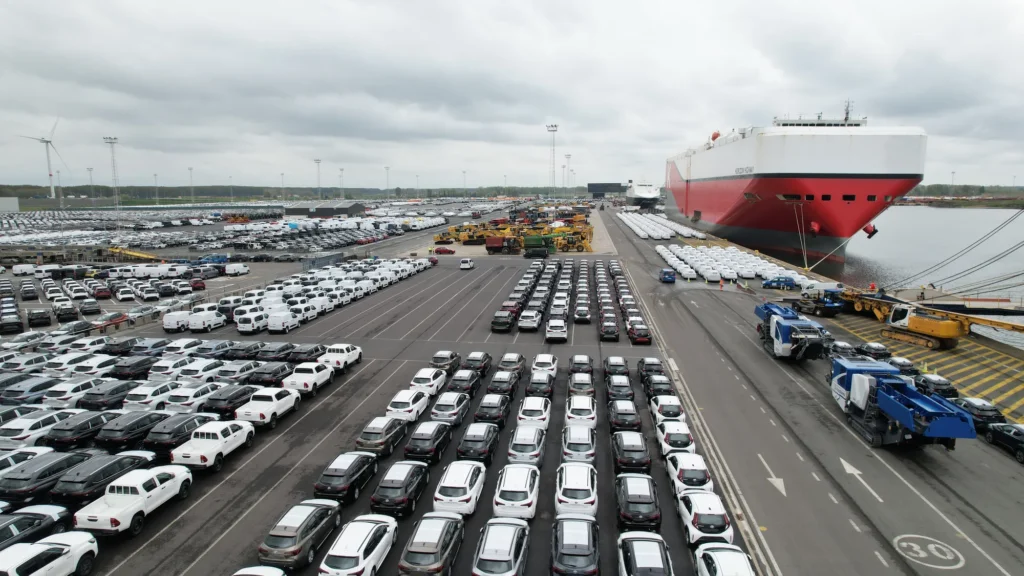
Antwerp-Bruges reported that it handled 3,186,000 new cars in 2025 (-1.2%), while highlighting a clear shift in origin: imports from China rose 11%, allowing China to overtake Japan as the main country of origin for vehicle imports.
Luka Koper reported 914,817 units (+3%) handled at its Car and RoRo Terminal, stating that the increase was driven primarily by imports from various Chinese manufacturers, alongside higher export volumes to Mediterranean markets.
Energy mix: LNG up, petroleum products down
Energy-related cargoes remained one of the most structurally disrupted parts of the throughput mix, with ports reporting declines in traditional petroleum flows alongside stronger LNG volumes.
Rotterdam reported LNG throughput of 13.0 million tonnes (+15.1%), while mineral oil products fell 12.6% (to 48.5 million tonnes). The port linked LNG growth to the need to replenish Europe’s gas reserves more than in 2024 and noted that chemical-product volumes (including methanol) fell within “other liquid bulk”.
Antwerp-Bruges reported that liquid bulk was “strongly affected” by a 19% drop in petroleum products, with specific products impacted by refinery closures and weaker demand. Within chemicals, it reported biofuels up 27.8%, while other chemical products fell 8.1%, which it linked to a weak European chemicals sector and a challenging policy environment.
The port also highlighted a shift in LNG sourcing: LNG supply from the US more than quadrupled to 3.7 million tonnes, while Russian LNG fell to 4.3 million tonnes (-16.6%), and the port stated that a full ban on Russian LNG imports is planned by 2027.
Investment and inland logistics: capacity, rail, and operational constraints
Beyond annual volumes, the 2025 results also underline that operational constraints and inland connectivity increasingly influence how ports perform and how flows translate into road and rail demand.
Luka Koper reported that rail accounted for 51% of its modal split despite restrictions related to upgrades and modernisation of Slovenia’s railway network. It also said its investment cycle will intensify, after allocating €132.9 million in 2025 (including €42.9 million for sustainability-related initiatives) and planning €201 million for 2026. Key projects include works on a new container quay and storage areas at Pier I, plus a multi-storey car garage with capacity for 11,700 vehicles.
In Rotterdam, the Port Authority reported net profit of €266.0 million (down €7.8 million) and €291.4 million in investments (9% lower than the year before), while the throughput narrative points to the practical logistics consequences of disruption and imbalance: more import containers, lower exports, and the need for empty container movements — alongside congestion-related diversions.


![Costs up 11%, rates up 5%: FarEye’s Suryansh Jalan on the hidden “inefficiency tax” in Europe’s last mile [INTERVIEW]](https://cdn-trans.info/uploads/2026/10/264940df8e8870b74281e69aeac-1024x769.webp)