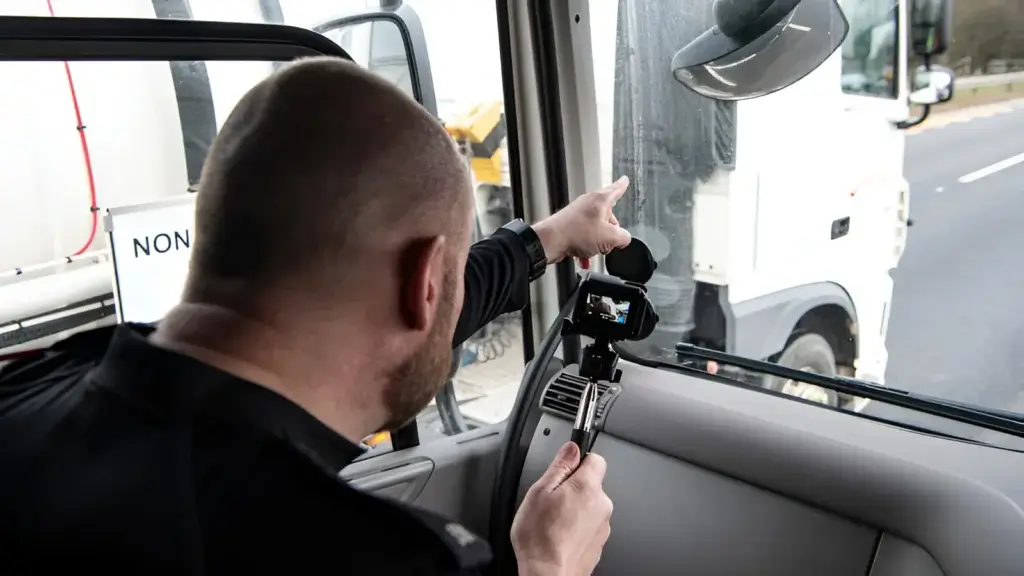
An HGV driver stopped in Suffolk whose cab was so full of rubbish that loose items could slide under the pedals was among those flagged during a four-day “spy truck” operation in eastern England in March; the latest sign that British police, like several European police forces, now do much of their HGV enforcement from inside a cab of their own.
Suffolk Constabulary ran the checks on the A14, A12 and A11 between 10 and 13 March 2026, using an unmarked HGV tractor unit loaned by National Highways. From the elevated cab, officers could see directly into passing lorries, including the one with the rubbish problem. The force said that the cab held “so much rubbish” that items were considered capable of falling beneath the pedals: a control risk, in police terms.
Phones, seatbelts and the four-day count
The rubbish-filled cab was one of 130 offences detected from 130 vehicle stops — among them 57 HGVs, 36 light goods vehicles, 34 cars, one bus, one motorcycle and one agricultural vehicle. Officers issued 128 Traffic Offence Reports, made 12 referrals to the Traffic Commissioner and collected one roadside deposit from a foreign driver.
The most common breach was the simplest: 50 seatbelt offences. Mobile phone use followed with 27, then 17 roadworthiness defects, 15 cases of drivers not being in proper control, 12 of careless driving, four speeding offences and three insecure-load offences.
The operation was supported by National Highways, the Roads Victims Trust, Suffolk Fire and Rescue Service, HM Revenue and Customs, and Trading Standards.
Sitting where the driver sits
Operation Tramline, the umbrella programme behind the Suffolk checks, has been running since 2015. National Highways supplies unmarked HGV cabs to 36 police partners across England and Wales, on the principle that an officer at lorry height can see things a patrol car driver cannot — phones in laps, food in hands, paperwork on the wheel.
Since the scheme began, police using the camera cabs have stopped more than 54,000 vehicles and recorded more than 59,000 offences. HGVs account for 40% of those stops, vans 22% and cars 34%. The consequences range from a warning to a fixed penalty, a court summons or, in some cases, an arrest.
Dutch campers and Bavarian decoys
The tactic is not a British invention. In the Netherlands, police have used vans, coaches and even a camper van to look down on truck and van drivers. In one operation, officers in a camper van patrolled the A7, A6, A28 and A32 motorways: one watched from the side window and radioed colleagues whenever a driver reached for a phone. The day ended with 355 drivers fined, 104 of them lorry drivers, Trans.INFO reported.
Germany has tried much the same. Bavarian officers used a camper van to watch lorry drivers, with the camper then overtaking the offender and flashing “POLIZEI, STOP” on a rear LED panel. In Lower Saxony, a year-long pilot in Oldenburg caught almost 1,700 truck drivers looking at their phones rather than the road — enough to convince the force to make unmarked-van checks permanent.