
Key takeaways:
- The Advocate General says Austria’s night-time, sectoral and winter Saturday HGV bans breach EU law.
- Austria’s truck-dosing system may remain lawful, as Italy failed to prove that it amounts to an unlawful import restriction.
- The opinion is not binding and the disputed measures remain in force until the Court delivers its final judgment.
- Should the judges follow the opinion, Austria may have to withdraw, narrow or redesign three major restrictions on the Brenner corridor.
Advocate General Manuel Campos Sánchez-Bordona has recommended that the Court uphold most of Italy’s legal challenge against Austria’s measures on the A12 Inn Valley and A13 Brenner motorways.
However, he reached a different conclusion on Austria’s controversial truck-dosing system, proposing that Italy’s complaint against that measure should be rejected.
The opinion is not a final judgment and is not binding on the Court. The judges will now consider the case before delivering their ruling at a later date.
Italy challenges four Austrian restrictions
Italy brought the case, C-524/24, directly against Austria, arguing that four Tyrolean traffic measures restrict the free movement of goods through one of Europe’s most important north–south freight corridors.
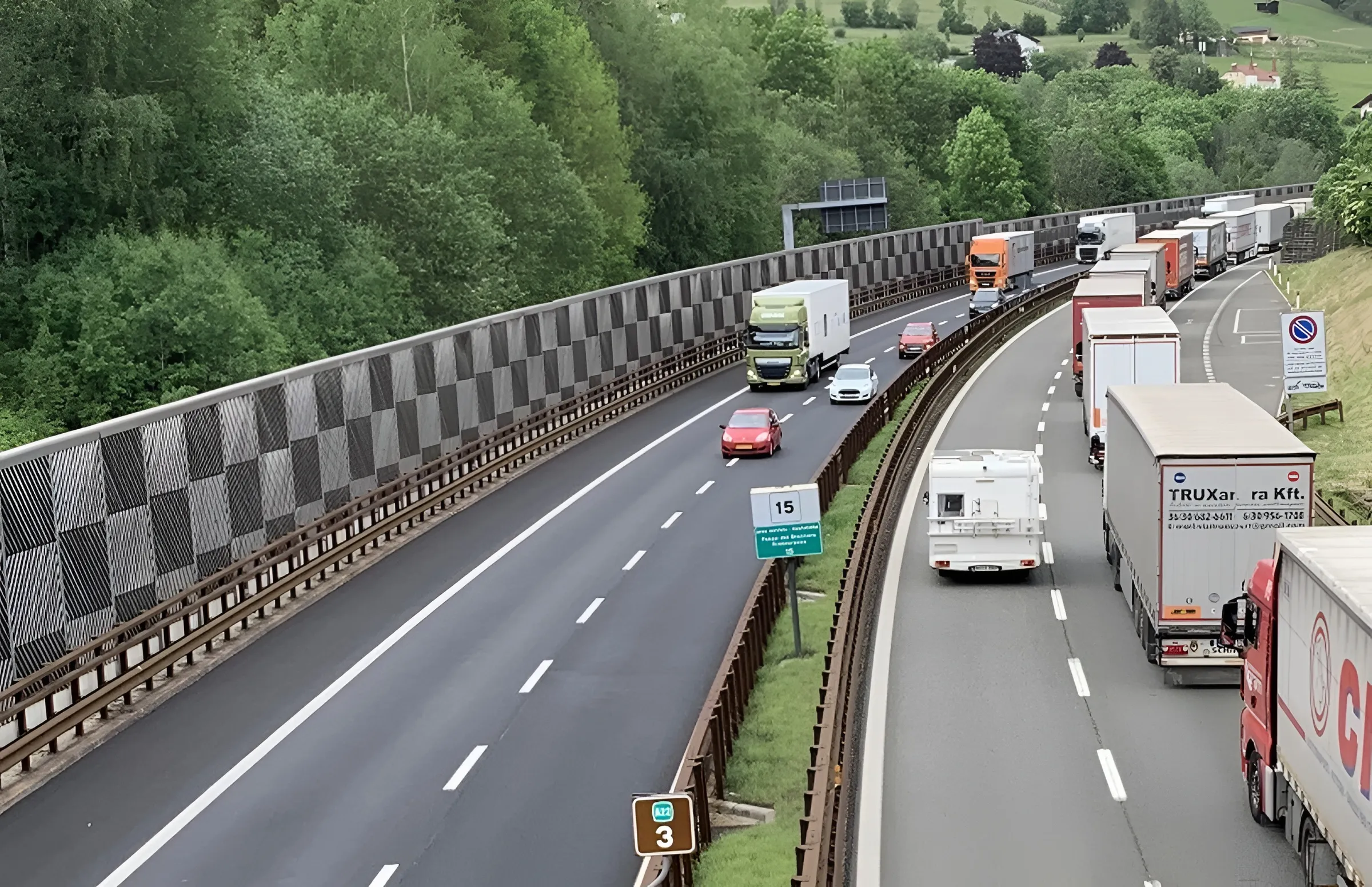
The A12 connects the German border near Kufstein with Innsbruck, where it joins the A13 towards the Brenner Pass and Italy. The combined route forms part of the trans-European transport network and provides a major road connection between Italy, Germany and northern Europe.
Austria acknowledges that some of its measures restrict the movement of goods but argues that they are justified by environmental protection, public health and road-safety concerns.
Campos Sánchez-Bordona proposed that the Court should rule against Austria over three measures:
- the night-time HGV ban;
- the sectoral ban on transporting certain goods by road;
- the winter Saturday ban.
By contrast, he found insufficient grounds to declare Austria’s traffic-dosing arrangements unlawful.
Night ban is not applied consistently, adviser says
Austria’s night-time ban prevents most vehicles above 7.5 tonnes from using an 84-kilometre section of the A12 during specified night-time periods. It applies throughout the year, although the precise hours vary with the season and whether the date is a working day or a public holiday.
Austria says the measure moves nitrogen dioxide emissions from the night into the daytime, when atmospheric conditions allow pollutants to disperse more effectively.
The Advocate General was not convinced that the restriction pursued this objective consistently.
According to the Court’s summary of his opinion, the night ban “does not reflect a concern to achieve the objective pursued in a consistent and systematic manner”.
Rather than reducing traffic or rerouting it, the restriction primarily delays journeys until daytime. The Advocate General also questioned exemptions for local and regional traffic, because Austria’s argument that these vehicles have no alternative route is not directly connected to the aim of improving the daytime dispersal of emissions.
He further concluded that Austria should have reassessed whether the year-round measure remained proportionate using the most recent evidence on health risks and should have examined less restrictive alternatives.
Austria should have reviewed sectoral ban
The sectoral ban prevents HGVs from carrying certain categories of goods along an approximately 65-kilometre section of the A12. The affected goods are those Austria considers suitable for transport by rail.
The Advocate General did not reject the principle of such a restriction outright. He considered that the measure could contribute to Austria’s environmental objective and found that its exemptions did not necessarily make it inconsistent.
The problem, in his view, was Austria’s failure to reconsider the restrictions as air quality improved.
Nitrogen dioxide limits under the EU air-quality rules had begun to be met along the relevant sections of the A12 and A13 by 2021. Austria should then have examined “whether that ban could be relaxed” or whether other restrictions within the same package could be removed or eased, the Court said.
The legal dispute follows two earlier Court judgments, delivered in 2005 and 2011, in which Austrian sectoral traffic restrictions on the Brenner corridor were also found to be incompatible with EU law.
Read more: Electricity instead of traffic jams: E-trucks on the Brenner route ease congestion and cut costs
Winter Saturday restriction called discriminatory
The Advocate General was particularly critical of the winter traffic ban.
In 2023 and again in 2024, the restriction prevented most HGVs bound for Italy, Germany or countries reached through them from using the A12 and A13 for eight hours on winter Saturdays. It generally applied between 7am and 3pm from January until early March.
Austria justified the ban as necessary to maintain road safety and motorway operations during periods of heavy congestion.
Campos Sánchez-Bordona nevertheless considered it discriminatory because its scope was based on the vehicle’s foreign destination.
The restriction “lacks proper justification”, according to the Court’s summary. Combined with Austria’s other bans, it made international road transport “almost impossible in practice” during parts of the weekend.
Across the week as a whole, HGVs could travel without restrictions for only around 46% of the total time.
The Advocate General also argued that some of the Saturday congestion Austria was seeking to manage was itself caused by the interaction of its other traffic restrictions.
Dosing system may survive the legal challenge
Italy was less successful in its challenge to Austria’s Blockabfertigung, or traffic-dosing system.
Introduced in 2018, the measure is applied on selected days to southbound HGV traffic entering Austria from Germany at Kufstein. Italy argued that it limits the flow to a maximum of approximately 300 trucks per hour.
Austria maintains that the system is used only when necessary, generally for a few morning hours, and works through an additional speed restriction rather than a predetermined numerical quota.
The Advocate General concluded that dosing was “not open to criticism” provided that, as Austria claims, it is used exceptionally, on limited motorway sections and in response to reliable congestion forecasts.
Italy had not demonstrated that the measure’s effect amounted to a quantitative restriction on imports or an equivalent obstacle under EU law, he found.
Restrictions remain in place for now
The opinion does not itself invalidate any of Austria’s traffic measures. Advocates General provide independent legal recommendations to the Court, but the judges are not required to follow them. The Court has now begun its deliberations, and the final judgment will be delivered later.
Should the Court ultimately rule that Austria has breached EU law, the country would be required to comply with the judgment without delay. That could force Tyrol to remove, narrow or redesign the affected restrictions, although the exact consequences would depend on the wording of the final ruling.