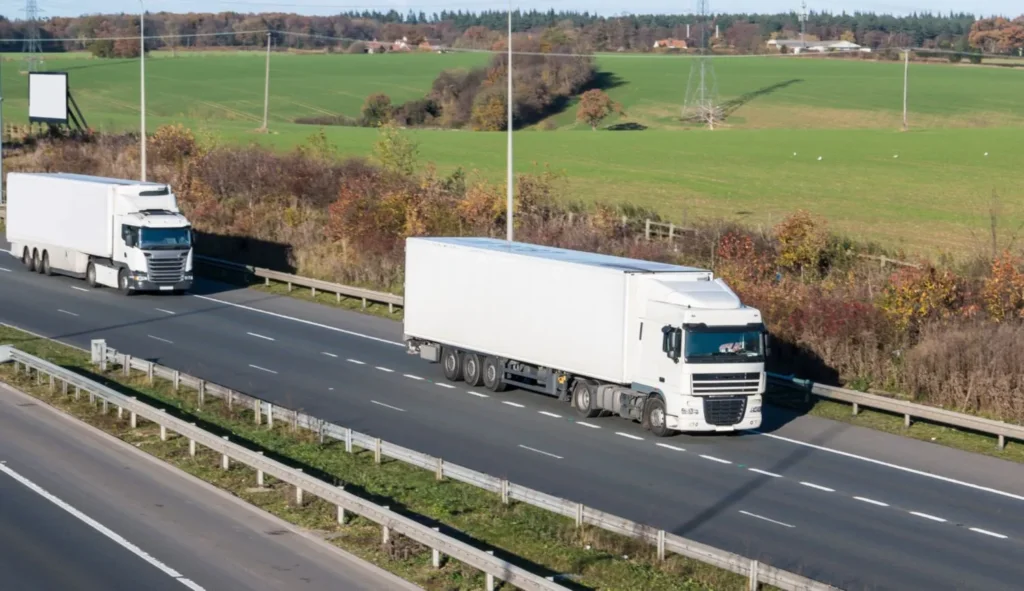
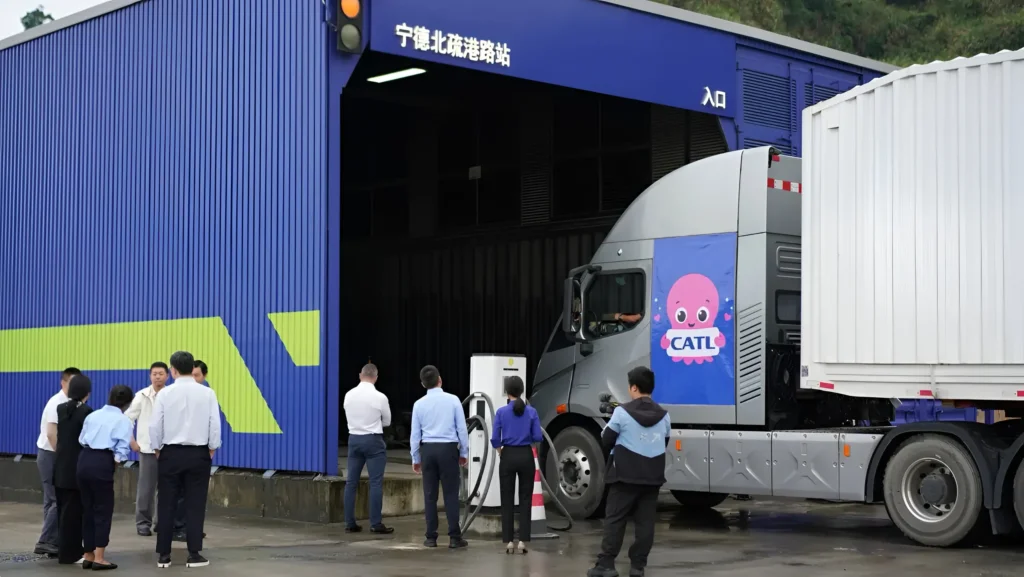
Energy company Octopus Energy and Chinese battery giant CATL have teamed up to build a battery-swap network for electric lorries under a joint venture called Swaptopus. Instead of waiting for a truck battery to recharge, drivers would pull into a hub and exchange it for a fully charged one in minutes.
The first UK sites are planned for 2027, with more than 30 large hubs across Europe by 2035. The companies say the network could eventually support more than 300,000 electric trucks and attract £30 billion of private investment.
Battery swapping could reduce charging downtime. It could also lower the upfront cost of electric trucks, as operators would lease the battery separately rather than paying for it as part of the vehicle. That upfront cost remains one of the biggest barriers to electric truck adoption.
CATL already operates this kind of network in China. According to figures cited by Nikkei Asia, the company has more than 300 swap stations serving electric trucks from 12 manufacturers across more than 16 models.
Why Europe is harder
The main challenge is not whether the technology works, but whether it can be made compatible across Europe’s open and competitive truck market.
For battery swapping to work at scale, truckmakers would need to align vehicle design, battery architecture, mounting systems, cooling, software, battery management and communications protocols. That would be a major shift for European manufacturers such as Volvo Trucks, Renault Trucks, Scania, Mercedes-Benz Trucks, MAN and DAF, all of which have invested heavily in their own electric truck platforms.
A CATL-led standard could therefore raise concerns over control and differentiation. Sun Jie, research analyst in the medium and heavy commercial vehicle forecasting team at S&P Global Mobility, told Nikkei Asia that European OEMs may be reluctant to adopt a standard that limits their ability to differentiate their vehicles.
David Cebon, professor and director of the Centre for Sustainable Road Freight at the University of Cambridge, was more direct. He told Nikkei Asia that major European truckmakers would not “take this lying down”, as joining such a system could mean giving up core intellectual property or accepting CATL’s battery-swapping architecture.
Thomas Fabian, chief commercial vehicles officer at the European Automobile Manufacturers’ Association, also pointed to the importance of open, competitive deployment. “For commercial road transport, the key question is not just whether a technology works, but whether it can be deployed at scale across an open and competitive European market,” he told Nikkei Asia.
The competing option: fast charging
The Swaptopus proposal also arrives as Europe is investing in a different solution: high-power charging.
EU rules require charging infrastructure for heavy-duty vehicles along major road corridors, including charging points of at least 350 kW on parts of the TEN-T network by 2030. Manufacturers are also lining up behind the Megawatt Charging System, or MCS, a high-power charging standard designed for heavy commercial vehicles.
According to analysts quoted by Nikkei Asia, MCS can charge a truck battery from 20% to 80% in around 30 to 40 minutes. That fits closely with existing driving rules, as HGV drivers in the UK and EU are required to take a 45-minute break after 4.5 hours behind the wheel. If a truck can charge during that mandatory break, the case for battery swapping becomes less obvious.
Fabian told Nikkei Asia that the priority should be to accelerate infrastructure deployment, implement the EU’s Alternative Fuels Infrastructure Regulation without delay and support open, interoperable solutions that enable cross-border transport and customer choice.
Scania and its partners are aiming for 1,700 MCS charging points by 2027, according to Nikkei Asia.
Where swapping could still work
Battery swapping is unlikely to disappear from the debate. It could still make sense for depots, fixed routes and closed logistics systems where one operator has greater control over the vehicles, batteries and charging setup.
However, an open European swapping network would come with practical challenges of its own. It would need standardised vehicles, robotic swap equipment, battery storage, grid capacity and enough spare batteries to keep the system moving. Cebon also warned that if swaps were offered on a first-come, first-served basis, drivers could simply end up queuing at swap stations instead of charging points, meaning a booking system would also be needed.