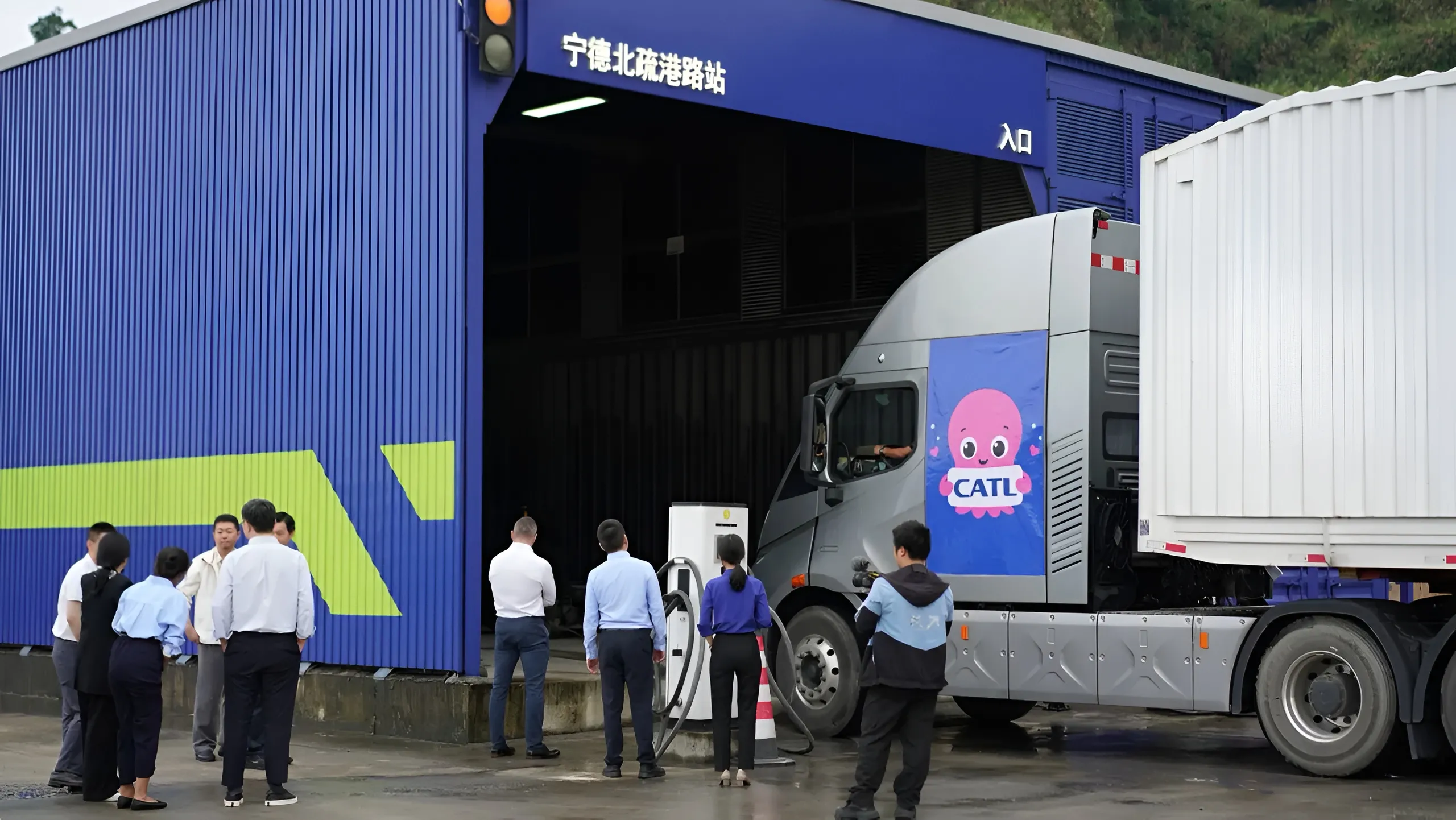

The joint venture, called Swaptopus, has been launched by Octopus Energy and Chinese battery manufacturer CATL. The companies say the network could eventually support more than 300,000 electric trucks and unlock over £30 billion in private investment.
The idea is simple: instead of waiting for a truck battery to recharge, the vehicle would pull into a hub, have its empty battery replaced with a charged one, and get back on the road within minutes. That could tackle one of the biggest operational headaches regarding electric trucks: downtime.
From charging stops to battery swaps
Most of the discussion around electric HGVs in Europe has so far focused on depot charging, public high-power chargers and future megawatt charging systems. Battery swapping offers a different model.
Rather than tying a truck to a charger for a long stop, the battery is treated more like a replaceable energy pack. The depleted battery is removed, a charged one is fitted, and the truck continues its journey.
According to Octopus Energy, the first battery-swapping “mega hubs” will open in the UK in 2027. The plan is then to expand to more than 30 hubs across Europe by 2035.
Each hub is expected to handle thousands of lorries per day, although the companies have not yet named the first locations.
Keeping electric trucks moving
Octopus Energy founder and CEO Greg Jackson said electric trucks already have lower running costs than diesel vehicles, but keeping them moving remains a key challenge.
“Battery swapping changes that. Instead of waiting for hours, trucks can be back on the road in minutes,” he said.
CATL chairman and CEO Dr Robin Zeng said battery swapping would become “a significant part of the future of commercial transport”, adding that the technology had already been field-tested in China.
Swaptopus CEO William Rowe said the batteries held at swapping stations could also support the electricity grid. The idea is that batteries could be charged when power is cheaper or more abundant, and discharged back into the grid at peak times, effectively turning the sites into large flexible energy assets.
The model could be particularly relevant for fixed, high-utilisation freight operations, including hub-to-hub routes, port shuttles, retail distribution and time-sensitive transport. In those operations, a truck sitting idle for charging can quickly become a problem. If a battery swap can be carried out during a normal driver break or a short operational stop, the economics of electric trucks could look different.
Battery swapping could also separate the question of buying the truck from the question of owning the battery. That may open the door to new leasing, pay-per-use or energy-service models, although Swaptopus has not yet set out its commercial structure in detail.
The difficult part: making it work at scale
The announcement is ambitious, but battery swapping still has several hurdles to clear in Europe. The system depends on compatible vehicle and battery designs, reliable station locations, enough spare batteries, and clear rules on ownership, billing, liability and battery health.
Without common standards, there is a risk that swapping networks could become fragmented between different vehicle manufacturers, battery suppliers and infrastructure providers. That is one reason why Europe has so far moved more cautiously than China, where CATL has already deployed battery-swapping technology more widely. Even so, the new venture is one of the clearest signs yet that battery swapping is moving from a niche idea to a serious option in the European electric-truck infrastructure debate.