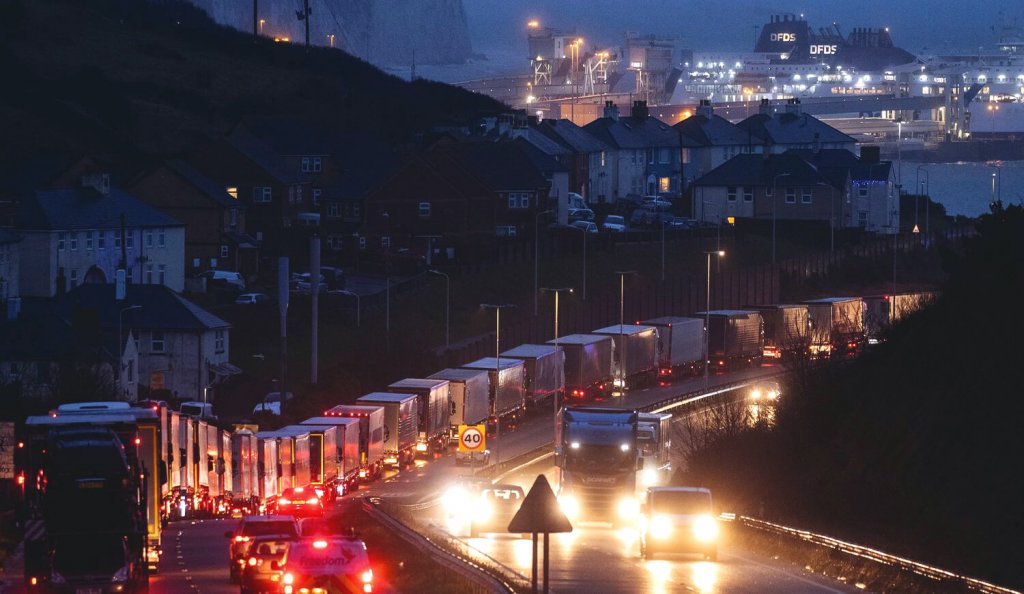
Despite years of post-Brexit friction, EU–UK trade has not collapsed. According to a new trade survey by Make UK and DHL, 82% of UK manufacturers still export to the EU, confirming that Europe remains their most important market. But while trade volumes have proven resilient, the report shows that the cost and risk of keeping goods moving have shifted increasingly onto transport and logistics.
For European hauliers, the message is clear: trade may be continuing, but road transport is where friction now accumulates.
The report, based on responses from 119 exporting UK manufacturers, identifies customs delays, transport costs and regulatory complexity as among the most significant barriers to trade. More than half of respondents (58%) cite tariffs and duties as a major issue, while 50% point to customs delays and 46% to transport costs. Only 3% say they face no barriers at all.
Borders still matter and they slow trucks
While manufacturers report that exports to the EU are, on balance, slightly higher than in 2020, the improvement is marginal. Just 42% say EU trade has increased since Brexit, while 19% report a lasting decline. Smaller firms, in particular, are more likely to report reduced EU trade, suggesting that border friction hits operators with fewer resources hardest.
For hauliers, this translates into persistent pressure at borders, where paperwork, regulatory divergence and inspection requirements continue to affect transit times. The report confirms what operators experience daily: EU–UK trade is functioning, but no longer frictionless.
Reliability overtakes price
One of the clearest signals in the report is the shift in priorities among shippers. When asked what they value most in logistics services, manufacturers point first to reliability (66%), followed by speed (55%) and security (41%). Cost is no longer the primary differentiator.
This reflects a trading environment where delays are more damaging than higher freight rates. Missed delivery slots, border hold-ups or documentation errors can disrupt entire supply chains, pushing manufacturers to favour operators who can deliver predictability — even at a premium.
Near-shoring reshapes road freight
The report also highlights a structural change in sourcing strategies. Nearly two-thirds of manufacturers (63%) expect to increase domestic sourcing over the next five years, accelerating a trend that has already been visible since the pandemic.
Rather than reducing transport demand, this shift is likely to reconfigure it. Shorter supply chains mean more regional and feeder traffic, increased reliance on UK–EU road corridors, and a higher frequency of time-critical movements. For hauliers, flexibility and route resilience may matter more than long-haul scale.
Logistics as a trade enabler — or a blocker
More than a third of manufacturers say they are avoiding certain markets altogether due to complexity or risk, underlining how transport and border reliability can determine whether trade happens at all. Logistics partner services are identified as the second most important support needed for export growth, after government export assistance.
This suggests a growing expectation that hauliers do more than provide capacity. Customs expertise, documentation accuracy and contingency planning are increasingly seen as part of the transport offer — especially on politically and regulatory sensitive routes.
Read more: Spanish transport will be flooded with Turkish drivers: a staffing revolution is on the way
Trade continues, pressure concentrates
While the report focuses on UK manufacturers, its implications extend across Europe. As exporters remain anchored in EU markets and redirect trade away from more volatile destinations, pressure on European road networks, border crossings and compliant operators is likely to increase.
The findings point to a trade system that has not broken, but has become more brittle. Volumes are holding up, yet risk, cost and responsibility have shifted down the supply chain — landing squarely on transport.
For European hauliers, the challenge is no longer just moving goods efficiently, but absorbing the instability of modern trade while keeping trucks rolling on time.