CMA CGM has started rerouting cargo around the Strait of Hormuz using emergency multimodal corridors, as the disruption in the Gulf pushes more freight onto feeder links, landbridge routes and trucking operations. The French shipping group says the measures are aimed at keeping supply chains running in the UAE and the northern Gulf, including Iraq, Bahrain, Qatar and Kuwait, without transiting through Hormuz.
According to CMA CGM’s latest advisory material, the group is using feeder services, landbridge connections and inland transport capabilities to redirect cargo through alternative gateways. The company has also reshuffled part of its maritime services between Asia and Europe to adapt to the situation. CMA CGM’s published corridor map points to rerouting options via Khor Fakkan, Fujairah, Sohar and Jeddah, with onward inland connections across the region.

This is how CMA CGM is building around Hormuz – source: CMA CGM
The sea route is blocked, so the trucks come in
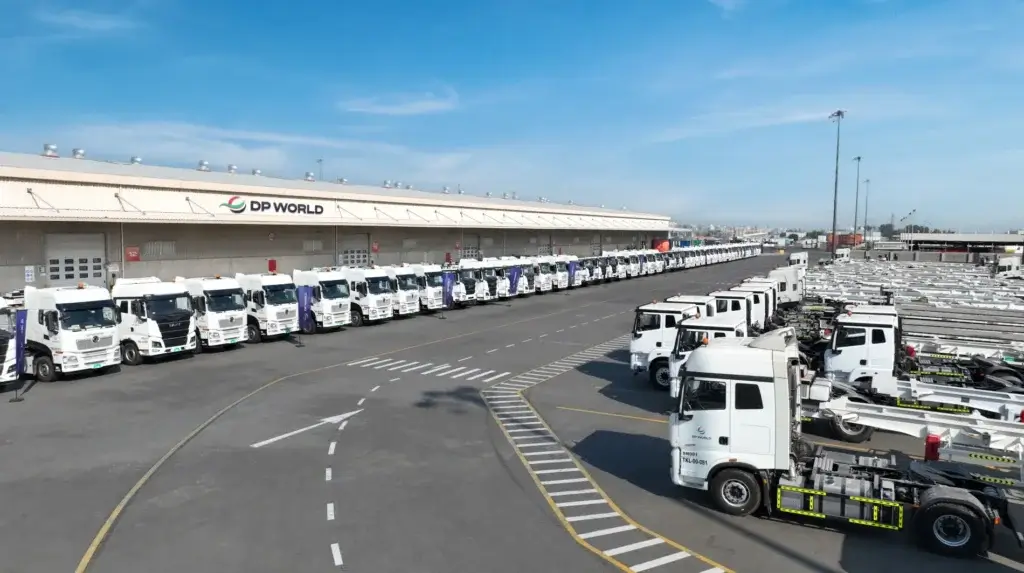
The shift is already showing up on the ground. Reuters reported on 16 March that importers across the Gulf were diverting cargoes to Fujairah, Khor Fakkan and Sohar, then moving containers onward by truck to their original destinations as commercial navigation through Hormuz remained effectively blocked for much of the market.
That diversion is creating fresh pressure elsewhere. Reuters said the alternative ports do not have the same capacity as Jebel Ali, and operators are already dealing with congestion, longer clearance times and higher costs. One French shipment of around 5,000 tonnes of apples bound for Dubai was hit with a €900,000 surcharge in the first days of the crisis.
Road freight demand is rising as a result. Reuters quoted logistics company TruKKer as saying it planned to increase ground transport from 60 truck movements a day to 500, while some Saudi-bound land routes were seeing price increases of 5% to 15%.
Stranded ships, selective passages, mounting costs
The wider operating environment remains highly unstable. Reuters reported on 18 March that some 20,000 seafarers were stranded in the Gulf, with hundreds of vessels at anchor, after Tehran threatened ships attempting to leave via the Strait of Hormuz. At least seven merchant sailors have been killed, according to IMO Secretary-General Arsenio Dominguez.
A proposal backed by Bahrain, Japan, Panama, Singapore, the UAE and the United States has called for a safe maritime corridor to evacuate merchant ships. Reuters also noted that the Strait normally carries around one-fifth of the world’s oil and liquefied natural gas, underlining how quickly disruption there spills into the wider global economy.
At the same time, AP reported that the waterway is not fully shut in absolute terms. Between 1 and 15 March, at least 89 ships crossed the Strait of Hormuz, including 16 oil tankers, although that was sharply down from roughly 100 to 135 vessel passages per day before the war. AP’s reporting, based on Lloyd’s List Intelligence and Kpler data, suggests the route is functioning only selectively, with Iran-linked traffic and a narrow set of tolerated non-Iranian movements still getting through.
That selective flow helps explain why companies are not simply waiting for a reopening. They are already redesigning routes. CMA CGM’s emergency corridors show that the response now includes alternative ports, bonded landbridges and inland delivery networks, not just vessel diversions.
The cost impact is also growing. Earlier this month, CMA CGM introduced an Emergency Conflict Surcharge on cargo linked to multiple countries in the region. The surcharge starts at $2,000 per 20-foot dry container, $3,000 per 40-foot dry container, and $4,000 per reefer or special equipment unit.
Our related coverage examines how the war in Iran is disrupting global supply chains and why its effects are already spreading from shipping lanes to European road freight.
More than a diesel spike: Iran war hits road freight on multiple fronts (5 March 2026)
Portugal cuts diesel excise duty as fuel prices surge (9 March 2026)
French diesel tops €2/litre; Spanish hauliers face €100m fuel hit (11 March 2026)
Maersk warns shipping could run short of fuel as Gulf attacks spread (12 March 2026)
Container rates start rising as the Middle East crisis adds pressure to Asia-Europe trade (13 March 2026)
AdBlue prices soar as Middle East conflict threatens European supply chains (17 March 2026)
Hauliers with access to Slovenia and Czechia can now buy a cost advantage (17 March 2026)
UK diesel up nearly 20p, but government still won’t extend 5p duty cut beyond August (19 March 2026)


![Costs up 11%, rates up 5%: FarEye’s Suryansh Jalan on the hidden “inefficiency tax” in Europe’s last mile [INTERVIEW]](https://cdn-trans.info/uploads/2026/10/264940df8e8870b74281e69aeac-1024x769.webp)