Key takeaways:
- Girteka is redistributing fleet operations across Europe, with Latvia and Romania becoming new bases for trucks, drivers and transport management.
- The shift is designed to ease driver recruitment pressures and protect the capacity Girteka can offer customers.
- The move builds on Girteka’s already decentralised model, which includes around 3,000 trucks supported from Poland.
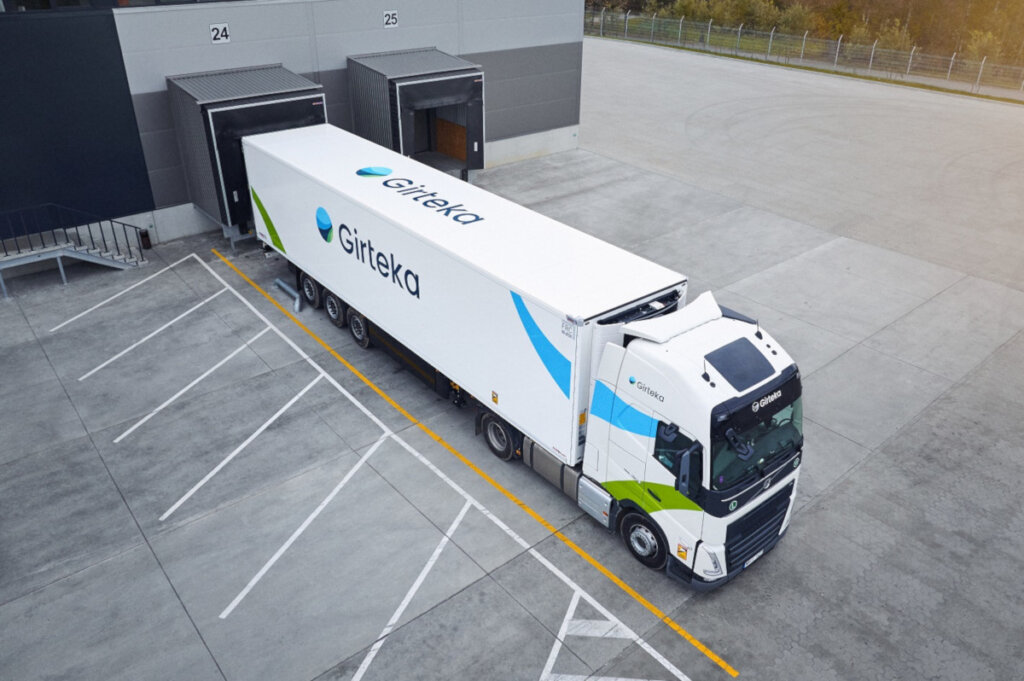
The Lithuanian logistics group already has almost 100 locally registered trucks operating in Latvia, while preparations are under way to bring the first trucks and drivers into its new Romanian operation in Oradea. The two entities will handle fleet registration, driver employment and transport management locally.
Girteka says the move is primarily intended to give it greater flexibility in recruiting professional drivers rather than being driven by a specific tax or regulatory advantage.
“The decision is not based on any specific regulatory or tax distinction. We assess the entire business environment, and currently, one of the most important reasons is the ability to provide a sufficient number of drivers for our fleet and meet customer needs,” the company told Lithuanian media.
Nearly 100 Girteka trucks already registered in Latvia
The Latvian operation is considerably further advanced than the Romanian one.

Girteka CEO Mindaugas Paulauskas
Girteka says its Latvian fleet is approaching 100 locally registered trucks, which are already operating on the road. The company is also recruiting transport and management staff in Riga as the local organisation develops.
In Romania, Girteka is preparing to receive its first trucks and drivers. Recruitment and other local functions are expected to expand as the Oradea operation grows.
The company says both entities will be fully integrated into its wider European network.
“This is a necessary step to ensure the continuity and efficiency of our transport operations,” said Mindaugas Paulauskas, CEO of Girteka Transport. “The availability of professional drivers remains a key constraint, and we need greater flexibility to recruit at the scale our fleet requires.”
Pavel Kveten, CEO of Girteka Logistics, framed the move in broader commercial terms, saying customers in temperature-controlled and high-value cargo expect reliable capacity and tight operational control.
“As labour availability, regulation and costs change across Europe, we need to make sure our operating model continues to support that promise and allows us to deliver at scale,” Kveten added.

Girteka Logistics CEO Pavel Kveten
Girteka’s fleet is becoming increasingly spread across Europe
The move adds another layer to Girteka’s increasingly decentralised European operating model.
Poland has already developed into one of its most important transport bases. Girteka says around 3,000 trucks are serviced through its Poznań operation, with more than 4,000 employees, including drivers, connected to the site.

Lithuanian public broadcaster LRT reports that Girteka originally expanded its Polish presence while preparing for requirements introduced under the EU Mobility Package. The group also operates in countries including Germany, Denmark and Norway.
Rather than concentrating its fleet and driver employment in Lithuania, Girteka can therefore increasingly position vehicles and personnel in the countries where operating conditions and access to labour are most favourable.
The company nevertheless stresses that its latest move should not be interpreted as a response to one particular national regulation.
Driver recruitment becoming a constraint on capacity
Behind the restructuring is a driver shortage that Girteka describes as a direct constraint on the amount of transport capacity it can offer.
The company carries around 800,000 full truckloads a year for more than 5,000 customers across Europe. For an operator relying heavily on its own fleet, having enough drivers available is therefore closely linked to how many trucks it can keep on the road.
The latest IRU research puts the scale of the problem at around 502,000 unfilled truck driver positions in Europe in 2025, equivalent to approximately 13% of the workforce required by the sector.

Girteka shifts transport operations to Latvia and Romania in search of drivers
Demographics are expected to deepen the problem further: around 20% of Europe’s current truck drivers are expected to retire within five years.
That is pushing large fleet operators to widen their recruitment footprint beyond their traditional home markets.
Lithuania itself has also tightened the framework governing recruitment of workers arriving from outside the country. The country has set a quota of 24,706 newly arriving foreign workers for 2026, slightly below the 2025 level. Once the quota is exhausted, additional salary or occupational requirements apply to residence permits issued on employment grounds.
Girteka has not said that these rules caused its decision to establish the Latvian and Romanian operations. The company instead describes the move as part of a broader effort to secure access to drivers and maintain fleet capacity as labour conditions change across Europe.
Latvia and Romania now give it two more locations from which to do so.