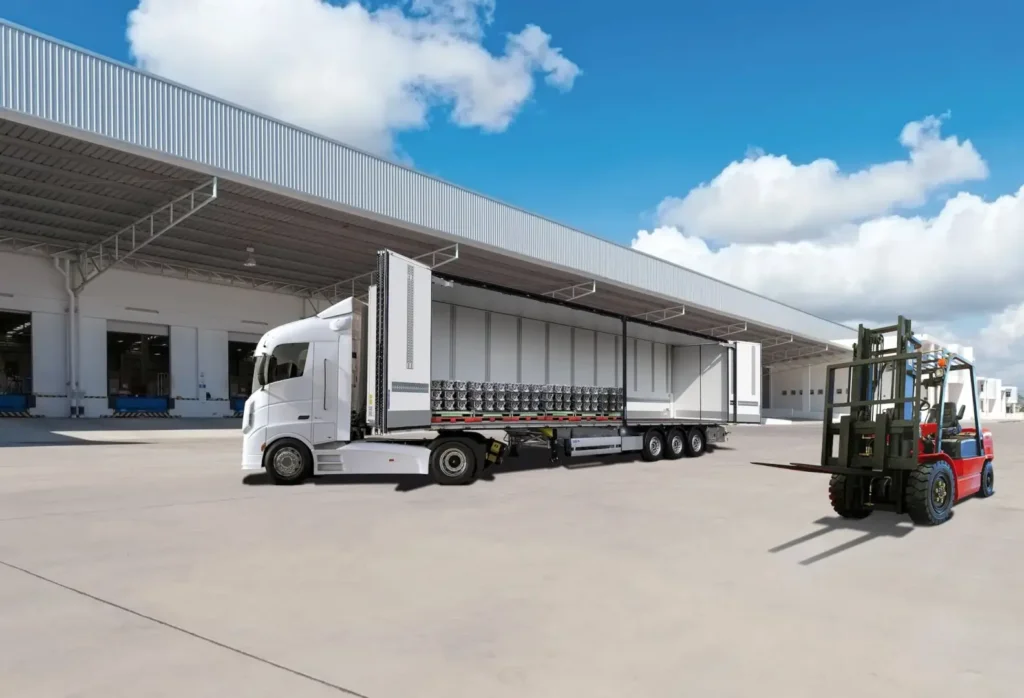
In Circular No. 1892 dated 21 January 2026, Italy’s Ministry of Infrastructure and Transport (MIT) acknowledges that waiting times for these inspections have increased, especially for O3 and O4 trailers/semi-trailers (EU categories for trailers over 3.5 tonnes). The ministry tells local Motorisation offices to expand inspection capacity rather than change the legal inspection timetable.
Which inspection does this affect?
This is not a roadside enforcement check and it is not an emissions test for the truck engine.
It is the scheduled, compulsory technical roadworthiness inspection that a trailer must pass at set intervals to remain legally in service. For trailers, the inspection typically focuses on roadworthiness items such as braking system performance and condition, axles/suspension, wheels/tyres, lights and electrics, chassis/frame integrity, and coupling devices, plus identification and documentation consistency.
Who is affected if you’re a non-Italian haulier?
For most foreign fleets, the impact is indirect.
Normally, periodic roadworthiness tests are carried out in the country where the trailer is registered, so a Polish-registered trailer is not required to book an Italian inspection slot just because it operates in Italy.
Where it becomes directly relevant is when a foreign haulier:
- operates Italian-registered trailers (through an Italian subsidiary, acquisition, leasing structure, or long-term rental), or
- depends on Italian subcontractors/partners whose trailer availability is reduced because units are waiting for test slots.
What Italy is changing
MIT is clear about one thing: it is not changing the legal inspection deadlines. Instead, the ministry focuses on how local offices schedule and staff inspection sessions.
A key point for operators is that MIT explicitly rejects a return to an earlier practical benchmark that assumed 15 minutes per heavy-trailer inspection (from earlier guidance). Under the system introduced by DM 191/2025, the organisation of sessions is described as not anchored to a fixed time-per-vehicle approach, and MIT says there are currently no conditions to revise the standard session configuration.
The ministry’s response: more inspectors, more flexibility
To reduce bottlenecks, MIT instructs Motorisation offices to meet demand by using inspector resources “structurally”—not occasionally—explicitly including authorised inspectors alongside qualified inspectors.
If local capacity is still insufficient, territorial directorates are told to notify the Directorate-General so it can arrange temporary staff “compensation”, including bringing authorised inspectors from other territorial areas.
MIT also says it is working on a permanent “task force” (mainly examiners) intended to support overstretched offices, although the procedure to activate it is still being prepared.