

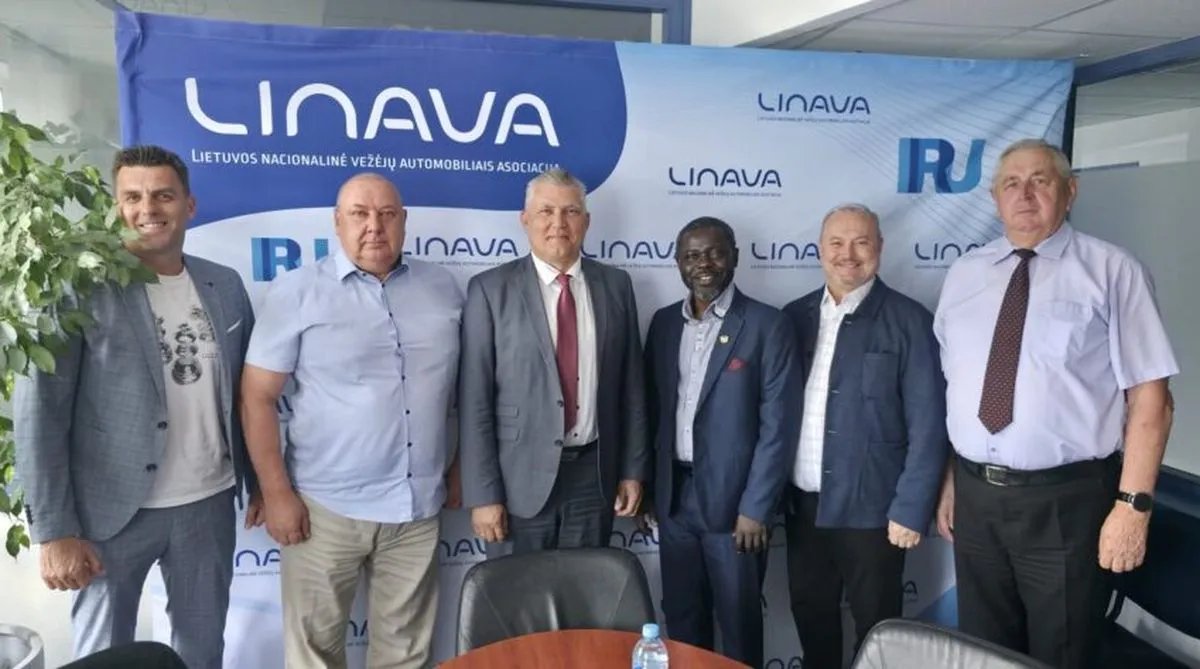

A meeting at Linava’s headquarters on 23 June brought together the association’s vice-president Oleg Tarasov, former Linava president Algimantas Kondrusevičius, Ghana’s presidential representative and technical coordinator Samuel Appiah-Kubi, Lithuania’s honorary consul in Ghana Artūras Roškovskis, and representatives of Linava and the Linava Training Centre.
Linava said Kondrusevičius has also been actively involved in advancing the initiative.
Recruitment beyond Central Asia and Eastern Europe
Lithuanian transport companies have typically recruited professional drivers from Central Asia and Eastern Europe. However, intensifying competition for staff and increasingly complex hiring procedures are prompting the industry to look for additional labour markets.
Linava argues that Ghana could become a viable partner, citing the country’s young working-age population, a vocational training system that could support tailored driver programmes, and English as an official language, which could ease integration into international road transport.
This potential is especially important in the context of the global driver crisis (…). Worldwide, there is currently a shortage of around 3.6 million truck drivers, and drivers under 25 make up only 6.5 percent of the profession. Over the next five years, another roughly 3.4 million drivers are expected to retire, which is why the transport sector is increasingly looking for new talent markets, Linava wrote in its statement.
A key role in the project is expected to be played by Lithuania’s honorary consul in Ghana, Artūras Roškovskis. The initiators say he would help strengthen cooperation with Ghanaian institutions and support the organisation of legal migration procedures. This, they argue, could simplify initial document checks, streamline visa issuance processes, and support a transparent selection of candidates.
Training in English, aligned with EU requirements
A central element of the plan is to prepare future drivers in line with European Union requirements.
The Linava Training Centre said it is ready to deliver mandatory initial and periodic professional training programmes in English. Given the widespread use of English in Ghana, the association expects candidates to learn EU road traffic rules, cargo securing requirements, and drivers’ working time and rest rules more quickly.
Together with the Lithuanian Driving Schools Association, Linava is also initiating a process to allow the final exam for initial professional training—required to obtain the so-called code 95—to be taken in English. In addition, the parties plan a preliminary assessment of candidates’ professional competences before they arrive in Lithuania.
Strict selection and full social protections
According to Linava vice-president Oleg Tarasov, member companies need skilled and reliable employees, and the recruitment process would therefore apply strict selection criteria.
Linava added that Ghanaian citizens who come to Lithuania would be guaranteed all social protections provided for by law, safe working conditions, and pay in line with EU market levels.
If the talks conclude successfully, the parties plan to sign a tripartite cooperation agreement between Linava, Lithuania’s honorary consul in Ghana, and the Linava Training Centre. Linava said the model could later be used to recruit professional drivers from other overseas markets.


